
“Can you get the last six cartons onto the Tampines lorry?” At 7.40 am, that is the question facing a shift supervisor in Jurong. A supermarket has ordered 24 cartons of promotional drinks. The picker has found 18. The warehouse management system (WMS) shows 36 cartons on hand, and the lorry leaves at 8.30 am.
The next move depends on where those six cartons are. If they are still at receiving, the supervisor needs a release time. If someone moved them to a reserve bay, the picker needs the address. If the warehouse genuinely has fewer cartons than the system shows, the outlet needs an accurate delivery quantity while it still has time to adjust its display.
Seven warehouse KPIs help distinguish these problems. The calculations below use illustrative figures. For a Singapore distribution centre supplying several outlets, the practical question is which figure deserves attention before the next delivery leaves. digitalplace.ai warehouse KPI
Seven warehouse KPIs and how to calculate them
| Warehouse KPI | Calculation | Worked example |
|---|---|---|
| Dock-to-stock time | Total time from dock arrival to availability for picking ÷ completed receipts | 210 minutes ÷ 3 receipts = 70 minutes per receipt |
| Putaway accuracy | Verified putaway tasks stored and recorded in the approved bin ÷ tasks verified × 100 | 38 ÷ 40 = 95% |
| Inventory record accuracy | SKU-and-bin records with an exact quantity match ÷ records counted × 100 | 57 ÷ 60 = 95% |
| Location accuracy | Stock units found at their recorded address ÷ stock units checked × 100 | 76 ÷ 80 = 95% |
| Cycle count completion | Scheduled counts finished by the cut-off ÷ counts due × 100 | 45 ÷ 50 = 90% |
| First-pass picking accuracy | Order lines picked correctly on the first attempt ÷ order lines checked × 100 | 247 ÷ 250 = 98.8% |
| Pallet position occupancy | Occupied pallet positions ÷ installed pallet positions × 100 | 510 ÷ 600 = 85% |
1. Dock-to-stock time measures when inbound goods become available
Three deliveries reach the same warehouse on Monday morning. Their dock-to-stock times are 35, 40 and 135 minutes. The average is 70 minutes, but the supervisor preparing the morning outlet run needs to know what was on the third delivery. A two-hour wait for next week’s display materials has a different consequence from the same wait for drinks advertised in stores today.
To investigate the 135-minute receipt, look at when the lorry reached the dock, when receiving finished its checks, when the goods reached the rack and when the WMS released them for picking. If the cartons were on the rack at 7.10 am and became available at 7.55 am, 45 minutes elapsed after putaway. The first call should go to the person responsible for release.
2. Putaway accuracy checks whether the next picker gets the right address
An operator reaches the assigned bay with an inbound pallet and finds it occupied. The supervisor approves an overflow bay one aisle away. If the operator stores the pallet there and records the new address, the putaway is correct. Trouble starts when the stock reaches overflow but the handheld device still shows the original destination when the operator closes the task.
Suppose 38 of 40 verified putaway tasks were correct. Before changing the procedure for the whole shift, inspect the two failures. Did both involve an occupied bay? Could the operator select the approved replacement on the handheld? Check soon after putaway, while the receiving team can still distinguish an incorrect placement from a later stock movement.
3. Inventory record accuracy shows whether the quantity in each bin is reliable
For the Tampines order, suppose the WMS lists 24 cartons in the picking bay and 12 in reserve. A physical count finds 18 in each. The warehouse owns all 36 cartons, yet both bin records are wrong. The immediate fix is to collect six cartons from reserve for the outlet. The follow-up is to find out why the two records disagree before another picker receives the same instruction.
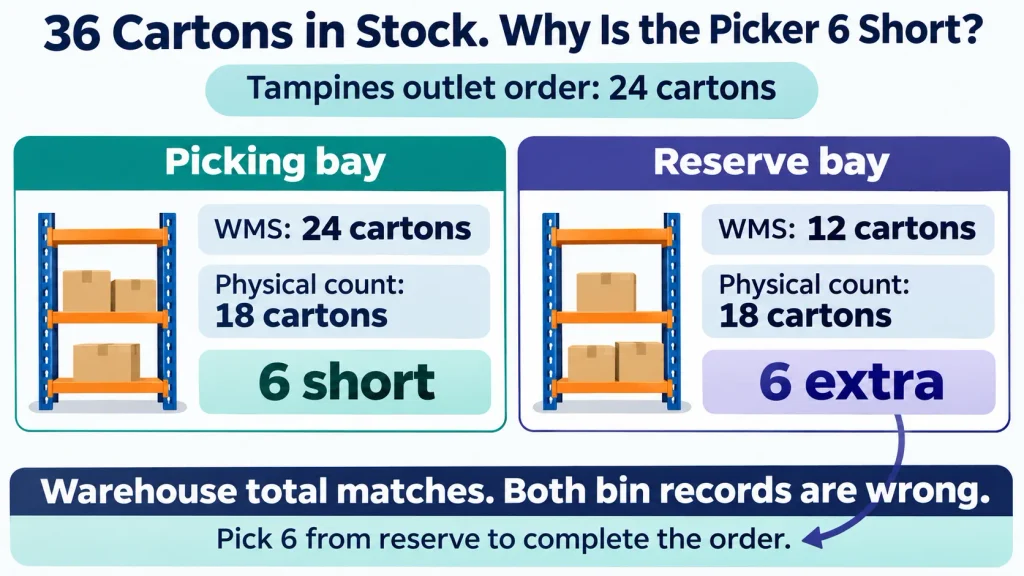
A Tampines outlet orders 24 cartons. The warehouse management system shows all 24 in the picking bay, but the picker finds only 18 there. The reserve bay holds 18 cartons, six more than recorded, so the picker can collect the remaining six from reserve to complete the order. The two discrepancies cancel each other out in the warehouse total, which is why the supervisor needs to check inventory accuracy at each bay.
Measure this KPI at the level the picker uses. Here, one record means one SKU in one bin, measured in cartons. If 57 of 60 records match the physical count exactly, inventory record accuracy is 95%. For the three discrepancies, compare the count time with the latest pick, transfer or receipt. A movement posted during the count can otherwise send the team looking for a stock loss that never occurred.
4. Location accuracy tells the team where to look for misplaced stock
Quantity and location answer different questions. A supervisor might confirm that a pallet holds the expected number of cartons and still need to know why it is standing in the next aisle. To measure location accuracy, select identifiable stock units from the WMS and check their recorded addresses. If 76 of 80 are where the system says they should be, location accuracy is 95%.
Digitalplace.ai supports high-bay location checks by drone. Its warehouse inventory drone for Singapore distribution centres reads visible QR codes on cartons and records where it finds them. If a code appears one bay away from its WMS address, the supervisor has a specific place to send someone before the next pick.
5. Cycle count completion shows which checks are still outstanding
Finishing 45 of 50 scheduled counts gives the shift a 90% completion rate. What matters at handover is which five remain open. Five reserve bays holding next month’s promotional painckaging can wait longer than five bays supplying tonight’s supermarket replenishment run. A useful handover gives the incoming supervisor enough information to schedule those checks around actual orders.
For each outstanding count, record:
- The bay and SKU so the next shift knows exactly what to check.
- Why the count is open, such as an active replenishment move through the aisle.
- The next order cut-off so someone can resolve a discrepancy before it affects a delivery.
If the same bays repeatedly generate picking exceptions between scheduled counts, review when a Singapore distribution centre needs more frequent stock verification. For operations using the Digitalplace.ai inventory drone, one practical option is to schedule a scan of the affected high-bay aisle after putaway, leaving the team time to investigate before outlet picking begins.
6. First-pass picking accuracy reveals the work that packing has to repeat
One outlet orders 12 bottles of a drink. Another orders 12 cartons of the same product. A checker catches a unit error at packing, and both outlets eventually receive the correct quantity. The delivery paperwork shows two successful orders. The picking team, however, had to return stock, collect the correct quantity and bring it back to the loading area while the driver waited.
Count an order line as correct on the first pass only when the picker gets the SKU, quantity and unit right on the initial attempt. If three of 250 checked lines need correction, first-pass picking accuracy is 98.8%. When all three errors involve bottles and cartons, look at how the handheld displays the unit. When they involve two flavours with nearly identical packaging, inspect their shelf labels and picking positions.
7. Pallet position occupancy helps receiving decide whether the next load will fit

The warehouse is 85% occupied. Can receiving accept another 25 pallets?
How many positions are empty?
600 installed positions − 510 occupied positions = 90 empty positions.
Which empty positions can take this load?
- 40 are reserved for another client.
- 20 have too little clearance for the incoming pallets.
- 12 are temporarily blocked.
These three groups do not overlap in this example. If a position has more than one restriction at your site, subtract it only once.
18 positions can accept the incoming pallets
90 − 40 − 20 − 12 = 18 suitable positions.
Receiving needs 7 more positions
25 incoming pallets − 18 suitable positions = a shortfall of 7 positions.
Before unloading, approve seven alternative positions or arrange a staggered delivery.
That calculation also depends on whether an apparently empty bay is genuinely available. A carton label facing away from the aisle can leave a scan without a readable code even when the bay holds stock. Before assigning that position to an inbound pallet, check the observation against the WMS and confirm the bay’s status. This guide explains how to verify an empty pallet location when a drone cannot read the QR code.
What should the supervisor record after dispatch?
Back in Jurong, the team finds the six cartons in reserve at 8.05 am and completes the Tampines order before the lorry leaves. Posting “order fulfilled” closes the delivery. A more useful shift note reads: “Tampines received all 24 cartons. Six were collected from reserve. Check the transfer that left the picking bay overstated by six.”
That note gives the next supervisor a transaction to investigate and a way to judge whether the fix worked. On the following delivery run, the test is simple: can the picker collect all 24 cartons from the address on the handheld the first time?