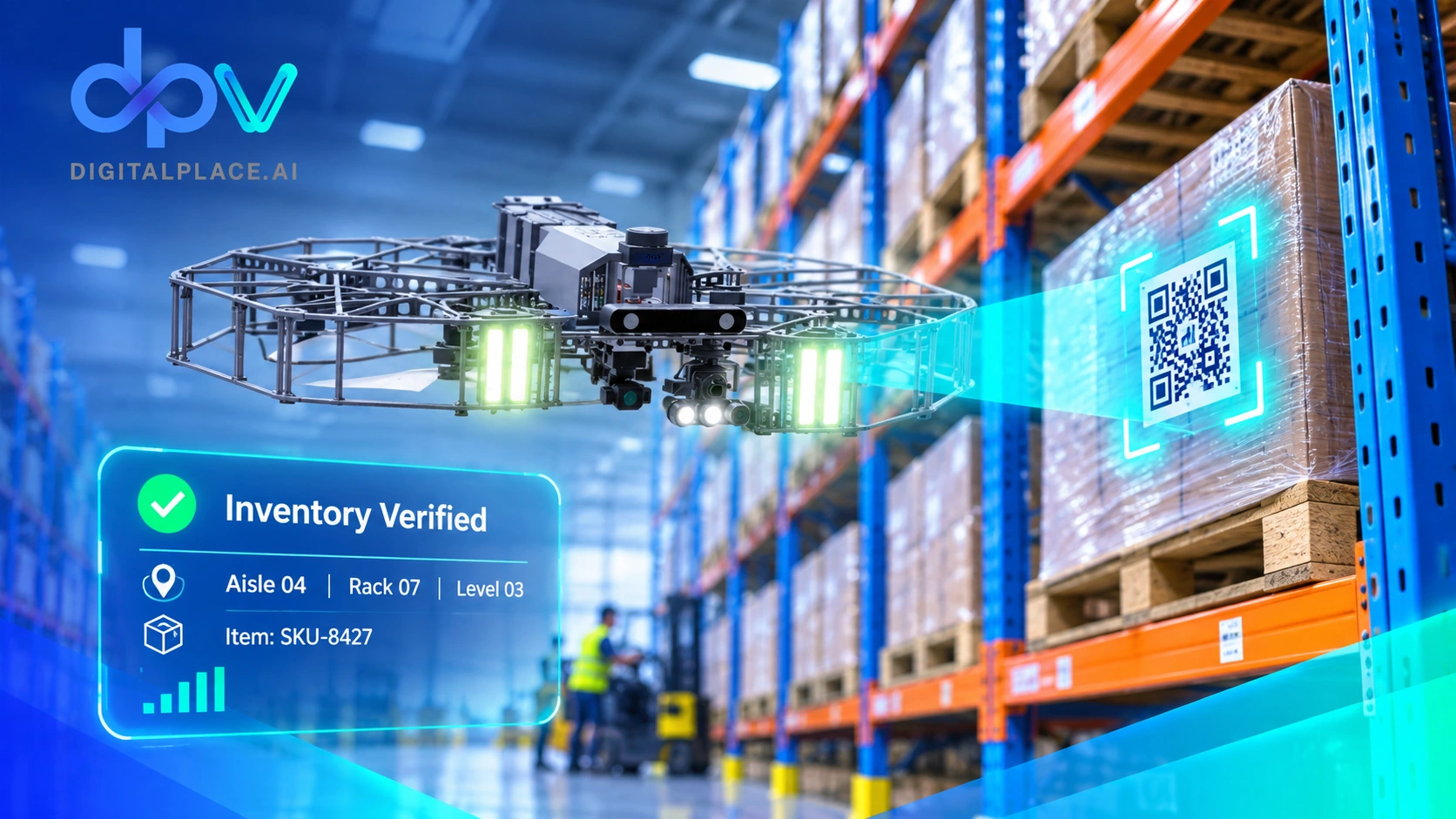
A pallet is recorded in the Warehouse Management System (WMS) as being in Aisle 04, Rack 07, Level 03. When a warehouse employee arrives to retrieve it, the location is empty. The pallet has not disappeared; it was moved during an earlier operation, but the system was never updated.
Situations like this are more common than warehouse operators might expect. In facilities managing thousands of pallet positions, even small inventory discrepancies can create unnecessary searching, picking delays, and additional work for warehouse personnel.
For Singapore’s logistics and distribution industry, maintaining accurate warehouse inventory records is becoming increasingly important. With businesses under pressure to improve operational productivity, manage manpower requirements, and fulfil orders efficiently, relying entirely on periodic manual stocktaking can make it difficult to maintain consistent inventory visibility.
Traditional cycle counting remains an essential inventory control practice. However, inspecting large warehouse facilities, particularly those with high-bay storage systems, requires considerable time, coordination, and physical effort. The challenge becomes even greater when warehouse teams need to repeat these checks frequently.
Autonomous warehouse inventory drones introduce a different approach. Rather than relying exclusively on employees to physically inspect individual storage locations, drones can follow configured scanning routes, identify inventory through QR codes, and verify where pallets are physically located.
Digitalplace.ai’s AI-powered Warehouse Inventory Drone is designed to support this transition from periodic manual counting to recurring inventory verification. By automating warehouse scanning activities, the solution helps businesses identify misplaced inventory, verify empty storage locations, and improve visibility across warehouse operations.
For Singapore warehouse operators, this creates an opportunity to make inventory verification more consistent without requiring employees to perform every repetitive scanning activity manually.
Why Manual Cycle Counting Creates an Inventory Visibility Gap
Warehouse Management Systems are designed to record inventory movements and maintain visibility over stock locations. When goods are received, stored, transferred, picked, or dispatched, the corresponding transactions should update the system.
However, physical warehouse operations do not always follow the digital records perfectly.
A forklift operator might temporarily move a pallet to another location to accommodate incoming goods. An employee might forget to update a stock movement, or a storage location could remain marked as occupied after its inventory has been removed. These situations create differences between what the WMS records and what physically exists inside the warehouse.
The problem is not necessarily that inventory has been lost. Instead, the warehouse has lost visibility over its actual inventory positions.
Consider several common examples:
- Misplaced pallets: Inventory is physically stored in a different rack location from the one recorded in the WMS.
- Unexpected empty locations: A storage position is marked as occupied even though the pallet has already been moved.
- Incorrect rack assignments: Products are placed on the wrong level or in an adjacent storage position.
- Unrecorded stock movements: Physical inventory transfers are completed without corresponding system updates.
These discrepancies can affect warehouse operations in several ways. Employees may spend additional time searching for goods, picking activities can be delayed, and replenishment decisions may rely on outdated location information.
Traditional cycle counting helps identify these problems, but its effectiveness depends on how frequently warehouse teams can perform physical checks. If a particular aisle is only inspected once every few weeks, discrepancies may remain undetected until someone needs the affected inventory.
For Singapore distribution centres handling high volumes of goods, this creates an important operational question: how can warehouses verify physical inventory more frequently without increasing the workload associated with manual counting?
From Periodic Stocktaking to Daily Inventory Verification
Warehouse inventory insight
From Manual Counting to Smart Inventory Verification
AI-powered warehouse drones can help make physical inventory checks more repeatable, especially across high-bay storage locations.
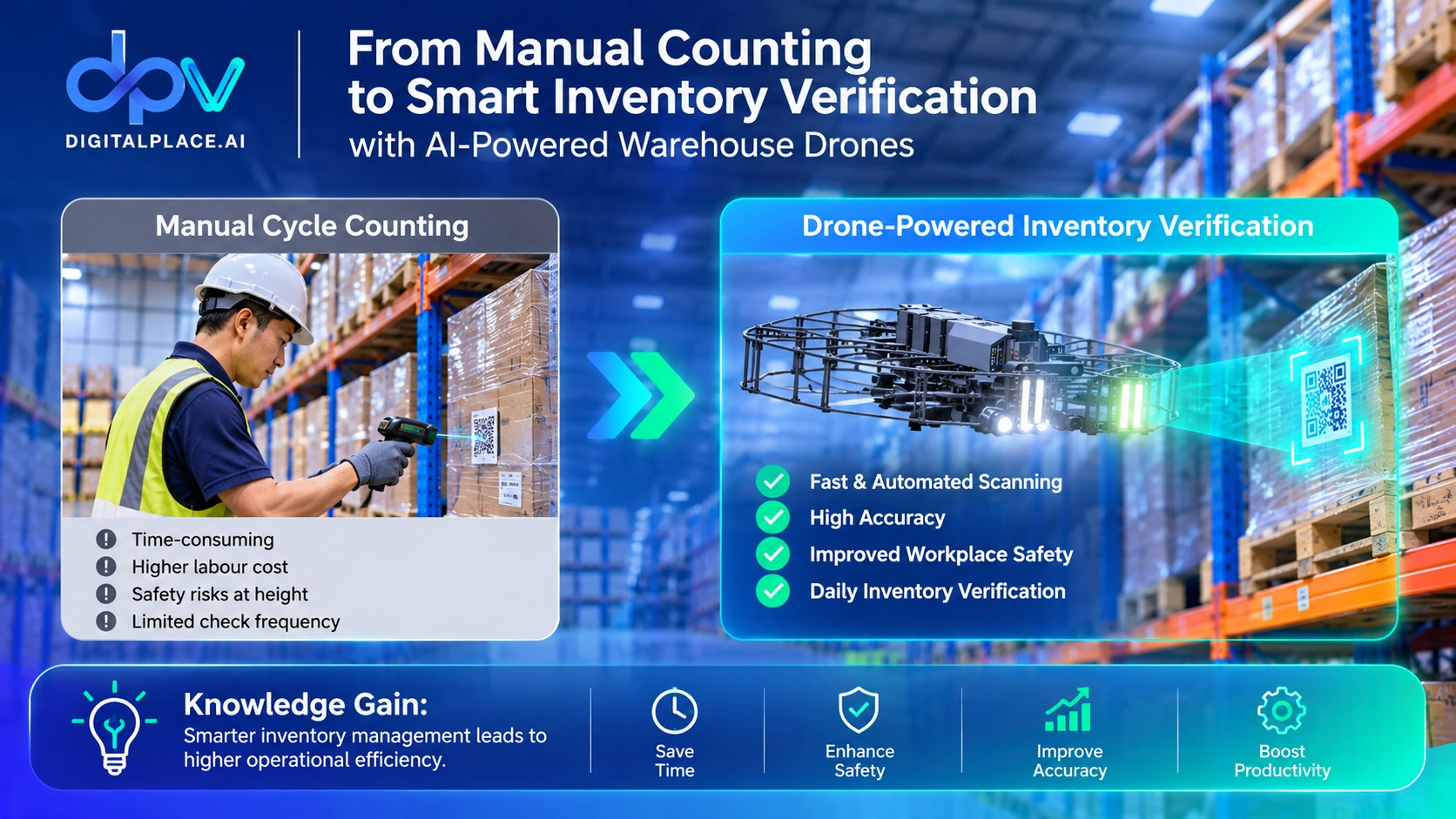
Manual Cycle Counting
- !Requires employees to travel through aisles and inspect inventory labels.
- !Can be time-consuming across large facilities and elevated rack positions.
- !May involve equipment and work-at-height procedures for high-level checks.
- !Verification frequency is constrained by available time, manpower, and coordination.
Drone-Powered Inventory Verification
- ✓Follows configured routes to scan QR-coded pallet labels.
- ✓Associates identified inventory with mapped physical rack positions.
- ✓Helps flag moved pallets and storage locations recorded as occupied but found empty.
- ✓Supports recurring checks of selected aisles or wider warehouse areas.
Scanning performance depends on suitable QR-code size, visibility, lighting, flight conditions, and warehouse configuration.
Knowledge Gain
The key benefit is not simply faster counting. More repeatable physical verification can help teams discover inventory discrepancies sooner and make better use of warehouse resources.
Drone scanning supports inventory control; warehouse teams remain responsible for reviewing findings and resolving exceptions.
For businesses interested in understanding how misplaced pallets and empty locations affect warehouse operations, read more: Misplaced Pallets, Empty Locations: How Warehouse Drones Help Singapore Operators Find Inventory Errors.
How AI-Powered Warehouse Inventory Drones Work
An inventory drone is more than a flying camera. A reliable warehouse scanning solution combines autonomous navigation, image capture, QR code recognition, inventory identification, physical location mapping, and software-based verification.
These components work together to turn physical warehouse observations into useful inventory information.
1. Autonomous Navigation Without GPS
Unlike outdoor drones, warehouse inventory drones operate in enclosed environments where satellite-based positioning systems such as GPS are generally unavailable or unreliable.
The drone therefore requires an alternative way to understand its position, maintain a stable flight path, and navigate between warehouse racks.
Depending on the system design, indoor autonomous navigation can use technologies such as:
- LiDAR and distance sensors.
- Inertial measurement sensors.
- Computer vision.
- Ultrasonic sensing.
- Preconfigured warehouse maps and flight paths.
These technologies help the drone understand its surroundings, maintain its position, and follow predefined scanning missions.
For warehouse operators, this means the drone does not simply explore the facility randomly. The warehouse layout is first assessed and configured so that scanning routes can be repeated consistently.
2. QR Code Recognition and Inventory Identification
Identifying inventory is another essential part of the scanning process.
A warehouse drone must first detect an inventory label within its camera image and then successfully read the information encoded within that label. These are two separate stages of the scanning process.
Label detection involves identifying whether a QR code or barcode is visible in the captured image.
Code recognition involves reading the information contained within the detected label.
Several factors influence scanning reliability, including label dimensions, image quality, lighting, camera distance, flight stability, and label positioning.
For this reason, warehouse operators should not overlook the importance of standardised inventory labelling when preparing for drone deployment.
Damaged, obstructed, poorly positioned, or undersized labels can reduce scanning reliability regardless of how advanced the drone’s camera or software may be.
Why Digitalplace Recommends QR Codes
Although traditional one-dimensional barcodes remain widely used in warehouse operations, QR codes offer a practical advantage for autonomous inventory scanning when implemented according to consistent specifications.
Digitalplace.ai recommends QR codes as the preferred inventory identification format for its warehouse inventory drone solution.
QR codes must be sufficiently large, clearly visible, and consistently positioned so that the drone can capture them from its intended scanning distance.
When the required QR code specifications and deployment conditions are met, Digitalplace’s solution can achieve 100% inventory scanning accuracy.
This performance should be understood within the context of the complete scanning environment rather than as an unconditional guarantee for every warehouse configuration.
Reliable inventory verification depends on the combination of:
Drone + Camera + Flight Path + QR Code + Rack Configuration + Software
Each component contributes to the overall scanning process.
Identifying Inventory and Verifying Its Physical Location
Reading a pallet’s QR code is only part of the inventory verification process. The warehouse system must also establish where that pallet has actually been observed.
Imagine a pallet originally assigned to:
Aisle 04 – Rack 07 – Level 03
Later, a forklift operator moves it to another storage position. The QR code remains associated with the same pallet, but its physical location has changed.
If the WMS is not updated, the digital record will no longer represent the warehouse’s actual condition.
This is where autonomous navigation and rack mapping become important.
The drone identifies the pallet through its QR code while simultaneously using its configured position and rack mapping to determine the physical storage location being scanned.
The verification process can therefore be represented as:
Inventory Identification + Observed Rack Position = Verified Inventory Location
The system can then compare the expected location recorded in the WMS against the location where the inventory was physically observed.
This distinction is particularly important for Singapore warehouses managing high volumes of palletised goods, where knowing that an item exists is not enough. Warehouse employees also need to know exactly where it is stored.
Detecting Moved Inventory and Empty Storage Locations
Once inventory identification and physical location verification are combined, warehouse drones can support several practical inventory management activities.
The system can help warehouse teams:
- Identify moved inventory: Detect pallets observed in locations different from their expected storage positions.
- Confirm empty locations: Verify whether a storage slot recorded as occupied is physically empty.
- Verify assigned pallet positions: Check whether inventory remains in its designated aisle, rack, and level.
- Perform recurring inventory checks: Compare observations from repeated scanning missions to identify changes.
- Support discrepancy investigation: Provide physical inventory observations that warehouse teams can review against WMS records.
These capabilities address an important distinction in warehouse inventory management: not every inventory discrepancy involves missing stock.
Sometimes, the inventory is still inside the warehouse. It has simply been placed somewhere else.
For distribution centres and fulfilment operations, inaccurate storage locations can affect picking efficiency, replenishment activities, and the time required to locate goods. Identifying these issues earlier helps warehouse teams investigate exceptions before they develop into more disruptive operational problems.
Why High-Bay Warehouses Are a Natural Use Case for Inventory Drones
Singapore’s limited land availability makes warehouse space utilisation an important consideration for logistics and distribution businesses. Many facilities use vertical storage systems to increase capacity without expanding their ground footprint.
While high-bay racks allow warehouses to store more goods within a given floor area, they also introduce additional challenges during physical inventory inspections.
Checking a pallet at ground level is relatively straightforward. Inspecting a pallet several metres above the warehouse floor is a different task.
Employees may need to arrange lifting equipment, coordinate access to elevated rack positions, and follow appropriate workplace safety procedures before inspecting or scanning a label. Repeating these activities across hundreds of elevated storage locations can become time-consuming and operationally demanding.
An inventory drone changes the relationship between employees and elevated storage positions.
Instead of transporting an employee or lifting equipment to the inventory label, the drone travels through the configured warehouse aisle and captures the required information.
Digitalplace.ai’s Warehouse Inventory Drone supports high-bay inventory scanning, alongside full-facility scans, selected-area cycle counts, moved-location verification, and empty-location checks.
Warehouse personnel remain responsible for configuring missions, reviewing scan results, and investigating exceptions. However, repetitive physical label inspections can be reduced, allowing employees to focus on activities that require human judgement and intervention.
For Singapore warehouse operators, this can mean less dependence on repeated manual access to elevated rack positions, better inventory visibility, and more efficient use of warehouse manpower.
For a deeper look at the relationship between elevated inventory inspections and workplace safety, read: High-Bay Warehouse Inventory Checks: Can Drones Improve Safety in Singapore?.
Turning Drone Scans Into Actionable Warehouse Data
Scanning thousands of inventory labels has limited value if the results remain isolated from the warehouse’s existing information systems.
The real operational benefit comes from connecting physical observations with the digital inventory records that warehouse teams already use.
A typical workflow involves several stages:
1. Warehouse configuration
Assess the facility, rack dimensions, aisle layout, and inventory labelling requirements.
2. Mission preparation
Configure the drone’s scanning routes and selected warehouse zones.
3. Autonomous scanning
The drone travels through the designated areas and captures inventory QR codes.
4. Inventory verification
Captured information is associated with physical rack positions and compared against expected inventory records.
5. Discrepancy identification
Moved pallets, empty locations, and other inventory exceptions are identified.
6. Exception investigation
Warehouse personnel review the findings and determine whether corrective action is necessary.
This creates a continuous verification workflow:
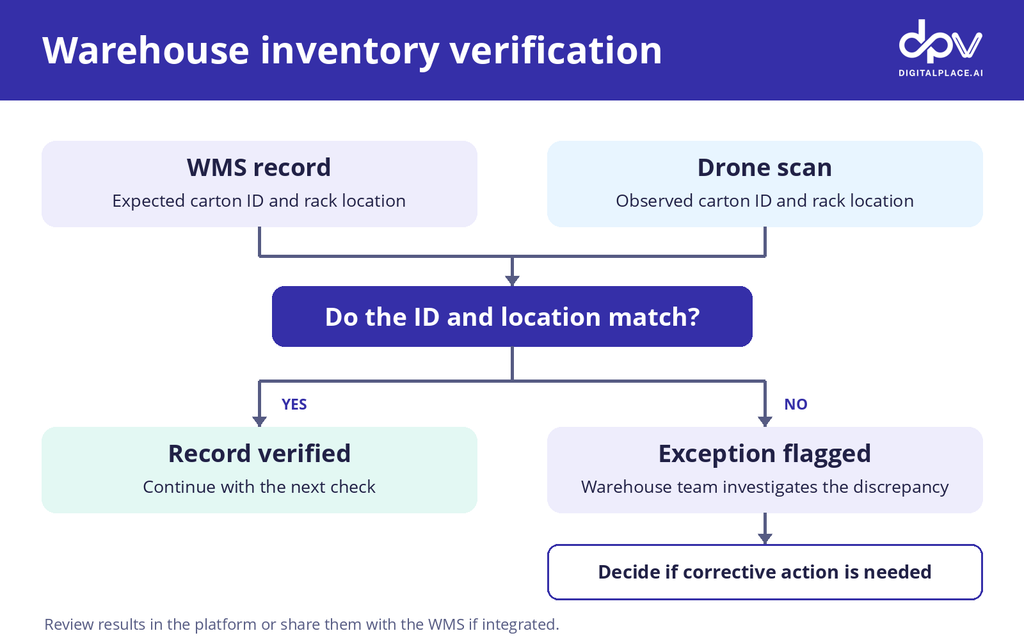
The objective is not to replace the WMS. Instead, the drone provides an additional source of physical inventory verification that helps warehouse teams determine whether their digital records reflect actual warehouse conditions.
The resulting information can be reviewed through the platform or connected with the WMS, depending on the integration requirements.
What Makes a Singapore Warehouse Suitable for Inventory Drones?
Although autonomous inventory drones offer several operational advantages, not every warehouse is immediately suitable for deployment.
The facility must provide an environment where the drone can navigate safely, capture inventory labels reliably, and associate scanned information with the correct physical storage positions.
Before introducing the technology, warehouse operators should evaluate the following conditions.
1. Adequate Aisle Width and Flight Clearance
The drone requires a sufficiently clear corridor between opposing rack faces to navigate and perform scanning missions.
Digitalplace’s current deployment guideline uses approximately 2 metres or more of clear aisle width as a practical reference.
Pipes, sprinklers, protruding materials, hanging straps, and other obstacles should also be assessed to ensure they do not interfere with the intended flight path.
2. Consistent Rack Geometry
Consistent rack dimensions and storage configurations make autonomous scanning easier to configure and repeat.
The system needs to associate scanned inventory identifiers with the correct horizontal and vertical rack positions.
Warehouses with structured rack layouts are generally better suited to repeatable scanning missions than facilities with highly irregular storage arrangements.
3. Standardised QR Code Labels
QR codes must be clearly visible and large enough to be captured from the drone’s intended scanning distance.
Consistent label placement across aisles and rack levels is equally important.
Before deployment, warehouse operators should assess whether existing pallet labels meet the required specifications or whether additional labelling standardisation is necessary.
4. Clear and Organised Flight Paths
Loose plastic wrapping, hanging cables, straps, and other materials can become obstacles during autonomous flight.
A warehouse that is organised for normal human movement is not automatically suitable for autonomous drone navigation.
The intended scanning zones should therefore be inspected and maintained to provide predictable flight corridors.
5. Stable Airflow and Suitable Environmental Conditions
Strong airflow from industrial fans can affect the stability of small indoor drones.
Temperature and environmental conditions also matter, particularly in facilities operating specialised storage environments.
Digitalplace’s current solution is validated for standard warehouse environments between 10°C and 45°C. Cold storage below 10°C and extremely dusty environments require separate evaluation and are not currently recommended for standard deployment.
6. Reliable Warehouse Location Data
The accuracy of drone-based inventory verification also depends on the quality of the warehouse’s existing digital records.
Every storage location should have a consistent digital identity so that the system can compare expected inventory positions against actual physical observations.
A warehouse with inconsistent location naming, outdated rack information, or incomplete WMS records may need to address these issues before introducing automated verification.
Why a Warehouse Drone Pilot Should Start Small
Introducing new warehouse technology across an entire facility without first validating its suitability can create unnecessary implementation challenges.
A more practical approach is to begin with one representative warehouse aisle or storage zone.
For example, a Singapore distribution centre could select a high-bay aisle with frequent inventory movement and use it to evaluate whether autonomous scanning can improve its existing cycle-counting process.
The pilot should focus on measurable operational questions:
- Can the drone consistently capture the QR codes used across the selected rack positions?
- Can the system associate scanned inventory with the correct physical locations?
- Can it identify moved pallets and confirm empty storage locations?
- Can the scanning mission be repeated without extensive manual intervention?
- Can the resulting inventory information be reconciled with the existing WMS?
Useful pilot performance indicators include:
- Percentage of storage locations successfully scanned.
- Number of QR codes successfully identified.
- Number of empty locations confirmed.
- Number of moved pallets detected.
- Duration of each scanning mission.
- Amount of manual intervention required.
- Accuracy of physical location verification.
- Compatibility with existing warehouse data workflows.
By evaluating these results, warehouse managers can determine whether the solution delivers measurable operational value before expanding deployment to additional aisles.
The Business Case Goes Beyond Counting Speed
When evaluating warehouse automation, it is tempting to focus exclusively on how quickly a drone can scan an aisle compared with a human employee.
While scanning speed is an important consideration, the broader business case involves several other operational factors.
For Singapore warehouse operators, the potential benefits can include:
1. Better manpower utilisation
Automating repetitive scanning activities allows employees to spend more time on inventory investigation, exception handling, and other warehouse responsibilities.
2. Reduced dependence on lifting equipment for routine inspections
High-bay inventory verification can be performed without repeatedly arranging equipment and personnel simply to access elevated labels, subject to suitable drone deployment conditions.
3. Improved workplace safety support
Reducing routine manual access to elevated rack positions can help minimise exposure to certain work-at-height activities. Drone operations must still follow appropriate site safety and operational procedures.
4. More frequent inventory verification
Scheduled autonomous scanning makes it easier to check selected warehouse zones more regularly instead of concentrating verification into occasional stocktake projects.
5. Reduced inventory search time
Earlier detection of moved pallets and incorrect storage locations can help reduce the time employees spend searching for inventory.
6. Better warehouse visibility
More frequent physical observations provide warehouse managers with additional information to review inventory discrepancies and improve operational decision-making.
The objective is not necessarily to eliminate manual inventory work entirely. It is to reduce the repetitive effort involved in maintaining accurate warehouse records while enabling employees to focus on activities that require human involvement.
For another perspective on measuring warehouse performance, read: Understanding Inventory Accuracy as a Warehouse KPI in Singapore.
From Periodic Stocktakes to an Automated Inventory Verification Layer
Warehouse inventory management has traditionally treated physical counting as a scheduled activity.
Employees are assigned to counting tasks, equipment is prepared, storage locations are checked, and discrepancies are investigated. Once the stocktake is complete, warehouse operations return to their normal routines until the next counting cycle.
Autonomous inventory scanning introduces the possibility of a different operating model.
Instead of treating physical verification as an occasional project, warehouses can incorporate it into their recurring operational workflows.
The drone performs repeatable scanning missions. Warehouse systems maintain the expected inventory records. Software compares physical observations with those records, while employees focus on reviewing discrepancies and handling exceptions.
This is the transition that Digitalplace.ai aims to support through its AI-powered Warehouse Inventory Drone solution.
Designed for structured warehouse environments, the solution helps automate inventory verification through autonomous scanning and QR-based identification. Its capabilities include:
- Full-facility inventory scanning.
- Selected-area cycle counting.
- High-bay pallet verification.
- Moved inventory location detection.
- Empty storage location confirmation.
- Inventory scanning results that can be reviewed through the platform or connected with the WMS.
When the required QR code specifications and deployment conditions are met, the solution can achieve 100% inventory scanning accuracy.
For businesses evaluating warehouse automation in Singapore, the most practical starting point is a focused pilot that addresses one clearly defined inventory challenge.
Whether the priority is improving high-bay inventory visibility, reducing repetitive manual stocktaking, or identifying misplaced pallets earlier, autonomous inventory scanning offers a way to make physical inventory verification more consistent and repeatable.
The long-term opportunity is bigger than replacing manual counting with a drone. It is about building a warehouse operation where inventory accuracy can be checked more frequently, discrepancies can be discovered earlier, and employees can spend less time on repetitive verification work.
Ready to move beyond manual warehouse stocktaking?
Discover how Digitalplace.ai’s AI-powered Warehouse Inventory Drone can help improve inventory visibility, automate recurring stock checks, and support smarter warehouse operations.
Contact Digitalplace.ai to explore a warehouse inventory drone pilot for your Singapore facility.