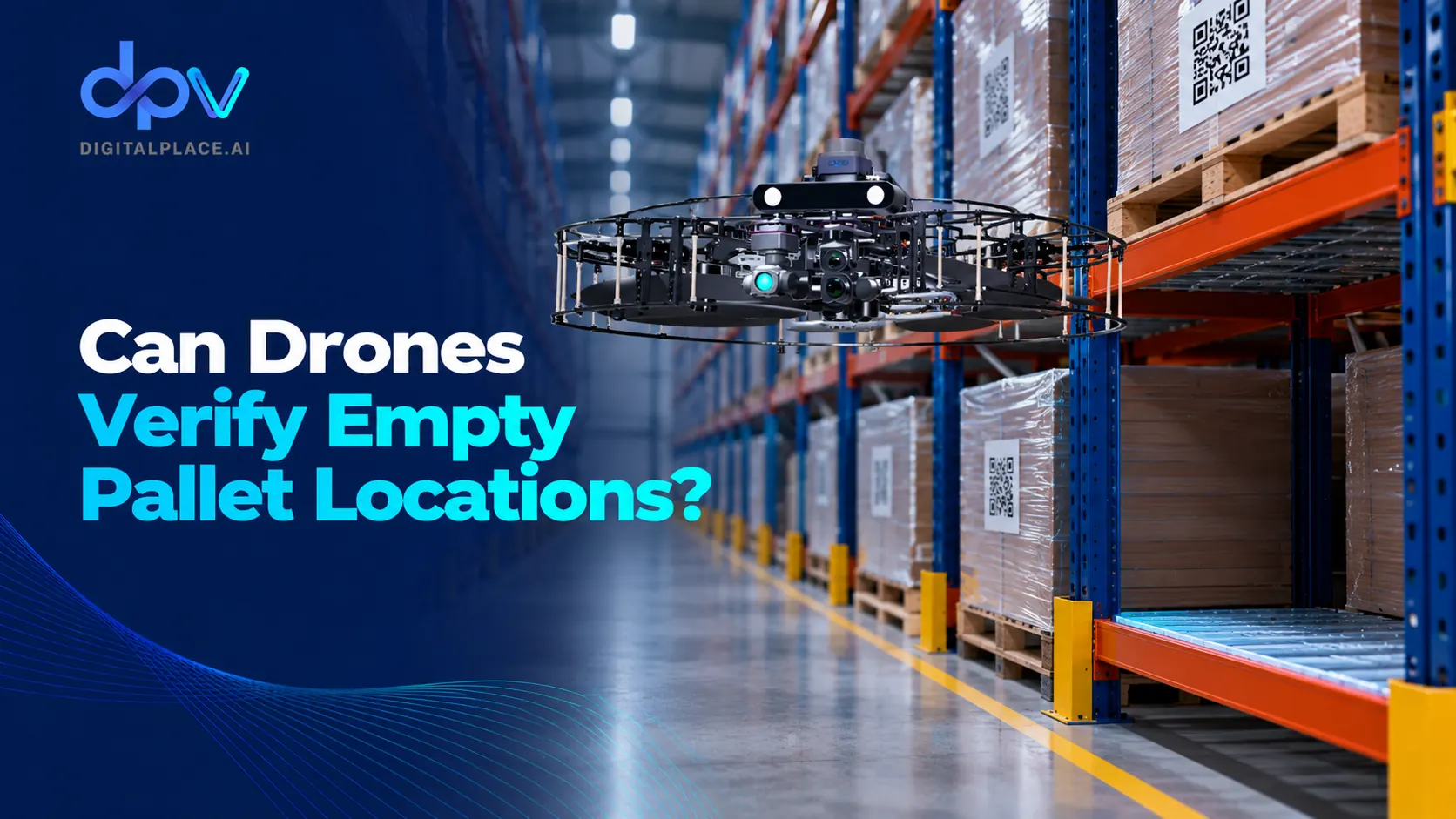
A missing QR code does not necessarily mean a pallet location is empty. This is one of the most important distinctions in warehouse drone empty location verification. While autonomous drones can help identify potentially vacant storage positions, reliable verification requires more than determining whether a barcode was detected during a scanning mission.
For warehouse operators in Singapore, this distinction matters because inventory discrepancies often involve the relationship between physical pallet locations and warehouse management system (WMS) records. A system may show that a pallet occupies a particular rack position even though the location is physically empty. Conversely, a pallet may be present but remain undetected because its label is damaged, obstructed, or outside the drone camera’s effective scanning range.
Warehouse drones can support empty pallet location verification, but a failed scan should not automatically be interpreted as proof of an empty location. Understanding the difference between missing inventory, unreadable identification labels, and incomplete scanning coverage is essential for turning autonomous inventory checks into reliable warehouse information.
Why Empty Pallet Locations Matter in Warehouse Operations
An empty pallet location may appear insignificant, particularly in a large distribution centre containing thousands of storage positions. However, discrepancies between physical storage conditions and WMS records can affect several warehouse processes.
Consider a rack location recorded as occupied by Pallet A. If the pallet was physically moved without a corresponding WMS transaction, warehouse employees may spend time searching for inventory that no longer exists at the recorded location. Picking activities may be delayed, replenishment tasks may be assigned incorrectly, and warehouse managers may struggle to understand the actual availability of storage space.
The opposite situation can also occur. A physically occupied location may be recorded as empty, potentially creating conflicts when the WMS assigns that space to an incoming pallet.
For Singapore logistics providers managing high-density pallet storage, such discrepancies can become increasingly difficult to investigate when inventory movements occur frequently. The challenge is not simply identifying empty spaces but establishing whether the observed physical condition matches the system’s expected inventory position.
Research published in the European Journal of Operational Research in 2025 examines how inventory record inaccuracies affect inspection and replenishment decisions. Although the study is not specifically about drones, it reinforces the operational importance of allocating verification resources to inventory discrepancies.
Why a Failed QR Code Scan Does Not Mean an Empty Pallet Location
Warehouse drones commonly use cameras to capture QR codes or barcodes attached to pallets. During a configured scanning mission, the system attempts to identify labels at designated storage positions and associate the captured information with warehouse locations.
However, the absence of a successful barcode reading can have several explanations.
A pallet may genuinely be missing from its expected location. Alternatively, the pallet may still be present, but its identification label could be obscured by stretch wrap, damaged during handling, or positioned at an angle that prevents successful decoding.
Environmental conditions can introduce further uncertainty. Inconsistent lighting, reflections, camera movement, and insufficient image resolution may prevent an otherwise readable code from being detected.
A 2026 study published in Symmetry, titled UAV-Based QR Code Scanning and Inventory Synchronization System with Safe Trajectory Planning, investigated QR scanning performance using warehouse simulations and controlled physical experiments. The researchers reported approximately 95–96% QR scanning accuracy in simulations, compared with 86–90.5% during experimental validation.
These figures do not represent the performance of Digitalplace.ai’s drone. Instead, they illustrate why scanning reliability must be evaluated under real operating conditions.
The technical challenge is that a scanning failure and an empty storage location can produce a similar initial observation: no successfully decoded pallet identifier.
Distinguishing between these outcomes requires additional verification evidence.
What Does Reliable Empty Location Verification Actually Require?
Reliable empty location verification should distinguish between confirming that inventory is present, establishing that a storage position appears vacant, and recognising situations where the available evidence is insufficient.
Digitalplace.ai’s warehouse inventory drone supports empty-location checks alongside pallet scanning and moved-location verification during configured indoor inventory missions.
From an operational perspective, a useful verification framework separates observations into three categories:
| Verification Outcome | Meaning | Recommended Response |
|---|---|---|
| Occupied Location | A pallet or its identifier has been successfully observed at the expected position. | Compare the observed identifier and location with WMS records. |
| Potentially Empty Location | The designated storage position appears vacant, but the observation requires appropriate validation. | Confirm the physical condition and investigate discrepancies with WMS records. |
| Unresolved Location | The scan does not provide sufficient evidence to determine occupancy. | Re-scan or request manual verification. |
These categories represent a recommended operational framework, not a claim that every commercial warehouse drone uses this exact classification.
The distinction becomes particularly important when automated scanning results are used to support inventory adjustments. If a system interprets every unreadable QR code as missing inventory, it may generate false discrepancies and increase the workload required to investigate them.
To understand how scanning fits into the wider inspection process, read how warehouse drone inspection works, from autonomous flight to inventory verification.
The Importance of Visual Evidence
Barcode identification and physical occupancy verification are related but different tasks.
A successfully decoded QR code establishes that a particular identifier was observed. Determining whether a pallet slot is physically empty requires evidence about the storage position itself.
Depending on the scanning technology, such evidence may include images showing the rack location, observations of the storage area, and the relationship between the observed position and its configured warehouse coordinates.
However, visual evidence also has limitations. A camera may fail to capture a pallet hidden behind rack structures, while an incomplete view may not establish whether the entire storage position is vacant.
For this reason, warehouse operators should evaluate what evidence their chosen drone system actually produces rather than assuming that barcode scanning alone can reliably determine physical occupancy.
From Drone Observation to WMS Verification
The operational value of empty-location detection becomes clearer when scanning results are connected to warehouse inventory records.
The warehouse inventory drone developed by Digitalplace.ai follows configured indoor scanning missions, captures pallet-level identification information, and produces results that can be reviewed or connected to a warehouse management system. Its documented capabilities include checking moved pallet locations and identifying empty storage positions. However, the available product documentation does not specify the internal classification method used to distinguish an unreadable code from a physically empty location, so these should not be treated as equivalent technical outcomes.
A practical verification process involves four stages.
First, identify the expected condition. The WMS provides the recorded pallet identifier and expected storage location.
Second, collect physical observations. The drone conducts its configured scanning mission and captures the available identification or location evidence.
Third, compare the observation with the record. Any mismatch becomes a potential discrepancy requiring further assessment.
Finally, investigate and resolve the exception. Warehouse personnel determine whether the problem involves an unrecorded pallet movement, an unreadable label, an incorrect WMS record, or another operational issue.
Importantly, identifying a discrepancy does not necessarily justify automatically correcting the WMS. Physical inventory adjustments should follow appropriate validation procedures, particularly when the evidence remains incomplete.
Why This Matters for Singapore’s High-Bay Warehouses
High-bay warehouses present additional challenges because upper-level pallet locations are not always easy to inspect manually.
Checking a potentially empty position at height may require access equipment, forklift coordination, and temporary restrictions on warehouse activities. Repeated manual checks can therefore consume operational resources even when the purpose is only to establish whether a pallet occupies a particular location.
Singapore’s Ministry of Manpower (MOM), through its Workplace Safety and Health Technology in Transportation & Storage Sector guidance, identifies drones for inventory management as a technology with potential applications in high-bay inventory counting and hard-to-reach inspections. The guidance highlights opportunities to reduce workers’ exposure to higher-risk activities while improving inspection efficiency.
For Singapore distribution centres managing large numbers of pallet locations, Digitalplace.ai’s warehouse inventory drone offers a way to support recurring physical inventory checks without requiring warehouse employees to inspect every rack position manually. The system is designed for GPS-free indoor navigation and configured scanning routes, with its current application focused on pallet-level verification. Nevertheless, actual deployment suitability depends on warehouse conditions, including clear flight paths, appropriate rack dimensions, readable identification labels, and environmental requirements. The current product guidance prioritises standard warehouse environments operating between 10°C and 45°C, while extremely dusty conditions and cold storage below the validated range require separate consideration. These constraints matter because unreliable scanning conditions can increase the number of unresolved observations and reduce the operational benefits of automated verification.
The objective is therefore not to eliminate human involvement completely. It is to reduce repetitive inspection work while ensuring that uncertain observations receive appropriate attention.
How Should Warehouses Measure Empty Location Verification Performance?
A warehouse drone may complete a scheduled scanning mission successfully while still leaving some locations unverified.
This raises an important question: should performance be measured by the number of locations visited, the number of QR codes decoded, or the number of storage positions whose occupancy status has been reliably established?
For empty-location verification, the third measure is particularly valuable.
Warehouse managers should distinguish between scanning coverage and verification completeness. Scanning coverage measures whether designated locations were visited during a mission, while verification completeness considers whether sufficient evidence was collected to establish their status.
Other useful indicators include the proportion of unresolved locations, repeat scanning requirements, incorrect empty-location classifications, and the time required to investigate discrepancies.
These measures can help operators assess whether automated inspection is improving inventory visibility or merely generating additional exceptions.
Singapore’s Infocomm Media Development Authority (IMDA), through its Logistics Industry Digital Plan, encourages logistics companies to evaluate digital technologies according to their operational requirements and digital readiness. For warehouse inventory drones, this reinforces the importance of measuring practical verification outcomes rather than technology performance in isolation.
For warehouse operators evaluating this approach, explore our warehouse inventory drone solution in Singapore and discuss how rack layouts, label conditions, and verification requirements would be assessed for your facility.
The Real Opportunity: Moving from Missing Labels to Verified Inventory Locations
The next stage of warehouse drone automation is not simply about scanning more QR codes or flying through warehouse aisles faster. It is about obtaining more dependable evidence of what physically occupies each storage location.
For Singapore warehouse operators, this requires an approach that recognises uncertainty. A readable label can support pallet identification, an appropriate physical observation can support occupancy assessment, and an incomplete scan should remain unresolved until sufficient evidence becomes available.
Empty pallet location verification becomes genuinely useful when these observations are connected to WMS records and supported by clear investigation procedures.
The goal is not to report every missing QR code as an empty location. It is to distinguish genuinely vacant storage positions from unreadable inventory—and help warehouse teams act on that difference with confidence.