

Key Takeaways
Before cutting an order, check how many units the outlet will sell before it can receive its next delivery. A carton due tomorrow can change the decision today.
Start with products carrying the most excess stock. In the example below, one Singapore outlet can skip a shampoo order, keep its usual order of soya milk and cut its noodle order from three cartons to one.
Measure stock reduction alongside shelf availability. Check bestsellers at the hours customers usually buy them, especially if a weekly report suggests everything is in stock.
Your retail director wants to cut inventory by 10%. Which products would you order less of next week, and which would you leave alone?
Imagine you place the Monday orders for a supermarket in Tampines. The backroom holds eight weeks of shampoo refills. The chilled cabinet has barely a day’s worth of the outlet’s best-selling soya milk. On your screen, instant noodles also look low, but two cartons are already on the way. Which line of the purchase order would you change first?
The 10% is an illustrative target for the value of stock the business holds. Your Tampines outlet can contribute by skipping the shampoo order. Cutting the milk order by the same percentage could leave a gap in the chiller before the next delivery. Here is how to work through those decisions, one product and one outlet at a time.
How Much Inventory Is Actually Excess?
Start with days of supply. Divide the units available for sale at the outlet by the number of units you expect to sell per day. If the Tampines store has 112 shampoo refills and sells two a day, it has 56 days of supply. If the supplier delivers weekly and the store wants a seven-day reserve, it needs roughly 28 units for the coming week and its reserve combined. That leaves 84 units above its current requirement, assuming steady demand.
A daily average works for shampoo that sells steadily. It can be misleading for a tin of pineapple tarts in the run-up to Chinese New Year. If that tin is in the festive catalogue, use the outlet’s forecast for the actual promotion dates. Check the supplier’s final order cut-off too. Missing it could leave the store without another delivery until after the promotion. The store manager’s guide to preparing for peak trading days covers how to identify products that could sell out in a single day.
For the order you are about to place, use this calculation before rounding to a full carton:
Units to order = forecast sales through the next replenishment opportunity + required reserve − saleable stock on hand − confirmed inbound units due in time.
Use zero if the result is negative. The period should extend to the delivery you could receive if you waited until your next ordering opportunity. Then check the dates within that period. A Friday delivery can help meet Saturday demand, but it cannot fill a shelf that runs empty on Thursday.
Which Products Should You Reduce First?
The same Monday order sheet can support three different decisions. In this example, the planner is covering seven days of demand. For chilled milk, the supplier can deliver today’s order tomorrow morning, before the outlet opens.
| Product at the Tampines outlet | Saleable stock and expected sales | What to order on Monday |
| Shampoo refill | 112 pouches on hand. Sales of 2 a day. Seven-day demand plus reserve is 28. | Skip this order. Review next Monday. Even after a week of expected sales, the outlet would have 98 pouches left. |
| Best-selling chilled soya milk | 18 bottles on hand. Sales of 12 a day. Seven-day demand is 84 bottles, plus a 6-bottle reserve. | Keep the usual 72-bottle order. The 18 bottles cover Monday. Check that tomorrow’s delivery is confirmed and the remaining shelf life covers the sales period. |
| Instant noodles, five-pack | 12 packs on hand. Seven-day demand is 42, plus a 6-pack reserve. Another 24 packs are confirmed for Tuesday morning. | Reduce the order from three cartons to one. The requirement is 48 packs. Deduct 12 on hand and 24 inbound, leaving 12 packs, or one carton. |
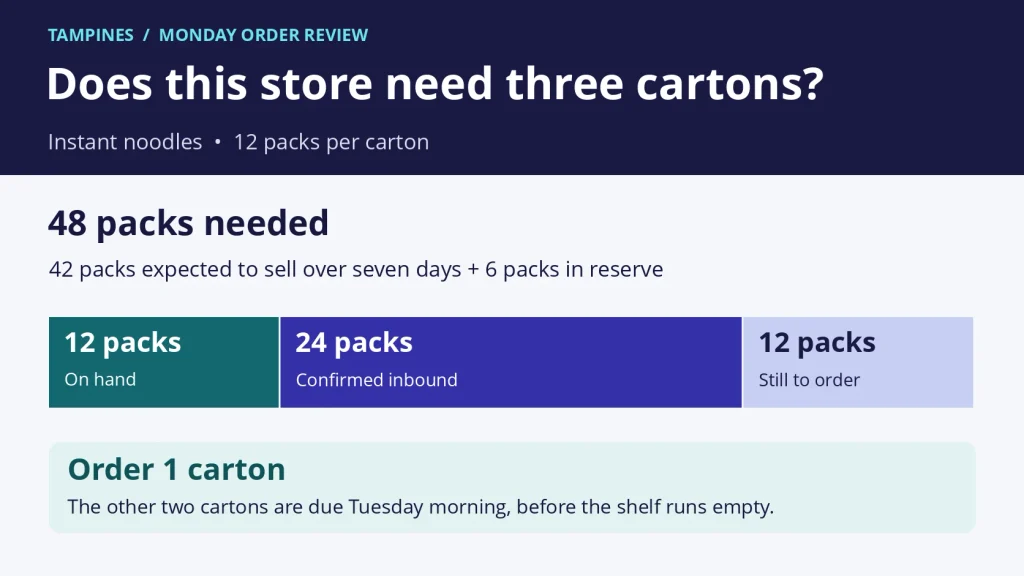
Timing is what makes the one-carton order work. At six packs a day, the 12 packs on the shelf should last through Tuesday. A confirmed Tuesday morning delivery gives the Tampines outlet enough stock to keep selling. If those same two cartons are delayed until Wednesday afternoon, the weekly total still adds up to 48, but shoppers could find an empty shelf on Wednesday morning. Before signing off on the smaller order, the planner needs to check when the cartons will reach the shelf.
Digitalplace.ai’s Inventory Optimization service for Singapore retailers brings outlet-level demand, available stock and incoming deliveries into the same replenishment decision.
Should You Order Less, Transfer Stock, or Return It to the DC?
Order less when the outlet can sell down the excess. If the shampoo refills have ample shelf life, enough backroom space and steady local demand, skipping repeat orders may be all the Tampines store needs to do. Set a review date so the pause ends while there is still time to replenish.
Transfer stock when another outlet can use it before its next delivery. Suppose a Bedok branch has six of the same shampoo refills and expects to sell 18 before its supplier can deliver. Sending 12 pouches from Tampines on a scheduled vehicle would cover the gap. Tampines would still have 100 pouches. Confirm that Bedok can receive the stock in time and adjust its open order. The transfer itself leaves the chain’s inventory unchanged. The opportunity to reduce it comes when Bedok can meet demand from stock the business already owns and buy fewer units.
Return stock to the distribution centre when several branches need small quantities. A direct transfer makes sense for one destination. If several outlets each need a few pouches and the DC can add them to scheduled deliveries, a return on the next collection may be more practical. Check handling costs, carton condition and remaining shelf life before moving the goods. If no branch expects to sell them, sending them back merely moves the surplus. When the same SKU repeatedly comes back from the same outlet, revisit the assortment and allocation decisions that put it there.
How Do You Know Whether the Reduction Worked?
Compare the same outlets and products over two comparable trading periods. For example, use four ordinary weeks before the change and four after it. Flag promotions, public holidays and supplier disruptions. A festive promotion in only one period makes the figures harder to interpret.
| Measure | What to compare | What to look for |
| Average inventory value | Average daily closing stock at cost, in SGD. Include the DC when measuring a chain-wide target. | The chain holds less stock over the period. A large return to the DC should not count as a saving. |
| Days of supply | Saleable units divided by expected daily demand for each SKU at each outlet. | Cover falls on overstocked lines while bestsellers retain enough to reach their next delivery. |
| Stockout rate | Out-of-stock observations as a percentage of scheduled SKU checks. Keep the outlets, assortment and check times consistent. | A stable chain-wide rate can hide a rise at one branch. Review the outlets where orders changed. |
| Bestseller shelf availability | Check the shelf at the hours that matter locally, such as lunchtime at a Raffles Place outlet or Saturday morning in Tampines. | A bestseller is available when shoppers arrive, even if a morning stock report still shows units in the backroom. |
Suppose average inventory falls from S$200,000 to S$180,000. That meets the illustrative 10% target. But if the soya milk is missing at three of 20 lunchtime checks, up from one of 20, look at delivery arrival times and when staff refill the chiller before reducing the next order. For the shampoo, check whether customers bought the surplus or the store simply moved it elsewhere. A store-level sell-through calculation helps answer that question.
Digitalplace.ai supports this work through its Singapore inventory optimisation service. A practical starting point is the next order review: choose one overstocked line, one bestseller and one item already in transit. Record what you changed on each order, then check the shelf just before the next delivery. That is when you can see whether the decision worked for the customer.