
The morning report shows that the team picked 198 of 200 order lines correctly. Yet in Aisle A, a picker spent 12 minutes looking for a carton that was one rack level above its recorded location. The order eventually shipped with the right item. Picking accuracy was 99%, and the report gave the supervisor no reason to investigate those 12 minutes.
That is why a useful warehouse KPI dashboard follows the stock through the building. How long did it take to make received goods available? Did the team store them in the right bin? Could the next picker find them there? Each measure answers a different question and points the supervisor toward a different action.
Seven warehouse KPIs at a glance
The figures below are illustrative. Each row uses the unit that fits the job: receipts for inbound timing, tasks for putaway, records for inventory checks, and order lines for picking.
| Warehouse KPI | Formula | Worked example |
|---|---|---|
| Dock-to-stock time | Total elapsed time from dock arrival to availability for picking ÷ completed receipts | 300 minutes ÷ 5 receipts = 60 minutes per receipt |
| Putaway accuracy | Correctly completed putaway tasks ÷ verified putaway tasks × 100 | 48 ÷ 50 = 96% |
| Inventory record accuracy | Counted records with an exact quantity match ÷ records counted × 100 | 92 ÷ 100 = 92% |
| Location accuracy | Checked stock units found at their recorded address ÷ stock units checked × 100 | 90 ÷ 95 = 94.7% |
| Cycle count completion | Scheduled counts completed by the cutoff ÷ counts due × 100 | 95 ÷ 100 = 95% |
| Picking accuracy | Order lines picked correctly on the first attempt ÷ order lines checked × 100 | 198 ÷ 200 = 99% |
| Pallet position occupancy | Occupied pallet positions ÷ total installed pallet positions × 100 | 850 ÷ 1,000 = 85% |
Dock-to-stock time: How long before receiving can release the goods?
A truck reaches the receiving dock at 8:00 a.m. The team finishes checking the delivery at 8:20, confirms putaway at 8:45, and releases the stock for picking at 9:00. Using dock arrival as the start and availability for picking as the finish, dock-to-stock time is 60 minutes. The 15 minutes between storage and release count because the picker was still waiting.
Use the same start and finish events for every receipt you compare. If one site starts its clock when unloading begins and another starts when the truck reaches the dock, their averages answer different questions.
When time increases: Split a slow receipt into unloading, receiving checks, waiting for putaway, and waiting for release. In this example, asking the forklift operator to move faster would do little about the final 15 minutes. First find out whether the goods needed a quality check or someone simply had an outstanding release transaction.
Putaway accuracy: Did the pallet reach its approved bin?
Suppose a supervisor checks 50 putaway tasks before any later stock movements. For 48 tasks, the pallet is in its approved destination and the warehouse management system (WMS) records that same bin. Putaway accuracy is 96%.
An approved change of destination can still count as accurate. If A-03-04 is occupied, the supervisor approves A-03-05, and the operator stores and confirms the pallet there, the task is correct. The failure occurs when the pallet goes into A-03-05 but the operator closes the task against A-03-04. This example shows how to confirm the actual bin during warehouse putaway.
When accuracy drops: Review the failed tasks at the rack. Did the operator scan a destination from the task sheet before reaching it? Was the original bay occupied? Did the replacement bin appear on the handheld device? Each finding calls for a different fix.
Inventory record accuracy: How often does the physical quantity match the WMS?
Choose the detail you want to verify. In this example, one record means one SKU in one bin, measured in cartons. The team counts 100 records and finds an exact quantity match in 92. Inventory record accuracy is 92%. A record showing 48 cartons when the team finds 47 counts as one mismatch.
Why measure matches record by record? Suppose the WMS lists 10 cartons in each of two bins. Staff find eight in the first and 12 in the second. The warehouse total is exactly 20, but a picker sent to the first bin for 10 cartons will leave two short. A warehouse-wide total would hide both errors.
When accuracy drops: Recount the affected bins and compare the count time with recent receipts, picks, and transfers. Check the unit of measure as well. An operator recording one case against a WMS field that expects pieces can create a large variance from a single entry.
Location accuracy: Can the team find the stock at its recorded address?
A supervisor selects 95 identified pallets from the WMS and asks the team to verify their addresses. The team finds 90 at the recorded locations. Location accuracy is 94.7% for the sample. Record the other five as exceptions and distinguish a pallet found elsewhere from one whose location remains unknown.
Here is how location accuracy can fall while the quantity remains correct. In a warehouse that numbers locations by aisle, bay, and level, A-03-04 and A-03-05 are directly above one another. A carton placed one level too high is still in the building, but the picking instruction sends the operator to the wrong shelf. Digitalplace.ai illustrates how to read a warehouse bin location code.
When accuracy drops: Look for a pattern in the addresses. If several errors involve adjacent levels in the same bay, stand where the operator normally works and read the labels from that position. If the errors follow a particular stock movement instead, check whether the destination was confirmed after the move.
Cycle count completion: Did the team finish the checks that were due?
The weekly plan calls for 100 location checks by Friday afternoon. The team completes 95. Cycle count completion is 95%. A completed check can reveal a discrepancy. The discrepancy remains open for investigation even though the count itself is complete.
Read this alongside location accuracy. If each of the 95 completed checks covered one expected pallet, and 90 pallets were found at the expected address, the dashboard should show 95% completion and 94.7% location accuracy among the completed checks. The five unvisited locations still have an unknown result. Keeping them visible helps the next shift decide where to start.
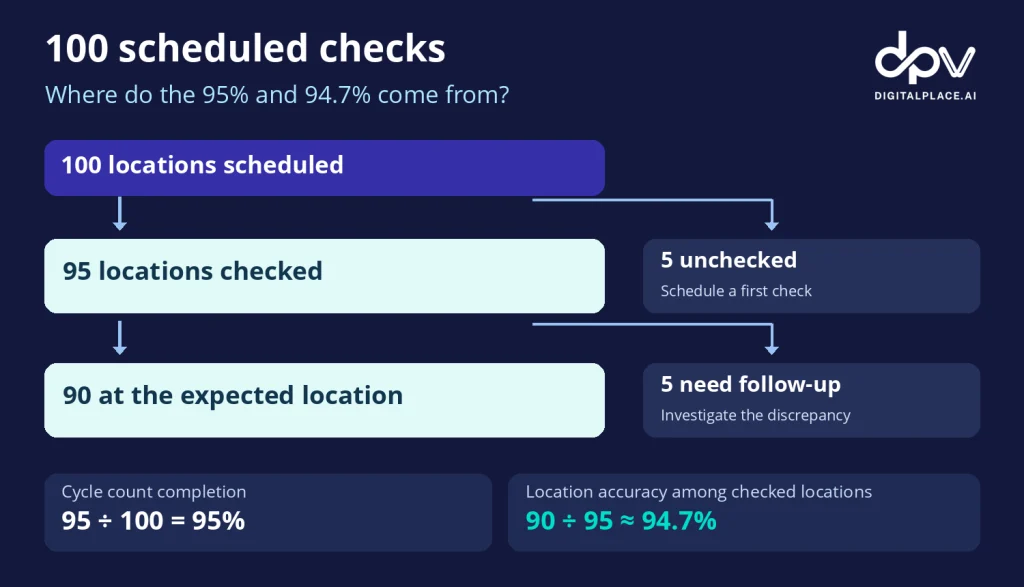
The two groups of five need different actions at shift handover. Assign a first check to the five locations nobody visited. For the five that were checked but did not match the WMS record, investigate the discrepancy. Dividing 90 by 100 tells the supervisor how much of the original schedule has a confirmed match. Dividing 90 by 95 answers a different question: how often was stock in the expected location when the team actually checked?
When completion drops: Group the unfinished checks by reason. A blocked aisle needs a new access window. An unreadable carton label needs another means of identification. For teams evaluating InfiniDrone from Digitalplace.ai, a comparison of drone and manual cycle counting shows how to separate locations reached from locations where the evidence was clear enough to complete the check.
Picking accuracy: Did the picker collect the right item and quantity on the first attempt?
An order line specifies an item and a quantity. If a picker collects the right cooking oil but takes 10 cartons instead of 12, that line fails the first-attempt check. If 198 of 200 checked lines are correct on the first attempt, picking accuracy is 99%. A packing team that catches the two mistakes can protect the customer while preserving those errors in the picking report.
When accuracy drops: Separate wrong-item, wrong-quantity, and wrong-lot errors where lot control applies. Wrong-item errors concentrated in neighboring bins may warrant a review of similar packaging or shelf labels. Repeated quantity errors on the same SKU may point to confusion between cases and individual units.
What about the picker who lost 12 minutes in Aisle A? If the picker eventually collects the correct carton on the first attempt, the line still passes. Record the search delay against the location exception so the supervisor can investigate it even when picking accuracy stays high.
Pallet position occupancy: How much rack capacity is in use?
A warehouse has 1,000 installed pallet positions and 850 are occupied. Pallet position occupancy is 85%. Of the remaining 150 positions, 50 are blocked for repairs. That leaves 100 positions available for receiving, assuming they suit the incoming pallets and have no reservations.
If a truck arrives with 120 pallets, the supervisor is 20 positions short. The occupancy calculation is correct. The receiving decision also needs the number of positions that can take that particular load at its arrival time. See the worked example of occupied and available pallet positions.
When space becomes tight: Check availability by storage zone and time. An empty ambient position cannot take a pallet that requires chilled storage. If occupancy falls instead, compare it with outbound shipments and planned arrivals before treating the change as a problem. A lower figure immediately after dispatch may be exactly what the next receiving shift needs.
Warehouse KPI Dashboard Example: What Should the Next Shift Check?

Warehouse KPI Dashboard
What should the next shift check?
Illustrative shift report. A picker spent 12 minutes searching for a carton in the racks.
| Dashboard reading | What it tells the supervisor | Next shift action |
|---|---|---|
| Picking accuracy99%198 of 200 order lines correct on the first attempt | The picker found the correct carton, so the 12-minute search did not count as a picking error. | Record the rack address where the delay occurred. |
| Location accuracy94.7%90 of 95 checked pallets at the expected address | Five checked pallets need follow-up. One of those discrepancies may explain the delay. | If the rack address appears on this list, review the latest putaway or transfer record. |
| Cycle count completion95%95 of 100 scheduled checks completed | Five locations are still awaiting a check. Their current status is unknown. | If the rack address appears on this list, verify what is physically there before the next pick. |
At shift handover, pair each number with a location and an action. For example: “Five scheduled checks remain in Aisle A. Revisit three bays once replenishment is complete and check two unreadable carton labels before the afternoon pick.”
The next time a picker visits that rack, check two things: was the carton at its recorded level, and how long did it take to find? If correcting the bin record saves the next picker a 12-minute search, picking accuracy can stay at 99% while the shift runs better. That is why it helps to read warehouse KPIs together: one shows whether the order was correct, while another helps explain what it took to get it right.