
Singapore’s Ministry of Manpower recognises drones for high-bay inventory management. But improving warehouse safety requires more than replacing manual inspections with automation.
The higher a warehouse stores its inventory, the more demanding it can become to verify what is actually sitting on each rack. A pallet positioned several metres above the warehouse floor may be clearly visible from a distance, but confirming its identification label, storage location, or physical presence can require additional equipment and operational preparation.
For a distribution centre managing thousands of pallet positions, these inspections are not occasional activities. Inventory verification must be repeated as goods are received, moved, stored, and dispatched. Depending on the warehouse layout and existing counting procedures, checking elevated storage positions may involve mobile elevating work platforms, forklifts with approved access arrangements, or other specialised equipment.
While high-bay racking improves vertical storage utilisation, it can also introduce additional safety considerations when employees need to inspect inventory at elevated locations.
Could autonomous warehouse drones reduce some of these risks by keeping workers on the ground?
Singapore’s Ministry of Manpower (MOM) has explicitly identified drones for inventory management as a workplace safety technology. However, replacing selected manual inspection activities with drone scanning does not automatically make a warehouse safer. The real question is which risks can be reduced, what new hazards automation introduces, and how warehouse operators should manage the transition.
Singapore’s MOM Recognises Drones for High-Bay Inventory Management
One of the strongest arguments for evaluating warehouse inventory drones in Singapore comes from the country’s own workplace safety guidance.
In its official publication, Workplace Safety and Health Technology in Transportation & Storage Sector, Singapore’s Ministry of Manpower and Workplace Safety and Health Institute (WSHI) include a dedicated section titled “Drones for Inventory Management.”
On page 4, the document identifies two applications particularly relevant to warehouse operations: inventory counting in high-bay warehouses and inspections of storage areas that are difficult to access.
MOM explains that drones can reduce workers’ exposure to higher-risk activities, including working at height. The guide also identifies potential operational benefits such as shorter inspection times, lower manpower requirements, and opportunities for workers to develop skills as drone operators.
Official Singapore Government Reference: MOM — Workplace Safety and Health Technology in Transportation & Storage Sector (PDF)
This recognition is important because it connects warehouse drone adoption with workplace safety, rather than evaluating the technology exclusively through productivity or inventory counting speed.
However, the MOM document should not be interpreted as a certification of individual drone products or proof that every deployment will reduce workplace accidents. It identifies potential applications and benefits, while responsibility for assessing and controlling workplace risks remains with warehouse operators.
Why High-Bay Inventory Checks Create Safety Challenges
Traditional inventory verification requires warehouse teams to compare physical stock against recorded quantities and locations. In high-bay environments, confirming pallet identities at elevated positions can be more complicated than checking inventory stored at ground level.
Depending on the facility’s equipment and counting procedures, workers may need access platforms or other equipment to obtain a sufficiently clear view of pallet labels. These activities can involve additional equipment movements, coordination with forklift traffic, and temporary restrictions around the inspection area.
The safety implications extend beyond working at height. Warehouses are active environments where forklifts, pallet movements, receiving activities, and order fulfilment may operate simultaneously. Introducing manual inspections into these workflows can increase the need for traffic separation and careful operational coordination.
Singapore’s MOM promotes a risk-management approach that requires workplaces to identify hazards, evaluate risks, and establish appropriate controls for routine and non-routine activities. This provides a useful framework for assessing whether certain inventory inspection tasks could be performed more safely through automation.
The objective should not be to eliminate manual counting entirely, but to identify repetitive inspections where physical access creates unnecessary exposure to operational hazards.
How Warehouse Inventory Drones Can Reduce Worker Exposure
Autonomous warehouse inventory drones provide an alternative method for verifying selected high-bay storage locations. Instead of requiring an employee to access an elevated position to read a pallet identifier, a drone can navigate along a configured warehouse aisle and capture identification information from pallet and rack labels.
The resulting observations can be reviewed against expected inventory records, helping warehouse teams identify misplaced pallets, unexpected empty locations, and other potential discrepancies.
Digitalplace.ai approaches this as a repeatable inventory verification process.
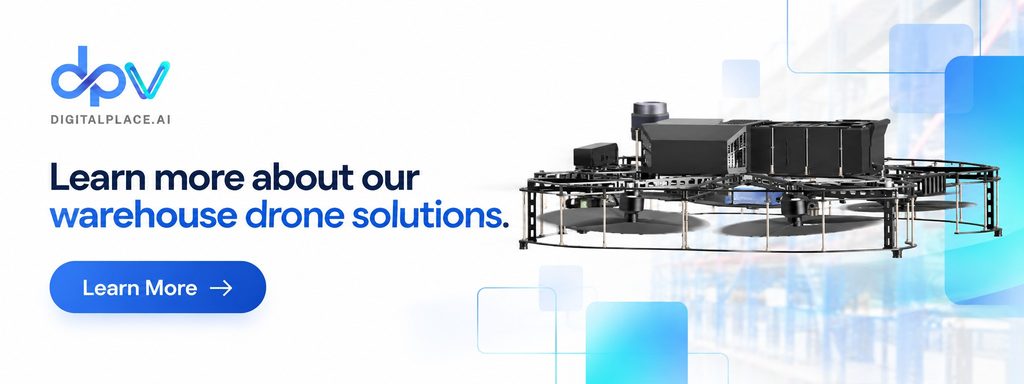
Its warehouse inventory drone solution is designed to support scheduled autonomous scanning of pallet locations, allowing warehouse teams to conduct recurring checks without relying entirely on manual rack inspections.
From a workplace safety perspective, the potential benefit comes from reducing the frequency of activities that require personnel or access equipment to reach elevated storage positions. Employees can remain responsible for reviewing scan results, investigating discrepancies, and performing necessary corrective actions, while selected data-capture activities are handled automatically.
This distinction is essential because drone scanning does not replace every physical warehouse task. Some discrepancies still require manual investigation, and certain inventory positions may remain inaccessible to automated scanning because of obstructions or unsuitable warehouse conditions.
Does Drone Automation Introduce New Warehouse Safety Risks?
Although warehouse drones can reduce exposure to selected manual inspection activities, they introduce hazards that must be evaluated independently.
A flying drone operates in an environment containing racks, palletised goods, forklifts, employees, and other equipment. Poorly planned operations could create collision risks, particularly where flight paths overlap with normal warehouse activities.
For this reason, safe deployment requires more than reliable navigation technology. Warehouse operators need appropriate operating procedures, defined scanning zones, and arrangements for handling unexpected conditions.
| Safety Consideration | Potential Benefit of Drone Scanning | Required Risk Control |
|---|---|---|
| Work at height | Reduces some elevated manual inspections | Prioritise remote verification where suitable |
| Forklift and pedestrian movement | Reduces some manual counting activity in aisles | Separate drone missions from occupied operating zones |
| Rack and pallet obstacles | Enables scanning without physical access platforms | Assess flight clearance and potential obstructions |
| Equipment malfunction | Automated missions reduce repetitive manual tasks | Establish emergency procedures and safe recovery methods |
| Inventory identification errors | Supports repeatable physical observations | Validate discrepancies before corrective action |
An important operating principle is that drones should not be scheduled to fly directly alongside warehouse personnel or active forklift movements without appropriate safeguards. Dedicated scanning periods, restricted access zones, and clear operating procedures can help prevent automation from creating unnecessary interactions with workers and equipment.
MOM’s broader workplace safety guidance supports this approach by emphasising hazard identification and the selection of controls based on the hierarchy of control.
A drone is a safety improvement only when the risks it removes outweigh the risks introduced by operating it.
Singapore’s Drone Regulations: What Warehouse Operators Should Know
Warehouse operators considering autonomous indoor drones should also understand the applicable requirements established by the Civil Aviation Authority of Singapore (CAAS).
According to CAAS guidance updated on 8 May 2026, unmanned aircraft weighing more than 250 grams must be registered, including those operated indoors. However, some pilot licensing and permit requirements differ between indoor and outdoor operations.
For example, ordinary commercial drone operations conducted indoors in areas that are not publicly accessible generally qualify for exemptions from certain pilot licensing and permit requirements. Specific activities, such as designated sporting events or events attended by more than 50 people, may be subject to different conditions.
Warehouse operators should therefore assess their intended deployment rather than assuming that indoor operations are either completely exempt or subject to the same requirements as outdoor commercial flights.
Official Reference: CAAS — Requirements for Flying Unmanned Aircraft
Regardless of aviation regulatory exemptions, workplace safety responsibilities still apply. Operating procedures, equipment suitability, risk assessments, and employee awareness remain important considerations for any warehouse automation project.
Evaluating Warehouse Drone Safety Before Deployment
For Singapore logistics companies and distribution centres, a practical evaluation should begin with a site assessment rather than immediately attempting full warehouse coverage.
High-bay rack geometry, aisle width, pallet positioning, label readability, and potential obstacles influence whether autonomous scanning is suitable for a particular facility. Warehouse operators should also consider when scanning missions can be conducted safely without interfering with normal receiving, picking, or forklift activities.
The AI-powered warehouse inventory drone offered by Digitalplace.ai is intended for structured pallet-storage environments where recurring scanning missions can verify inventory locations and identify discrepancies. Its use should be evaluated against the warehouse’s physical conditions and existing safety procedures.
A controlled pilot can help determine whether the technology can capture inventory information reliably while maintaining acceptable separation from workers and equipment.
The evaluation should include more than counting speed or the number of successfully scanned locations. Relevant measures include:
- Reduction in manual elevated-location inspections.
- Time workers spend performing potentially hazardous counting activities.
- Scanning reliability and verification coverage.
- Safety incidents, near misses, and operational interruptions.
- Labour requirements for investigating and resolving discrepancies.
These indicators help warehouse managers determine whether the technology improves both operational efficiency and safety performance, rather than assuming that faster inventory scanning necessarily creates a safer workplace.
For operators exploring this approach, the Digitalplace.ai Warehouse Inventory Drone solution provides further information about scheduled autonomous scanning and pallet-location verification.
Beyond Productivity: A Different Way to Evaluate Warehouse Automation
Warehouse drone projects are often assessed through operational metrics such as scanning speed, labour savings, and inventory accuracy. These remain important measures, but the Singapore government’s recognition of drones for inventory management highlights another dimension: reducing worker exposure to activities that may involve elevated access or difficult inspection conditions.
This creates an opportunity to evaluate warehouse automation through a combination of inventory performance and workplace safety outcomes.
A warehouse that reduces manual elevated inspections while maintaining reliable inventory verification may achieve benefits that extend beyond counting efficiency. Nevertheless, those benefits should be demonstrated through site-specific assessments, controlled operating procedures, and measurable results.
Digitalplace.ai’s warehouse inventory technology can form part of this approach by supporting recurring physical verification while allowing employees to concentrate on exception handling and other operational responsibilities.
Conclusion: Safer Inventory Verification Requires a Balanced Approach
Singapore’s Ministry of Manpower explicitly recognises drones for inventory counting in high-bay warehouses and inspections of difficult-to-access storage areas. This provides a relevant government reference for warehouse operators evaluating technologies that may reduce worker exposure to certain manual inspection activities.
However, drone automation does not remove the need for workplace risk management. Flight-path planning, worker separation, warehouse conditions, operating procedures, and equipment reliability must all be considered before deployment.
For Singapore’s logistics providers and distribution centres, the opportunity is to combine more efficient inventory verification with better management of workplace hazards.
The goal is not simply to count inventory faster. It is to verify warehouse stock accurately while reducing unnecessary exposure to risk.