
A picker arrives at the rack the system assigned, checks the location code, and stops.
The Warehouse Management System (WMS) says the pallet should be here. Physically, the slot is empty.
The search begins. The picker checks nearby locations and asks whether anyone moved the pallet. Someone else pulls up the movement history. Eventually the pallet may turn up two aisles away, or the slot may simply be empty because stock was moved without the record being updated.
The stock is not necessarily lost. What has broken is the match between the physical warehouse and what the inventory system believes.
That is why warehouse inventory discrepancy detection matters. Misplaced pallets, unexpected empty locations and unrecorded movements can stay hidden until they disrupt picking, replenishment or fulfilment.
For Singapore operators, the stakes are higher than most. Warehouses here run lean, with frontline roles such as warehouse assistants and forklift operators among the hardest to fill. Every hour spent hunting for a pallet is an hour a scarce team member is not picking, receiving or replenishing.
Digitalplace.ai supports warehouse operators as an AI-powered warehouse inventory drone partner.
Many inventory errors are really location errors
Warehouse inventory accuracy is usually discussed in terms of quantity: does the number in the system match the number on the floor?
But a warehouse can have the right total quantity and still have inaccurate inventory data.
Say the system records 20 pallets of a product, and all 20 are physically in the building. On quantity, inventory looks correct. But if three of those pallets sit in locations different from what the WMS shows, the team will still run into operational problems.
That problem is location accuracy.
A reliable inventory record needs to answer two questions at once:
- What inventory do we have?
- Where exactly is it?
When either answer is wrong, stock that does exist can behave, operationally, like stock that doesn’t.
In Singapore, location accuracy can also be a compliance matter. Operators running a Zero-GST warehouse must show good stock record-keeping and warehouse procedures to Singapore Customs, and support its audits and stock checks. For licensed warehouses holding dutiable goods, Singapore Customs’ Licensed Warehouse Handbook goes further: higher-tier licensees need a system that records the exact location of goods, down to the area code or shelf number, and must report stock discrepancies by the next working day. A record that says the wrong thing about where goods are is harder to defend when someone comes to check.
Read more
How Do Warehouse Inventory Drones Navigate Without GPS or New Wi-Fi Infrastructure?
The wrong rack can look like missing stock
A misplaced pallet doesn’t need to travel far to cause trouble.
Take Pallet 72941. The system says it should be in Rack B-04-03. During earlier activity, it was moved to Rack B-05-03. The physical move happened, but the transaction was never completed or recorded correctly in the WMS.
Then a picker is told to collect the pallet from B-04-03.
It isn’t there.
Several things can follow:
- the picker searches nearby racks,
- fulfilment is held while stock is checked,
- another team member reviews movement history,
- trust in the system record drops for a while,
- or the warehouse uses a different pallet, even though the original stock is still available.
The inventory isn’t actually lost.
What’s lost is the link between where the stock physically sits and where the system says it sits.
So discrepancy detection isn’t only about finding shortages. It also finds stock that exists but is in the wrong place.
Moved pallets can “disappear” between two cycle counts
A warehouse is a constantly changing environment.
Pallets are received, moved, replenished, picked, consolidated, staged and sometimes parked temporarily somewhere else. Most moves are recorded correctly. But even a small number of missed or incomplete transactions can slowly open a gap between the WMS and the floor.
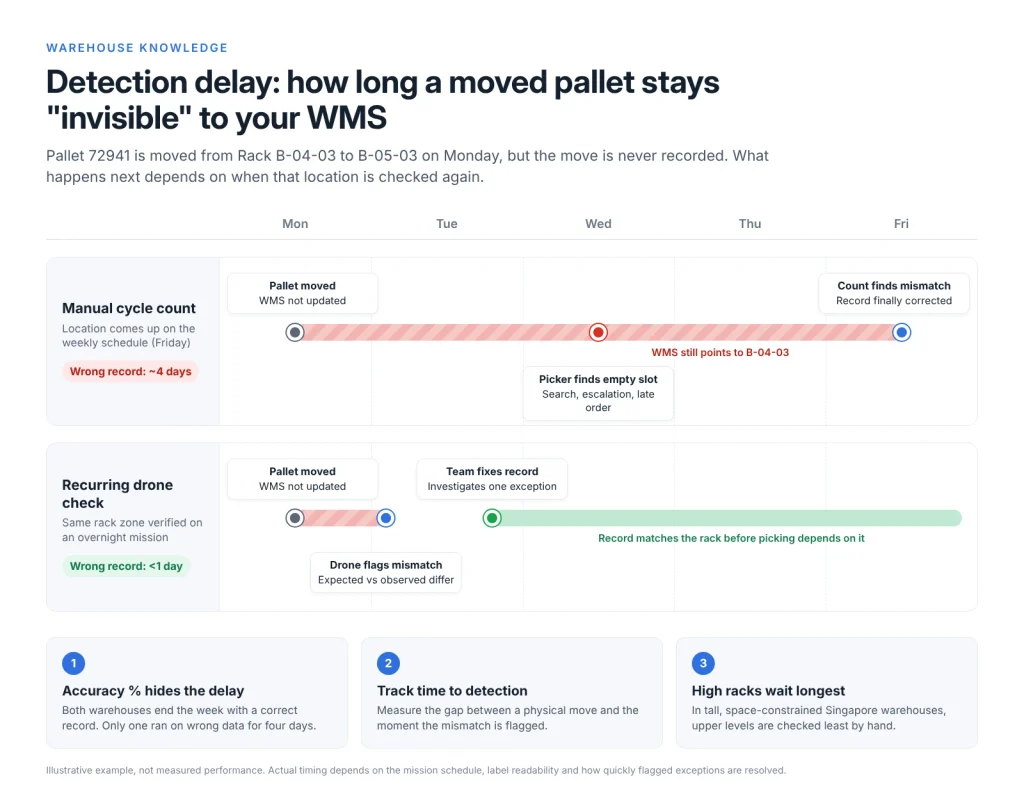
Manual cycle counting can catch these issues, but only when the affected location finally comes up on the counting schedule.
That creates a detection delay.
A pallet might be moved on Monday, while its rack location isn’t checked again until Friday. For four days, the warehouse runs on a wrong location record. The problem may surface earlier if a picker goes looking for that pallet, but then the discrepancy is found only because it has already caused an operational problem.
The delay tends to be longest exactly where checks are hardest. Because industrial land is scarce, Singapore operators often build upward, with multi-storey ramp-up facilities and tall racking. Upper-level locations need access equipment and an operator to check by hand, so they are often counted least.
Warehouse drones can change this pattern by making recurring location verification easier.
Instead of waiting for a location to come up in the next manual count, specific aisles or rack zones can be verified more often.
An unexpected empty location is also data
An empty rack position is not an absence of information.
If the WMS says a pallet should be in Rack C-08-04, but physical inspection shows the location is empty, the missing pallet is itself an exception.
That doesn’t necessarily mean the stock is gone. Possible causes include:
- the pallet was moved but the transaction wasn’t recorded,
- the pallet was picked but the confirmation wasn’t completed,
- the location assignment was wrong,
- the stock is actually in another rack,
- or the inventory really has left the warehouse.
What matters is that an unexpected empty location gives the team a reason to investigate.
The reverse can happen too. A location the system shows as empty may actually hold a pallet. That can point to an unrecorded put-away, temporary storage that was never updated, or a movement transaction that didn’t complete properly.
In both cases, physical observation reveals a mismatch.
Expected location vs observed location
One of the most practical ways to understand discrepancy detection is to compare two things:
- Expected location: where the WMS says the inventory should be.
- Observed location: where the inventory is actually found during a physical check.
| Expected (WMS) | Observed (physical) | Exception type |
|---|---|---|
| Pallet 47281 → Rack D-06-02 | Pallet 47281 → Rack D-07-02 | Location mismatch |
| Pallet 58302 → Rack F-03-05 | Empty location | Expected inventory not found |
| Rack G-02-03 → Empty | Pallet 66519 | Unexpected inventory |
A warehouse inventory drone supports this process by reading identifiers at each rack location and linking every physical observation to the location where it was found.
The value isn’t the scan alone.
It lies in the combination of identity + physical location + expected system record.
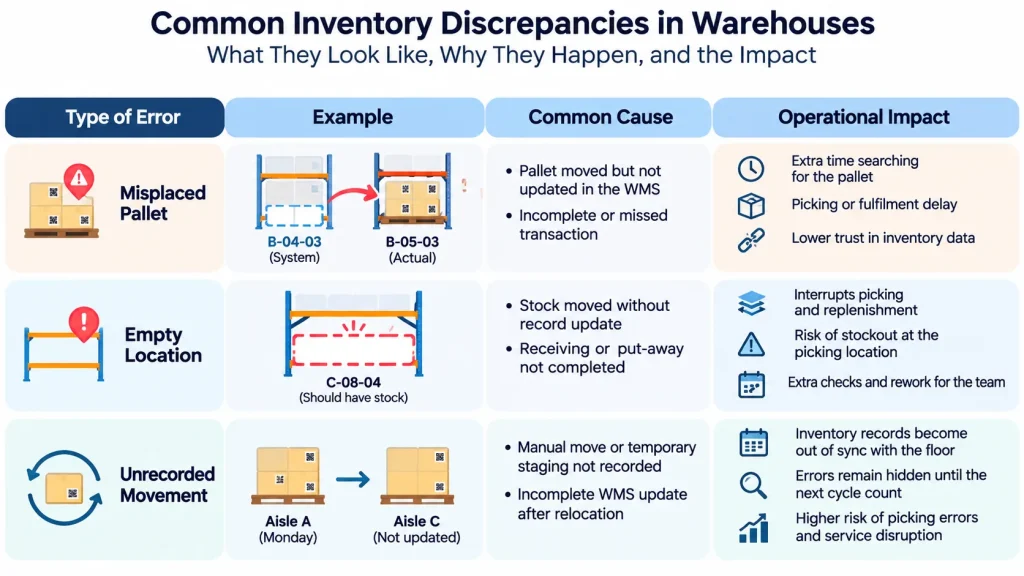
Warehouse inventory discrepancies generally fall into three common categories: misplaced pallets, unexpected empty locations, and unrecorded inventory movements. Although these errors may appear minor individually, their operational consequences can extend beyond inventory accuracy. A misplaced pallet can increase search time and delay order fulfilment, while an unexpected empty rack location may indicate an incomplete transaction, an unrecorded movement, or inventory stored elsewhere. Similarly, pallet movements that are not properly updated in the Warehouse Management System (WMS) can create discrepancies between physical inventory and digital records. For warehouse operators in Singapore, where labour availability and operational efficiency are critical, identifying these discrepancies before they disrupt picking or replenishment is particularly important. Automated warehouse inventory drones can support this process by regularly verifying pallet identities and storage locations, helping inventory-control teams detect exceptions earlier and focus their investigations where they are needed most.
Why warehouse drones are useful for detecting discrepancies
A warehouse drone can follow a predefined route and repeatedly inspect selected rack zones.
During a mission, its onboard camera or scanning system captures the QR codes or barcodes linked to pallets and storage locations. Those observations are then compared against the expected inventory record.
This helps surface:
- pallets in the wrong rack,
- expected inventory missing from its recorded location,
- inventory appearing in locations the system shows as empty,
- discrepancies in high-bay locations that are harder to check manually,
- and recurring location mismatches in particular areas of the warehouse.
The value grows when missions run regularly.
A single scan gives you a snapshot.
Recurring scans create a verification process.
Changes between inspections become visible sooner, without waiting for an operational problem to expose them.
Picking problems are often the first visible symptom
An inventory discrepancy can stay hidden until another process actually depends on that data.
Picking is the clearest example. When a picker is sent to the wrong location, the warehouse can face:
- extra walking or forklift travel,
- search time,
- delayed order completion,
- escalation to inventory-control staff,
- substitution with another pallet,
- or temporary uncertainty about whether the item is available at all.
Many Singapore warehouses serve as regional distribution hubs, consolidating stock for outbound air and sea shipments across Asia Pacific. Here, a pallet that can’t be found doesn’t just delay one order. It can mean missing a flight or vessel cut-off and a costly re-booking.
Warehouse knowledge
When a location error becomes a picking problem
A misplaced pallet can stay invisible in the inventory record until a picker depends on that location to complete an order.
WMS expected location
Rack B-04-03
The system sends the picker here.
VS
Physical condition
Pallet not found
It may have been moved, picked, or stored elsewhere.
One location mismatch can trigger a chain of extra work
- Picker arrives. The picker follows the WMS instruction to the recorded rack.
- Stock not found. The expected pallet isn’t physically there.
- Search and escalation. The team checks nearby racks and movement history, or calls in inventory control.
- Fulfilment impact. The order is delayed, even though the stock is still in the building.
The impact goes well beyond one mismatched scan
Extra travel
More walking or forklift movement to search nearby locations.
Search time
Staff hunt for stock instead of finishing planned work.
Late orders
Picking and fulfilment wait while the discrepancy is checked.
Escalation
Inventory control may need to review transactions and physical locations.
Pallet substitution
Another pallet is used, though the original stock is still available.
Availability doubt
The team is briefly unsure whether the stock exists at all.
Why early detection matters
The best time to find a location discrepancy is before a picker depends on that location. Earlier physical verification turns misplaced inventory into an exception to investigate, not a fulfilment problem to recover from.
The discrepancy may look small.
But its operational impact can spread across many workflows.
That is why location accuracy is not just an inventory-control issue. Accurate location data supports picking, replenishment, allocation, staging and fulfilment.
One wrong rack assignment can create far more work than the original error.
Drone verification changes the investigation workflow
Automation doesn’t remove the need for people to investigate inventory discrepancies.
What changes is which locations need human attention.
In a manual model, warehouse staff spend a lot of time collecting routine observations across many locations, including the ones that are already correct.
With a drone-supported workflow, the process becomes more exception-driven:
Scan rack locations→Compare with system records→Flag mismatches→Investigate exceptions
If the expected pallet is found in the expected location, there may be no reason to check it again by hand.
If the physical observation differs from the system record, that’s when the team steps in.
The root cause might lie in receiving, put-away, internal movement, picking confirmation, damaged labels or an incorrect system transaction. The drone doesn’t determine all of that. Its role is to narrow down where the physical warehouse differs from the digital record.
In a market where skilled warehouse staff are hard to hire, that shift matters. People spend their time resolving real exceptions, not walking aisles to confirm locations that were already right.
As an AI-powered warehouse inventory drone technology partner, Digitalplace.ai helps automate recurring verification of pallet locations, moved inventory, empty slots and hard-to-reach racks, while keeping the results connected to the inventory-control workflow the warehouse already uses.
Deploying warehouse drones in Singapore
- Aviation rules: CAAS sets separate requirements for indoor flights. For business use indoors, permits apply mainly to organised sporting activities and events attended by more than 50 people, so routine warehouse missions generally fall outside them. Safety on the warehouse floor still needs to be covered by the site’s own risk assessment.
- Personal data: if cameras may capture identifiable staff, PDPA obligations apply. The PDPC’s Advisory Guidelines on the PDPA for Selected Topics include a dedicated chapter on drones.
- Funding: Enterprise Singapore’s EDGE Grant, which replaced the EDG and PSG from 30 September 2026, covers automation and digitalisation projects, with support of up to 70% for SMEs. Support levels vary by activity, so check eligibility directly with the agency.
General guidance, not legal advice. Confirm current requirements with the relevant agency.
Detection speed matters as much as inventory accuracy
Two warehouses can report almost the same inventory accuracy percentage and still perform very differently.
The first finds a misplaced pallet within hours.
The second finds the same problem a week later.
Both records eventually get corrected.
But the second warehouse spends far longer working from wrong information.
That is why inventory-control teams should track not just accuracy percentage, but also time to detection.
Metrics worth considering include:
- number of location mismatches found,
- unexpected empty locations,
- misplaced pallets identified,
- percentage of rack locations successfully verified,
- time between the physical movement and detection of the discrepancy,
- and time from detection to resolution.
Shortening detection delay can matter as much as improving the final inventory count.
From searching for stock to verifying the physical warehouse
Misplaced pallets and empty locations don’t mean a warehouse is badly run. They are a natural risk wherever thousands of physical movements must stay in sync with digital transactions.
The more important question is how quickly those mismatches are found.
Manual cycle counting still plays an important role. Recurring drone inspections add another layer of verification, especially for structured pallet racking, high-bay locations, and areas that are slow or costly to check by hand. In Singapore’s tall, space-constrained warehouses, that describes a large share of the racking.
The goal isn’t simply to count more often.
It’s to keep answering the question that matters most:
Does the physical warehouse still match what the inventory system says?
When that question becomes easier to verify, misplaced pallets and unexpected empty locations stop being problems found during picking. They become exceptions the team can investigate early.
Read also: The Hidden Costs of Manual Cycle Counting and How Warehouse Drones Can Help