
A warehouse does not need to stop operating for inventory records to become inaccurate. A pallet can be moved to another rack without the corresponding system update. A storage location that appears occupied in the warehouse management system may actually be empty. A product may be placed one level above or beside its expected location.
Individually, these discrepancies may appear small. Across thousands of pallet positions, however, they can gradually create a gap between the warehouse that exists physically and the warehouse represented in the system.
Traditional cycle counting is designed to close that gap. Warehouse teams regularly verify selected inventory locations, compare physical stock with system records, and investigate discrepancies. The challenge is that manual counting is repetitive, labor-intensive, and often difficult to perform frequently enough. High-bay locations can require additional equipment, while large facilities may need significant coordination simply to verify a portion of their inventory.
This is where drones for warehouse inventory are beginning to change the operating model. Instead of treating inventory verification as a periodic counting project, warehouses can increasingly turn it into a repeatable process.
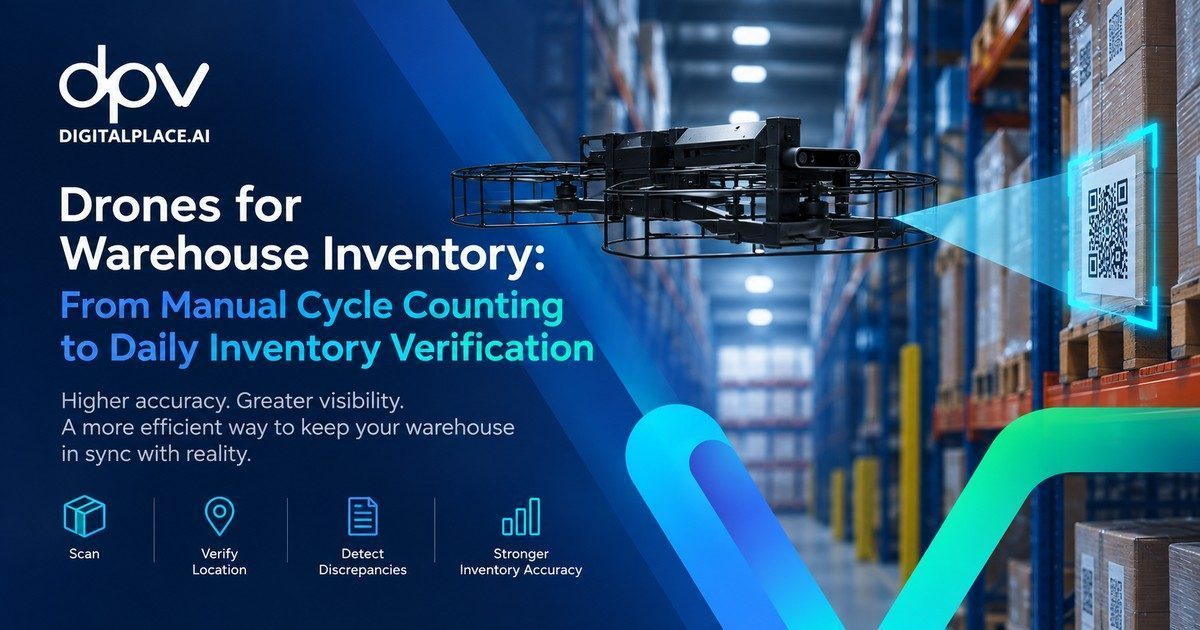
Digitalplace.ai has developed an AI-powered warehouse inventory drone solution designed around this recurring verification model. The drone can autonomously travel through configured warehouse aisles, scan QR codes, verify pallet locations, identify moved inventory, confirm empty locations, and support full-facility or selected-area scans. The system is intended to reduce the amount of repetitive physical counting performed by warehouse staff, particularly in environments with high racks and large numbers of pallet positions. Digitalplace currently recommends QR codes for deployments where the required label specifications can be followed, and under those conditions its warehouse inventory drone can achieve 100% inventory scanning accuracy. The resulting information can then be reviewed through the platform or connected with the warehouse management system, allowing physical inventory observations to become part of the wider warehouse data workflow.
Why Manual Cycle Counting Creates an Inventory Visibility Gap
Warehouse management systems are largely transaction-driven.
When inventory is received, put away, moved, picked, or shipped, the system records what should have happened. In an ideal environment, every physical movement is reflected immediately and correctly in the digital record.
Real warehouses are rarely perfect.
A forklift operator may temporarily place a pallet in another location. Inventory may be moved but not recorded correctly. A label may be associated with the wrong position. A location may remain marked as occupied even after the inventory has been removed.
The warehouse can continue operating even though the system and physical reality are beginning to diverge.
The problem may only become visible when someone needs the inventory.
A picker reaches a location and discovers that the pallet is missing. A replenishment task is created for stock that is not actually where the system expects it to be. An empty location is assumed to contain inventory. A warehouse employee spends time searching adjacent racks to find an item that has been moved.
Traditional cycle counting helps identify these problems, but its effectiveness depends heavily on how often the warehouse can perform the checks.
If an area is verified only occasionally, a discrepancy can remain unnoticed for days or weeks.


From Periodic Counting to Daily Inventory Verification
One of the most important changes introduced by autonomous warehouse scanning is not simply speed.
It is frequency.
Traditional inventory counting often requires people to travel through the warehouse, access individual locations, scan or record labels, and reconcile the results. Every additional counting cycle requires additional labor and operational coordination.
Automated scanning changes that relationship.
Once a warehouse has been mapped and a repeatable drone mission has been configured, the same scanning route can be executed again without rebuilding the entire counting process.
This makes a different inventory strategy possible.
Instead of asking:
“When are we doing the next cycle count?”
warehouse teams can begin asking:
“Which areas should be verified today?”
Fast-moving locations might be scanned more frequently. High-value stock could receive additional checks. Locations with repeated discrepancies might be included in a daily mission. A larger full-facility scan could be combined with shorter area-specific missions.
The objective is not necessarily to count every location continuously.
It is to shorten the time between a physical inventory error occurring and the warehouse discovering it.
How Drones for Warehouse Inventory Work
A warehouse inventory drone is more than a flying camera.
A reliable system combines several processes:
- autonomous indoor navigation;
- image and label capture;
- QR or barcode recognition;
- inventory identification;
- physical location verification;
- discrepancy detection;
- and integration with warehouse data.
Each component matters.
Autonomous Navigation Without GPS
Warehouse environments present a fundamental navigation challenge: they are indoors.
Satellite-based positioning systems such as GPS cannot normally provide reliable positioning between warehouse racks. An autonomous drone therefore needs another way to understand where it is and how it should move.
Recent academic research into autonomous warehouse inventory systems has demonstrated the use of technologies such as LiDAR, inertial sensors, ultrasonic sensing, and computer vision to help drones estimate their position relative to warehouse shelving and aisle geometry.
The drone can use these systems to maintain its position inside an aisle, avoid obstacles, and follow a predefined flight path.
In practical warehouse deployments, this means navigation is not based on a drone randomly exploring the building.
The facility is first measured and configured. The scanning mission then follows predetermined areas and routes.
A QR Code Is More Than Something the Drone Has to See
There are two separate stages when an inventory drone scans a label.
The first is detecting the label.
The system must recognize that a barcode or QR code exists within the camera image.
The second is reading the information contained in that label.
Recent research into autonomous warehouse inventory drones has shown that computer-vision systems can achieve 100% barcode or QR detection under appropriate controlled conditions.
The important lesson for warehouse operators is not simply that the drone can see a label. Reliable inventory verification depends on the complete data-capture process, including image quality, label recognition, code readability, flight stability, and the relationship between the label and its physical rack position.
For warehouse operators, the practical lesson is straightforward:
label quality matters.
A drone cannot reliably verify inventory if the label is too small, damaged, poorly positioned, obstructed, or difficult to capture from the intended flight path.
Why Digitalplace Recommends QR Codes
One-dimensional barcodes can still be used for warehouse identification, but QR codes can provide a practical advantage for drone-based scanning when the warehouse follows consistent label specifications.
Digitalplace currently recommends QR codes as the preferred format for reliable warehouse inventory scanning.
The warehouse still needs to follow requirements relating to code size, visibility, placement, scanning distance, and rack configuration.
When those conditions are met, Digitalplace’s warehouse inventory drone can achieve 100% inventory scanning accuracy using QR codes.
This is important because warehouse drone accuracy should not be viewed as a property of the aircraft alone.
It results from the complete scanning environment:
Drone + Camera + Flight Path + QR Code + Rack Configuration + Software
Improving only one component does not necessarily improve the overall inventory verification process.
Identifying Inventory and Locating Inventory Are Different Problems
Another important concept in warehouse automation is the difference between identification and location.
A QR code can contain an inventory identifier. It can also contain additional information if the warehouse chooses to encode it.
But the label itself does not automatically know where the pallet is physically located.
Imagine a pallet originally assigned to:
Aisle 04 – Rack 07 – Level 03
Later, the pallet is moved to another rack.
The QR code remains associated with the same pallet.
The inventory system therefore needs another source of information to establish where that pallet has actually been observed.
For a drone inventory system, this is where navigation and rack mapping become important.
The process can be simplified as:
Inventory identification + observed rack position = verified inventory location
The drone identifies the pallet while also knowing which rack position it is scanning.
That makes it possible to compare:
Where the WMS expects the inventory to be
with
Where the inventory was actually observed.
This is much more useful than simply reading a product or pallet ID.
Detecting Moved Inventory and Empty Locations
Once identification and physical location are combined, several practical warehouse use cases become possible.
A drone can help verify whether an expected pallet is still in its assigned position.
It can identify that a pallet has been observed in another location.
It can confirm that a location expected to contain inventory is actually empty.
It can also perform repeated scans across the same warehouse area and compare observations from different missions.
These checks are particularly useful because many warehouse inventory problems are not necessarily quantity problems.
Sometimes the inventory exists.
It is simply in the wrong place.
For warehouse operations, location accuracy can be almost as important as quantity accuracy because picking and replenishment depend on employees or automated systems knowing exactly where inventory is located.
High-Bay Inventory Is a Natural Use Case
High-bay storage illustrates why drones can be valuable even before considering advanced analytics.
A pallet at ground level is relatively easy for a warehouse employee to verify.
A pallet many meters above the floor is different.
Employees may require lifting equipment simply to reach a label. The operation may require additional safety procedures and can interrupt normal warehouse activity.
Repeating that process across hundreds of high-bay locations turns a simple scanning task into a substantial operational activity.
A drone changes the relationship between the employee and the inventory.
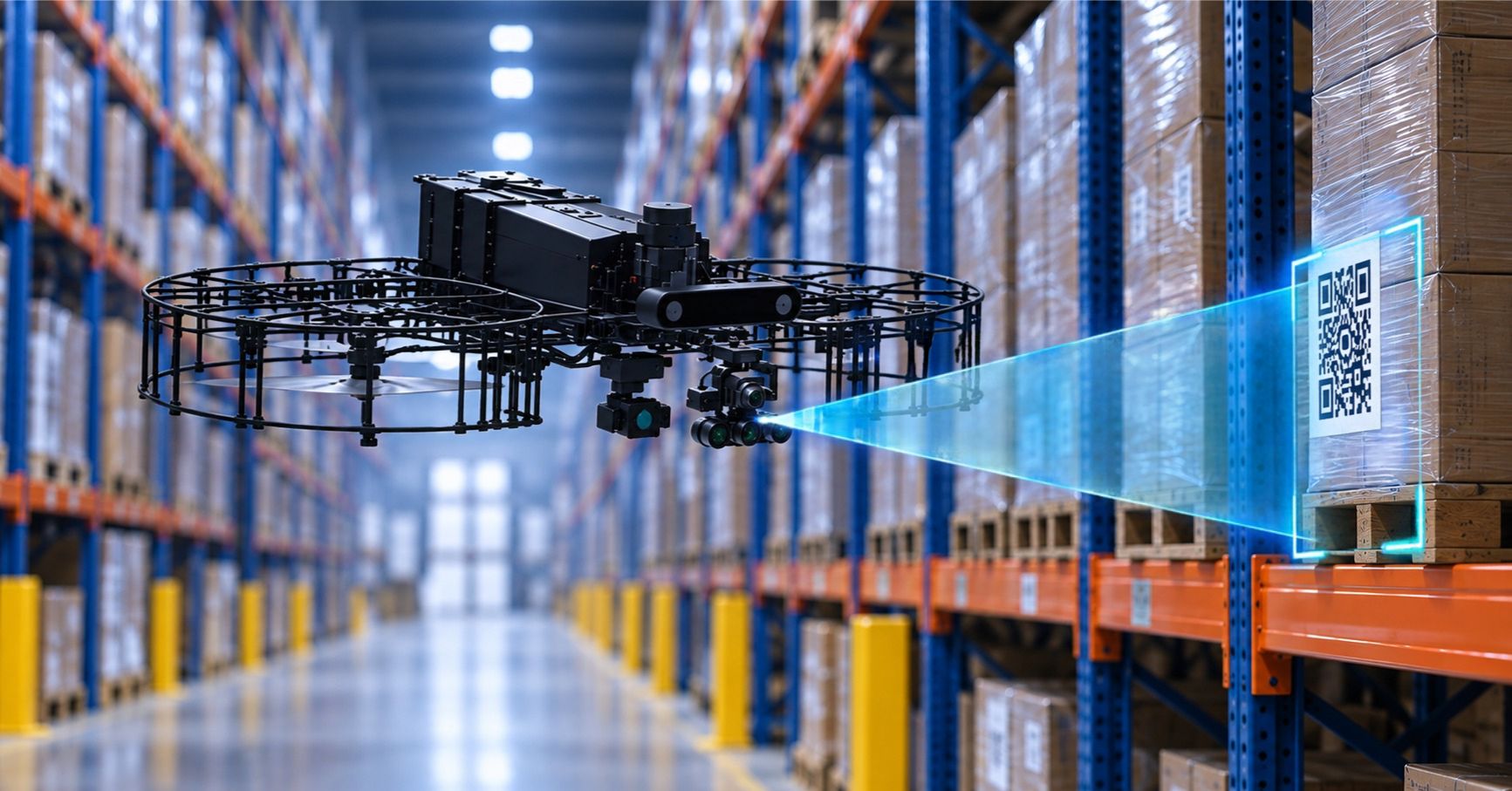
Instead of transporting a person to the barcode or QR code, the scanning device travels to the label.
This is one of the key use cases built into the Digitalplace.ai warehouse drone inventory solution. Digitalplace supports full-facility scans, selected-area cycle counts, moved-location verification, empty-location checks, and high-bay inventory scanning. The drone follows configured missions between warehouse racks while warehouse personnel remain responsible for mission setup, reviewing results, and handling exceptions that require investigation. For high-rack facilities, the benefit is particularly clear: routine inventory verification can be performed without repeatedly sending employees or lifting equipment to elevated rack positions simply to read labels. Digitalplace currently positions the solution for standard warehouse environments with structured rack geometry, suitable aisle clearance, and consistent QR-coded pallet locations, where repetitive inventory checks can be converted into a more automated and repeatable workflow.
Turning Drone Scans Into Warehouse Data
A drone can scan thousands of labels, but the operation has limited value if the results remain in a separate application.
The final step is connecting physical observations with warehouse systems.
A typical operational workflow starts with site measurement and mission configuration.
The drone then performs autonomous scanning within selected rack zones.
After the mission, the resulting inventory information can be reviewed, uploaded, or connected with the warehouse management system.
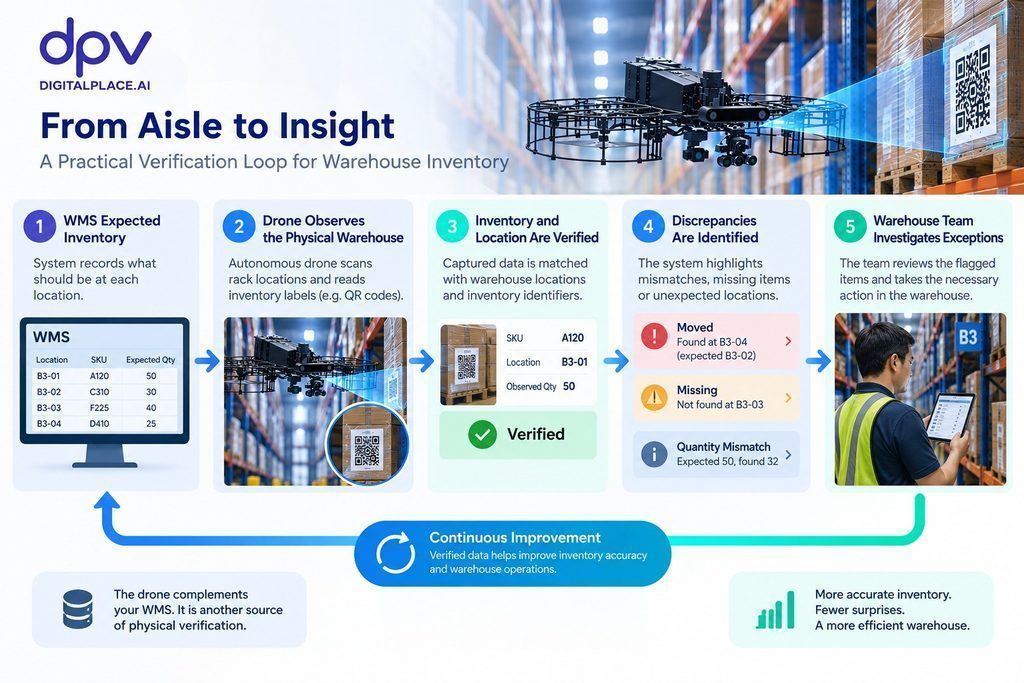
This creates a useful verification loop:
WMS Expected Inventory
↓
Drone Observes the Physical Warehouse
↓
Inventory and Location Are Verified
↓
Discrepancies Are Identified
↓
Warehouse Team Investigates Exceptions
The purpose is not necessarily to replace the WMS.
The drone becomes another source of physical verification for the information already stored there.
Why More Frequent Verification Changes Warehouse Operations
Consider a pallet that is moved incorrectly on Monday morning.
If its warehouse zone is physically counted once a month, the error could remain invisible for weeks.
The problem may only appear when the pallet is needed.
Now consider the same area being verified daily.
The movement can potentially be discovered much sooner.
The drone has not prevented the original mistake.
It has reduced the detection delay.
This is an important way to think about warehouse inventory automation.
Some technologies attempt to prevent operational errors.
Others make errors easier to discover.
Reducing the time between those two events can have significant operational value.
A discrepancy discovered during routine verification is usually easier to investigate than a discrepancy discovered while an urgent customer order is waiting to be fulfilled.
What Makes a Warehouse Suitable for Inventory Drones?
Not every warehouse should immediately deploy an inventory drone.
The facility itself needs to support reliable autonomous scanning.
Several factors should be evaluated before a pilot.
Aisle Width and Flight Clearance
The drone needs a clear flight corridor.
Rack faces, pipes, sprinklers, hanging materials, wrapping, or other obstacles should not extend into the intended flight region.
Digitalplace’s current deployment guideline uses approximately two meters of aisle width or more as a reference condition for suitable warehouse environments.
Rack Geometry
Consistent rack dimensions make repeatable scanning easier.
The drone needs to understand where inventory positions are located vertically and horizontally so that the mission can be configured consistently.
Structured rack geometry also makes it easier to associate a scanned QR code with the correct storage position.
Label Size and Placement
QR codes must be large enough and clearly visible from the drone’s intended scanning distance.
Consistency is important.
If one warehouse area uses large QR codes while another uses small, damaged, or irregularly positioned labels, scanning performance can vary.
Clean Flight Paths
Loose plastic wrap, straps, cables, or other materials hanging into an aisle can become obstacles.
A warehouse that is operationally organized for human movement is not automatically organized for autonomous flight.
Airflow
Strong airflow from industrial fans can affect small indoor drones.
Airflow therefore becomes part of the deployment assessment alongside rack dimensions, aisle geometry, and flight clearance.
Why a Pilot Should Start With One Clear Question
A warehouse drone pilot should not attempt to prove that “drones work.”
That question is too broad.
A better pilot begins with a measurable operational problem.
For example:
Can the drone accurately verify QR-coded pallets across one high-bay aisle?
Or:
Can the system identify moved and empty pallet locations during a daily scanning mission?
A pilot can then measure:
- percentage of locations successfully scanned;
- number of QR codes identified;
- number of empty locations confirmed;
- number of moved pallets detected;
- amount of manual intervention required;
- duration of the mission;
- and whether the resulting data can be reconciled with WMS records.
This produces information that warehouse managers can use to decide whether deployment should expand.
Starting small also helps identify warehouse-specific issues involving labels, rack structures, flight paths, or operational procedures before the solution is scaled across the facility.
The Business Case Is Bigger Than Counting Speed
Drone inventory automation is often explained using a simple comparison:
How long does a person take to count an aisle versus how long does a drone take?
That comparison is useful, but incomplete.
The broader business case includes:
employee time;
use of forklifts or lifting equipment;
operational interruptions;
safety considerations;
frequency of inventory verification;
time spent searching for misplaced stock;
time spent reconciling inventory discrepancies;
and the downstream consequences of inaccurate inventory records.
A warehouse might therefore obtain value even if a drone does not eliminate manual inventory work entirely.
The more important question can be whether the warehouse is able to perform physical verification much more frequently with less operational effort.
That changes the economics of cycle counting.
Instead of concentrating labor into occasional counting projects, the warehouse can move toward more frequent verification and exception-based investigation.
From Stocktake Projects to an Inventory Verification Layer
Warehouse inventory management has traditionally treated physical counting as an event.
Employees are assigned.
Equipment is prepared.
Locations are counted.
Discrepancies are investigated.
Operations then return to normal until the next counting cycle.
Autonomous inventory scanning creates the possibility of a different model.
Inventory verification can become a recurring layer of warehouse operations.
The drone performs the repeated observation.
Warehouse systems store the expected inventory position.
Software compares physical observations with expected records.
People focus on the exceptions.
Digitalplace.ai’s warehouse inventory drone solution is designed around this transition from periodic manual counting to recurring physical verification. Using autonomous missions and QR-based inventory identification, the system can verify pallet locations, check empty slots, detect moved inventory, scan high-bay locations, and support broader facility scans. When Digitalplace’s QR code requirements and deployment conditions are met, the current solution is capable of achieving 100% inventory scanning accuracy. The objective is not simply to replace one manual cycle count with a faster technological version of the same process. It is to create a repeatable inventory verification capability that can operate more frequently and provide fresher physical inventory information to warehouse teams and their WMS. For organizations evaluating the technology, a structured pilot focused on one warehouse zone is usually the most practical place to begin.
The long-term shift is therefore bigger than the drone itself.
Drones for warehouse inventory can transform inventory counting from an occasional attempt to confirm warehouse accuracy into a recurring process for maintaining it.




