
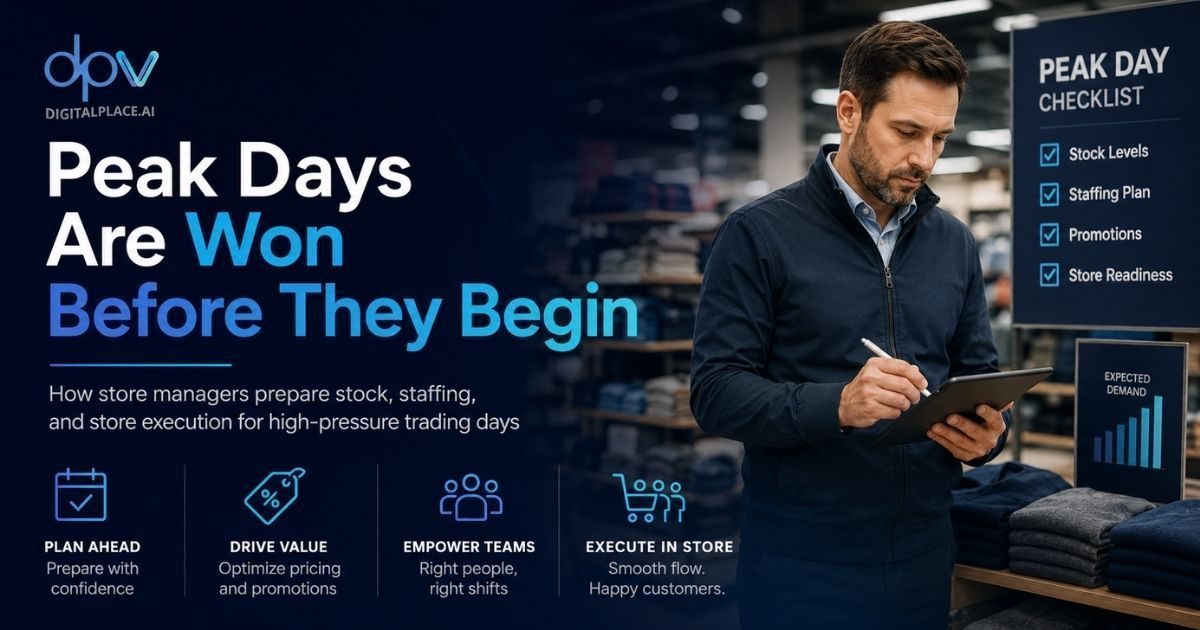
A peak day does not become successful because the store team “works harder” on the day itself.
It becomes successful because the right products are available, the team already knows the plan, the promotion is clear, the store layout is ready, and the manager has removed as many surprises as possible before the doors open.
This is the reality of retail operations: peak days expose preparation. They do not create it.
Whether it is Eid, Black Friday, Back to School, payday weekend, a seasonal campaign, a shopping festival, or a major local promotion, the busiest trading days of the year can either become your biggest revenue opportunity or your most stressful operational breakdown. The difference is usually not luck. It is preparation.
What Makes a Peak Day Different?
Peak days are the historically busiest trading periods for a store, category, week, month, or year. They are not ordinary busy days. They are moments when footfall increases, customer expectations rise, transactions happen faster, and small operational problems become much bigger.
A missing price tag on a normal day may slow down one customer.
A missing price tag on a peak day may create a queue.
A confused staff member on a normal day may ask a colleague for help.
A confused staff member on a peak day may delay service, lose a sale, or create frustration for several customers at once.
This is why a peak trading day is not the time to start preparing. It is the result of preparation done two to three weeks earlier.
The best store managers understand this. They do not wait until the week before the event. They start early, make the plan visible, brief the team repeatedly, and keep the operation simple enough to execute under pressure.
Three Weeks Before: Build the Commercial Plan
Three weeks before the peak day, the manager’s focus should be on commercial readiness.
This is the time to confirm the promotional range, pricing, hero products, and expected demand. Every major promotion should be reviewed with one simple question: which products could sell out in a single peak day?
Those items need urgent attention.
A store can survive many small problems during a peak day, but it cannot recover easily from running out of the exact products customers came to buy. When a promoted item sells out too early, the impact is not only lost sales. It can also damage customer trust, reduce basket size, and create unnecessary pressure on store staff.
At this stage, managers should raise replenishment requests early, align with area managers, and make sure the trading plan is clear. The goal is not just to have more stock. The goal is to have the right stock in the right place, with enough confidence that the team can focus on selling instead of firefighting.
This is also where technology can support better decisions. Retail teams using tools such as Digitalplace can better connect inventory visibility, sales patterns, and store execution, making it easier to identify which products need earlier action before the pressure of peak trading begins.
Two Weeks Before: Prepare the Team and the Roster
Two weeks before the peak day, the focus shifts from the commercial plan to people planning.
A strong peak-day roster is not just about putting more people on the floor. It is about putting the right people in the right roles at the right time.
Managers should confirm maximum floor staffing, reduce or reschedule back-office tasks, and ensure the strongest team members are available during the busiest trading windows. Tasks such as admin work, stockroom organization, reporting, and non-urgent meetings should be moved before or after the peak period wherever possible.
During peak hours, the floor matters most.
This is also the time to brief the full team on promotional offers, selling priorities, store targets, and expected customer flow. Every team member should know what is being promoted, where products are located, what the key targets are, and what to do if something goes wrong.
Knowledge gaps create hesitation. Hesitation creates delays. Delays create queues and missed sales.
A simple team briefing two weeks before the event can prevent many problems later. Staff should not be hearing the peak-day plan for the first time on the morning of the event. By then, it is already too late.
One Week Before: Reset the Store for Execution
One week before the peak day, preparation becomes more physical and practical.
The visual merchandising reset should be completed according to the peak-day planogram. Promotional displays should be checked. Product placement should be clear. High-demand items should be easy to find. Signage should already be printed, installed, and visible from the customer’s point of view.
This is also the time to test price programming, promotional mechanics, POS readiness, and any operational systems involved in the campaign. A pricing issue during peak hours can quickly become a major bottleneck. Customers expect promotional prices to be accurate, and staff should not need to debate or manually check every item at checkout.
The middle of the preparation process is also the right time to stress-test the plan.
Managers should walk the store as if they were customers. Can they understand the offer within a few seconds? Can they find the promoted items easily? Are the displays blocking movement? Is the checkout area ready for longer queues? Are impulse-buy items positioned well? Are replenishment routes clear for staff?
Peak-day readiness is not only about stock and staffing. It is also about flow.
A store may have enough products and enough people, but if customers cannot move comfortably, if staff cannot replenish quickly, or if promotional areas are confusing, the store will still lose efficiency.
Peak Day: Manage in Shorter Cycles
On the peak day itself, the manager’s role changes.
This is no longer the time for big planning. It is the time for sharp execution, fast decisions, and constant energy management.
The briefing should be longer and more detailed than usual. Every person should understand the target, the priority products, their assigned role, queue procedures, break schedule, and escalation process.
After opening, KPI checks should happen more frequently. Instead of checking every hour, managers should review performance every 45 minutes. This gives the team more chances to adjust while there is still time to act.
Important checks may include:
Sales versus target
Conversion rate
Average transaction value
Queue length
Stock availability on key items
Replenishment speed
Staff energy and coverage
Customer service issues
These checks do not need to become complicated. The point is to keep the store in control. A peak day can change quickly. What looked fine at 10 a.m. may become a problem by 11 a.m.
Shorter control cycles help managers spot issues early.
Assign a Queue Manager
One of the most important peak-day roles is the queue manager.
Long queues are not only a checkout problem. They are a customer experience problem. When queues look unmanaged, customers become impatient. Some may abandon baskets. Others may leave before buying.
A queue manager helps control the flow, guide customers, open additional tills when needed, answer simple questions, and keep the checkout area organized.
This role also reduces stress for cashiers. Instead of feeling alone in front of a growing line, the cashier knows someone is actively managing the situation.
For busy retail days, queue management should not be treated as an afterthought. It should be planned as a core role.
Keep the Team Energized
Peak days are not only operationally difficult. They are physically and emotionally demanding.
High footfall, nonstop service, customer questions, replenishment pressure, and long hours can drain the team quickly. A manager who only focuses on sales numbers may miss the real engine of the day: people.
The manager’s job is not only to hit the target. It is to carry the energy of the team for 10 to 12 hours, sometimes more.
This means checking in regularly.
“How are you doing?”
“Do you need water?”
“Take five minutes. I’ve got the floor.”
These small moments matter.
On the hardest days of the year, human consideration builds loyalty. Staff remember whether their manager supported them when the pressure was highest. A team that feels protected will usually give more effort, stay more focused, and recover faster from difficult moments.
Retail leadership is not just about directing tasks. It is about maintaining the emotional rhythm of the store.
Use Data, But Keep the Plan Human
Modern retail teams have more data than ever. Sales dashboards, stock reports, workforce schedules, inventory alerts, and store execution tools can all help managers prepare better.
But data only becomes useful when it is translated into action.
For example, if a dashboard shows that a certain category spikes before a holiday, the manager still needs to secure stock, brief the team, prepare displays, and assign responsibilities. If a system highlights high-risk out-of-stock items, the team still needs to replenish, monitor, and respond.
This is where practical AI retail tools can support the store team without replacing the manager’s judgment. Digitalplace, for example, focuses on helping retailers improve inventory planning, shelf execution, warehouse visibility, and daily operational decisions, which are especially important before high-pressure trading periods.
The best outcome is not a store that depends only on technology. It is a store where technology helps people act earlier, faster, and with more confidence.
After the Peak Day: Review While It Is Fresh
A strong peak-day process should not end when the store closes.
Managers should conduct a short review as soon as possible while the experience is still fresh. The goal is not to blame. The goal is to learn.
Useful review questions include:
Which products sold faster than expected?
Which items were overstocked?
Where did queues build up?
Which part of the promotion confused customers?
Did the roster match the actual traffic pattern?
Were break times realistic?
Which staff members performed strongly under pressure?
What should be changed before the next peak day?
The best managers turn every peak day into a playbook for the next one.
Over time, this creates a store that becomes more predictable, more disciplined, and more confident during high-pressure trading periods.
Conclusion: Peak Days Reward Preparation
Peak days are not won by panic, last-minute effort, or hope.
They are won by preparation.
Three weeks before, managers should secure the commercial plan and identify high-risk products. Two weeks before, they should prepare the roster, remove unnecessary tasks, and brief the team. One week before, they should reset the store, test pricing, install signage, and check the customer flow. On the day itself, they should manage in shorter cycles, assign clear roles, protect team energy, and keep the operation moving.
The busiest retail days will always be demanding. But they do not have to feel chaotic.
When managers prepare early, communicate clearly, and lead with both discipline and care, peak days can become more than just stressful trading events. They can become the moments when the store team performs at its best.