
A customer sees an empty shelf.
A store manager sees a stockout.
An inventory planner may need to look much further back.
The problem might have started weeks or even months earlier, when the retailer selected the assortment, decided how many units to purchase, allocated inventory across stores, or failed to respond quickly enough when demand began moving differently from the original forecast. What appears on the shelf today is often only the visible outcome of a much longer chain of decisions. A stockout can originate from underbuying, poor allocation, an inaccurate inventory count, a supplier delay, or a replenishment rule that reacted too slowly. Excess inventory can begin with an optimistic forecast, but it can also happen because the right amount of stock was sent to the wrong stores. Looking only at the final symptom therefore makes inventory problems appear simpler than they really are.
This is why retail inventory management should not be viewed merely as the task of maintaining enough stock. Inventory moves through a lifecycle, and every stage creates decisions that affect what happens next.
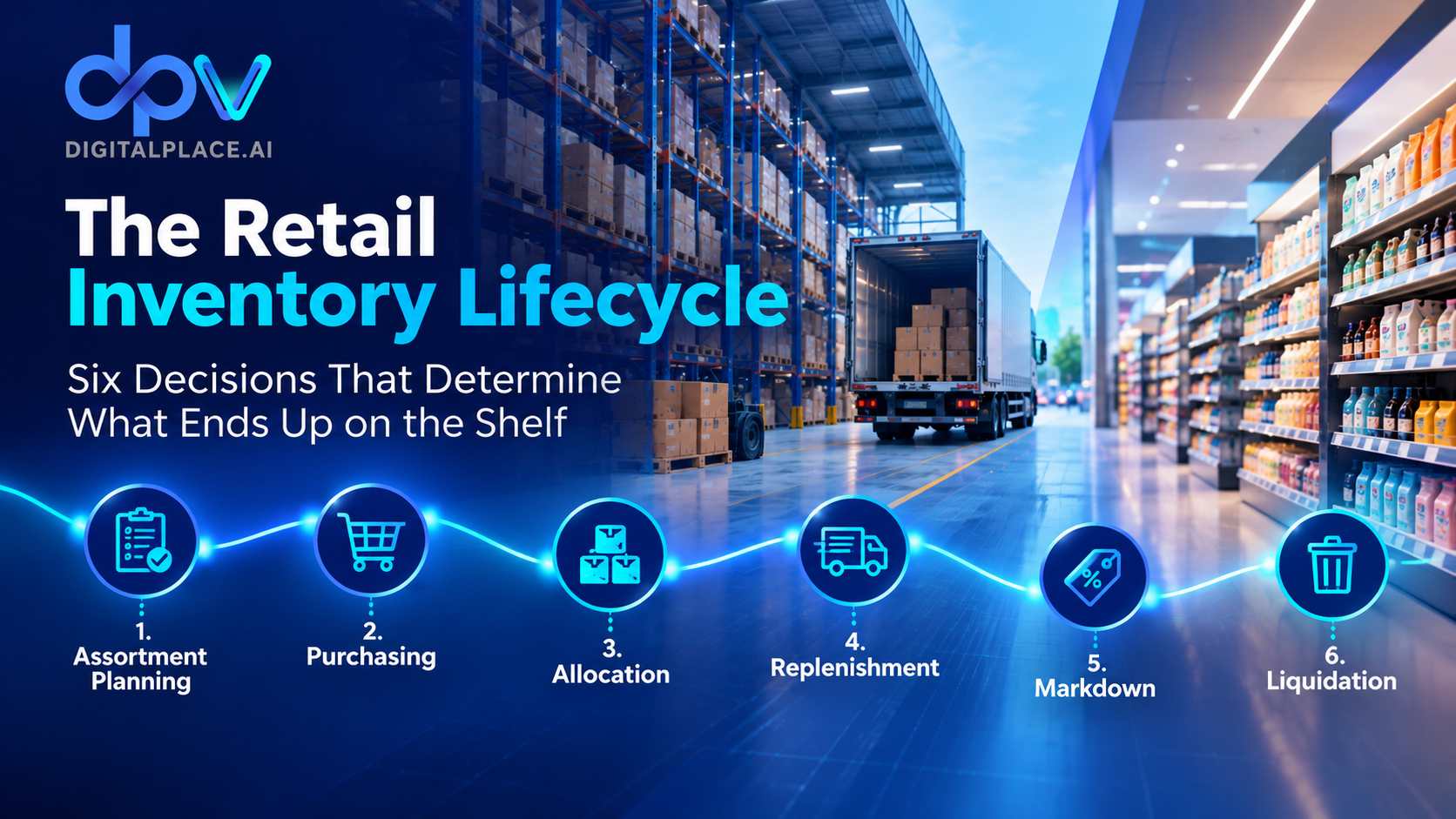
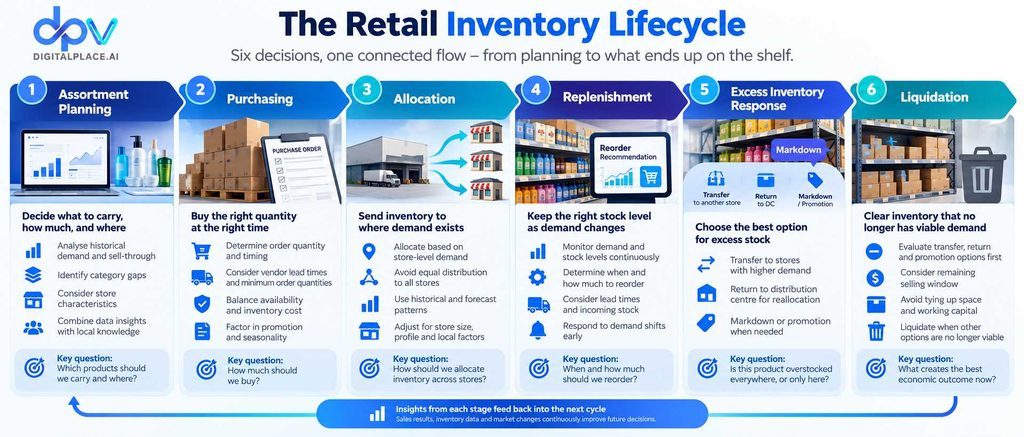
A useful way to understand that lifecycle is through six interconnected stages:
- Assortment planning
- Purchasing
- Allocation
- Replenishment
- Markdown
- Liquidation
Each stage answers a different question. But none operates in isolation. A poor decision early in the lifecycle may eventually surface as a stockout, excess inventory, unnecessary markdown, trapped working capital, or dead stock several weeks later.
Increasingly, retailers are using AI to improve these decisions. Digitalplace.ai works with retailers as an inventory optimization and auto replenishment partner.
1. Assortment Planning: Deciding What Deserves Shelf Space
Inventory management begins before any purchase order exists.
Assortment planning determines which products a retailer should carry, how much space or depth should be assigned to each product, and which stores should carry each SKU. These decisions become increasingly difficult as the network grows because demand rarely behaves uniformly across locations. A product that performs strongly in one neighbourhood may be slow-moving only a few kilometres away, while another item may have limited national sales but consistently high demand in a particular store cluster. If assortment decisions rely primarily on chain-wide averages, these local differences can disappear inside the aggregate.
AI can help planners identify patterns that would be difficult to monitor manually across thousands of SKU-location combinations. Historical sell-through, recurring forecast misses, product affinities, seasonal patterns, store-level overperformance, category gaps and differences in customer behaviour can all contribute to better assortment decisions.
Typical inputs may include:
- historical sell-through by SKU and location,
- recurring forecast errors,
- category and subcategory performance,
- seasonal demand differences,
- local store over- or under-indexing,
- product substitution patterns,
- promotional history.
But assortment planning cannot become entirely algorithmic. Historical data mainly describes what has already happened. A new competitor opening nearby, a major construction project, a change in store catchment, an upcoming local event, or a change in customer profile may not yet appear clearly in the data. This is where merchant experience, store knowledge and commercial judgment remain important. The strongest assortment process is therefore not AI replacing planners, but AI helping planners see patterns more clearly while humans contribute context that may not yet have left a measurable data trail.
2. Purchasing: Buying Enough Without Buying Too Much
Once the assortment has been determined, retailers need to decide how much inventory to purchase.
That sounds straightforward, but purchasing is one of the earliest points where an inventory imbalance can be created. Buying too little increases stockout risk and may lead to missed sales just when demand is strongest. Buying too much ties up working capital, consumes warehouse and store capacity, and creates pressure later in the lifecycle to move excess stock through redistribution, markdown, returns or liquidation. The purchasing decision must therefore balance service level and availability against the cost and risk of holding inventory.
Demand forecasts are an important input, but they are only one part of the decision. Vendor lead times, minimum order quantities, supplier reliability, case-pack sizes, purchasing cycles, safety stock requirements, promotional plans, season length and available warehouse capacity all affect how much should actually be ordered. Two products with identical expected demand may require different purchasing strategies if one can be replenished within two days while the other requires a six-week supplier lead time.
There is also a behavioural element that models cannot fully eliminate.
Retailers can over-order because teams are optimistic about a new product, a promotion or an upcoming season. They can also under-order because recent excess inventory has made the organization overly conservative.
Forecasting helps reduce these extremes, but a forecast should be treated as an input into the purchasing decision rather than the purchasing decision itself.
3. Allocation: The Right Inventory Can Still Be in the Wrong Store
Even when a retailer buys approximately the right quantity at total network level, inventory performance can still fail if stock is allocated poorly.
Imagine a retailer purchases 1,000 units of a product and distributes exactly 100 units to each of ten stores. On paper, the allocation appears balanced and fair. In reality, customer demand is unlikely to be equally distributed across all ten locations. Store A may sell through almost its entire allocation within a week while Store B still holds most of its units a month later. The business can therefore experience a stockout and excess inventory for the same SKU at exactly the same time.
This distinction is important because it changes the diagnosis. The retailer may not have an inventory quantity problem at network level. It may have an inventory location problem.
AI-based allocation can examine sales velocity, forecast demand, store-level inventory positions, local seasonality, historical over-index patterns and store characteristics to recommend differentiated allocation instead of sending the same quantity everywhere. A high-demand store may receive a larger initial allocation, while another location begins with less inventory and is replenished only when actual demand confirms the need.
Digitalplace.ai’s inventory optimization approach connects demand signals with store-level inventory positions, helping retailers make allocation and replenishment decisions based on where demand is actually occurring rather than assuming every location behaves the same way.
This is also why allocation should not be treated as a one-time decision. Initial allocation can be corrected later through replenishment or inventory rebalancing, but the sooner the mismatch is identified, the more options the retailer still has.
4. Replenishment: Turning Demand Signals Into Reorder Decisions
Allocation determines where the initial inventory goes. Replenishment determines what happens after customers start buying it.
This is where inventory management becomes continuous rather than periodic.
Every day, retailers need to evaluate whether the inventory available today will be sufficient to support expected demand until the next delivery arrives. They must consider current on-hand stock, expected sales, incoming purchase orders, supplier or DC lead times, safety stock, promotion effects and changes in demand velocity. A SKU that looked adequately stocked several days ago may suddenly become vulnerable to a stockout if demand accelerates, while another item may need its next replenishment reduced because actual sales are running below the original forecast.
The questions are operational:
- Which SKUs are approaching stockout?
- When should the next order be triggered?
- How much should be ordered?
- Has demand changed enough to revise the original plan?
- Is stock already incoming?
- Should inventory come from a supplier, DC, or another store?
Traditional replenishment systems frequently depend on fixed reorder points, days-of-stock rules or historical averages. These methods can work well when demand is stable, but they react less effectively when sales patterns shift rapidly or vary materially between locations. AI-assisted replenishment can continuously combine forecast demand, current stock, inventory already on order, lead times and store-level selling patterns to reassess the appropriate stock position.
The important shift is from predicting what customers may buy to determining what inventory action should happen next.
A demand forecast on its own does not prevent a stockout. It becomes operationally valuable only when the business can translate the forecast into an appropriate ordering, allocation or replenishment decision.
5. Excess Inventory: Markdown Is Only One Option
When stock accumulates faster than demand, the most visible response in retail is often a markdown.
Sometimes that is the right action.
But excess inventory should not automatically lead to discounting.
Suppose Store A has 80 units of a SKU that are moving slowly, while Store B is approaching a stockout for exactly the same product. Marking down Store A’s inventory may increase sell-through, but it sacrifices margin even though customers elsewhere in the network may still be willing to buy the product at full price. In that situation, the problem is not necessarily weak product demand. It may simply be that inventory was placed in the wrong location.
Retailers therefore have several possible responses.
Inter-store transfer. Inventory can be moved from a low-demand location to another store where demand is stronger.
Return to the distribution centre. Stock can be returned to the DC, consolidated with other inventory, and subsequently reallocated to locations where it is more likely to sell.
Markdown or promotion. Price can be adjusted when demand is genuinely weak across the network, the remaining selling window is shortening, or the economics of transfer no longer make sense.
These alternatives introduce a more useful decision sequence. Before asking, “How much should we discount this product?”, the retailer should ask, “Is this product actually overstocked across the network, or only in this particular location?”
That distinction can protect margin. It can also reduce unnecessary markdowns and improve product availability elsewhere.
Inventory optimization therefore extends beyond identifying slow-moving products. It also involves detecting inventory imbalances and deciding whether the best response is to hold, replenish, transfer, return, promote or eventually liquidate the stock.
6. Liquidation: Knowing When Inventory Has Reached the End of Its Useful Lifecycle
There is also an important difference between excess stock and genuine dead stock.
A product sitting too long in one store is not necessarily dead if the same SKU continues to sell in other locations. Before inventory is classified as dead, retailers should evaluate whether it can be transferred to another store, returned to the DC, reallocated, included in a targeted promotion, or otherwise repositioned. Only when those options become commercially unattractive does liquidation become the final stage of the inventory lifecycle.
At that point, holding the inventory creates its own economic burden. The product consumes shelf or warehouse space that could be used by faster-moving items. Cash remains tied up in merchandise that no longer produces sufficient return. Employees continue counting, moving and managing inventory that contributes little value. Old inventory can also distort future ordering decisions if systems continue treating it as usable stock even though it has limited commercial value.
One of the hardest problems at this stage is psychological rather than mathematical.
Businesses can become reluctant to clear inventory because significant money has already been spent acquiring it.
But the purchase cost has already been committed.
The more useful question is:
What decision creates the best economic outcome from this point forward?
Sometimes the answer may be a markdown. Sometimes it may be a vendor return or transfer. And sometimes liquidation is economically better than allowing unproductive inventory to continue occupying cash and space.
AI Works Best When the Inventory Data Is Trustworthy
There is another layer connecting all six stages: inventory accuracy.
An AI system can generate an excellent demand forecast and still recommend the wrong replenishment quantity if the inventory balance feeding the system is inaccurate. Suppose a system records 120 units available while only 78 units physically exist. From the algorithm’s perspective, inventory may appear sufficient for several more days. Operationally, however, the store may already be moving toward a stockout.
This is why better forecasting does not automatically create better inventory outcomes. The decision engine needs a reliable view of what inventory actually exists, where it is located, what is already committed, what stock is incoming and how demand is changing. In larger retail and distribution environments, discrepancies can accumulate through receiving errors, misplaced stock, shrinkage, delayed system updates, incorrect transfers or inconsistent counting processes.
The quality of an inventory decision therefore depends on more than the forecasting model.
A useful way to think about it is:
Demand data + inventory position + incoming stock + lead time + location-level behaviour = better inventory decisions
Improving the frequency and reliability of inventory verification—whether through stronger store processes, better systems, warehouse automation or technologies such as automated inventory scanning—can therefore improve the quality of downstream allocation and replenishment decisions as well.
The Inventory Lifecycle Is Really a Decision Lifecycle
The six stages may appear sequential, but in modern retail they increasingly behave like a feedback loop rather than a straight line. Sales results influence forecasts. Forecasts affect purchasing. Purchasing determines available inventory. Allocation decides where that inventory starts. Actual demand then triggers replenishment, transfers or rebalancing. Slower-than-expected sell-through may create the need for a return to the DC, an inter-store transfer, a promotion or eventually a markdown. Outcomes from these actions should then feed back into the next assortment, purchasing and allocation cycle.
This is why inventory optimization is broader than demand forecasting alone. Retailers do not simply need more accurate predictions. They need a system that can convert changing demand and inventory conditions into increasingly better operational decisions.
As an inventory optimization and auto replenishment partner, Digitalplace.ai helps retailers connect forecasting, inventory positioning and replenishment so that decisions are not made independently at each stage. The objective is not simply to hold less stock or eliminate every stockout, but to maintain sufficient availability while continuously identifying where inventory is becoming unbalanced, where replenishment is needed, and where existing stock can be repositioned before margin, working capital or customer availability is unnecessarily affected.
Ultimately, what customers see on the shelf is the result of dozens of earlier decisions.
A stockout may have started with an allocation mistake. Excess inventory may reflect a location mismatch rather than weak demand. Dead stock may trace back to an overly optimistic purchase made months earlier. And a replenishment problem may have little to do with forecasting if the inventory data itself was already wrong.
Retailers that understand inventory as an interconnected decision lifecycle can therefore ask a more useful question than simply, “How much stock do we have?”
They can ask:
“Is our inventory in the right place, in the right quantity, at the right time—and what should we do next?”




