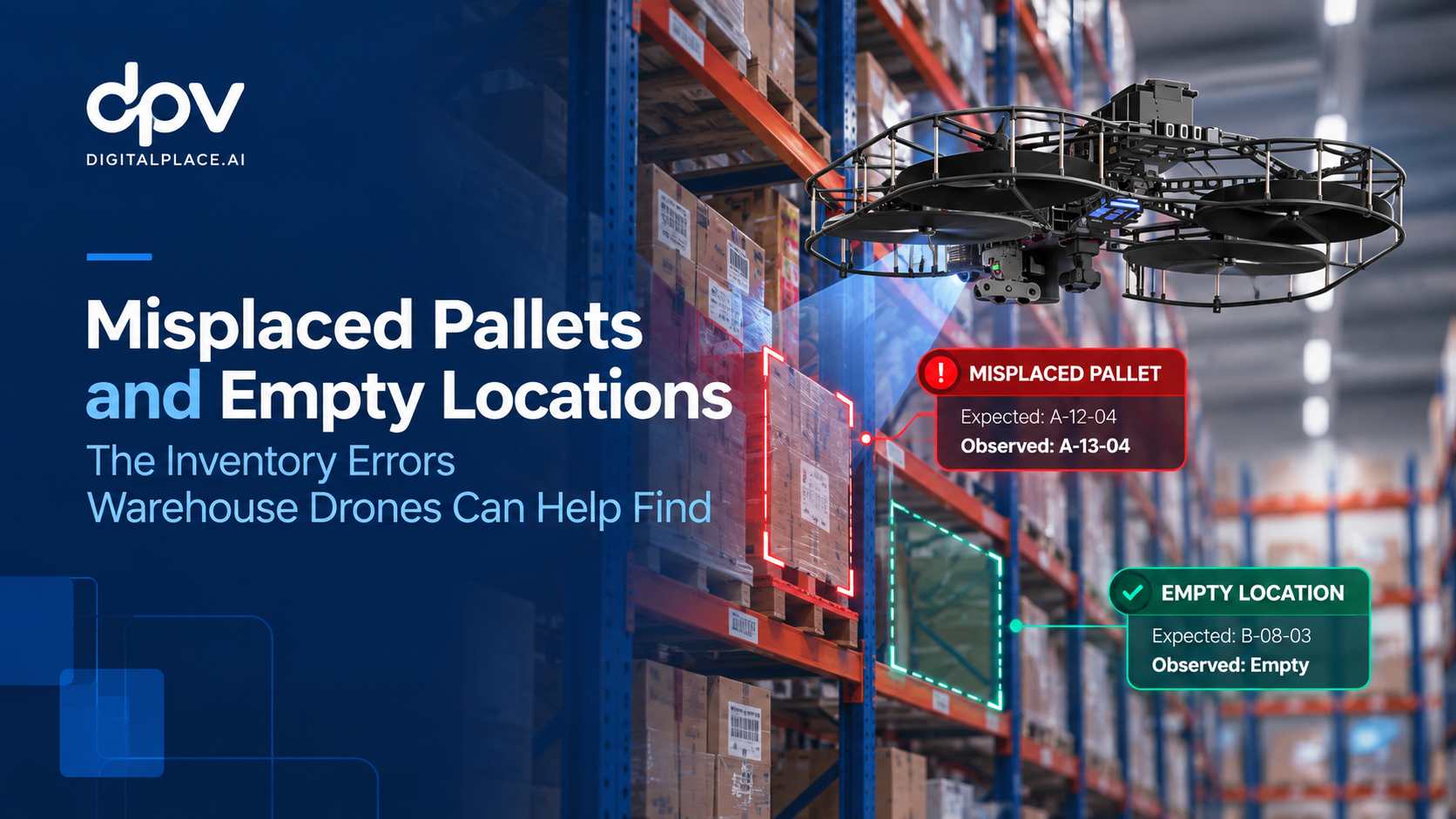
The picker reaches the rack, checks the location code, and stops.
The warehouse management system says the pallet should be there. The rack says otherwise.
Now the search begins. The picker checks the next location, asks another operator whether the pallet was moved, and waits while someone reviews transaction history. Eventually, the inventory may be found two aisles away—or it may turn out that the original location was emptied without the corresponding system record being updated.
The problem is not necessarily missing inventory. It is a gap between what the warehouse physically contains and what the inventory system believes is there.
This is where warehouse inventory discrepancy detection becomes especially important. Misplaced pallets, unexpected empty locations, and unrecorded inventory movements can remain invisible until they interfere with picking, replenishment, or fulfillment.
Digitalplace.ai supports warehouse operators as an AI-powered warehouse inventory drone partner.

Inventory Errors Are Often Location Errors
Warehouse inventory accuracy is frequently discussed in terms of quantity: does the system quantity match the physical quantity?
But a warehouse can have the correct total quantity and still have inaccurate inventory data.
Imagine that the system records 20 pallets of a product, and all 20 pallets physically exist somewhere inside the facility. On paper, inventory quantity is correct. But if three pallets are stored in locations different from those recorded in the Warehouse Management System (WMS), warehouse teams can still experience operational problems.
The issue becomes location accuracy.
A reliable warehouse record should answer two questions simultaneously:
What inventory exists?
and
Where is it physically located?
When one of those answers is wrong, inventory may technically exist while behaving operationally as though it were unavailable.
The Wrong Rack Can Create the Same Problem as Missing Stock
A misplaced pallet does not need to be far away to create disruption.
Suppose Pallet 72941 is expected at Rack B-04-03 but was moved to Rack B-05-03 during a previous warehouse activity. The move happened physically, but the corresponding transaction was never completed in the WMS.
Later, a picker receives an instruction to retrieve the pallet from B-04-03.
The picker finds nothing.
At that point, several things can happen:
- the picker searches nearby locations,
- fulfillment slows while inventory is investigated,
- another employee checks movement records,
- the system may temporarily appear less trustworthy,
- or an alternative pallet is selected even though the original stock is still physically available.
The inventory was never lost.
The location relationship between the physical warehouse and the digital record was lost.
That distinction is important because inventory discrepancy detection is not only about finding shortages. It is also about identifying stock that exists in the wrong place.
Moved Pallets Can Become Invisible Between Counts
Warehouses are dynamic environments.
Pallets are received, moved, replenished, picked, consolidated, staged, and sometimes temporarily repositioned. Most movements are recorded correctly. But even a small number of missed or incomplete transactions can gradually create differences between the WMS and physical reality.
Manual cycle counting can discover those problems, but only when the affected location is eventually checked.
That creates a detection-delay problem.
A pallet might move on Monday, while the relevant rack location is not cycle counted until Friday. For four days, the warehouse operates with an inaccurate location record. The discrepancy may be discovered sooner if someone tries to pick the pallet—but in that case, the error is being detected by an operational failure rather than by inventory control.
Warehouse drones can change that sequence by making recurring location verification easier to perform.
Instead of waiting for a location to appear in the next manual counting schedule, selected aisles or rack zones can be scanned more frequently.
Unexpected Empty Locations Are Data, Not Just Empty Space
An empty rack position can carry useful information.
If the WMS says a pallet should be stored at Rack C-08-04, but a physical inspection observes no pallet there, the absence itself becomes an exception.
That does not immediately prove inventory is missing.
Several explanations are possible:
- the pallet was moved but the transaction was not recorded,
- the pallet was picked but the confirmation process was incomplete,
- the location assignment is wrong,
- the stock is physically nearby but stored in another rack,
- or the inventory truly is no longer present.
The important point is that an unexpected empty location gives the warehouse a reason to investigate.
The reverse can happen as well.
A location expected to be empty may contain a pallet. That can indicate an unrecorded putaway, temporary storage that became permanent, or a movement transaction that was never completed correctly.
In both cases, physical observation exposes a mismatch.
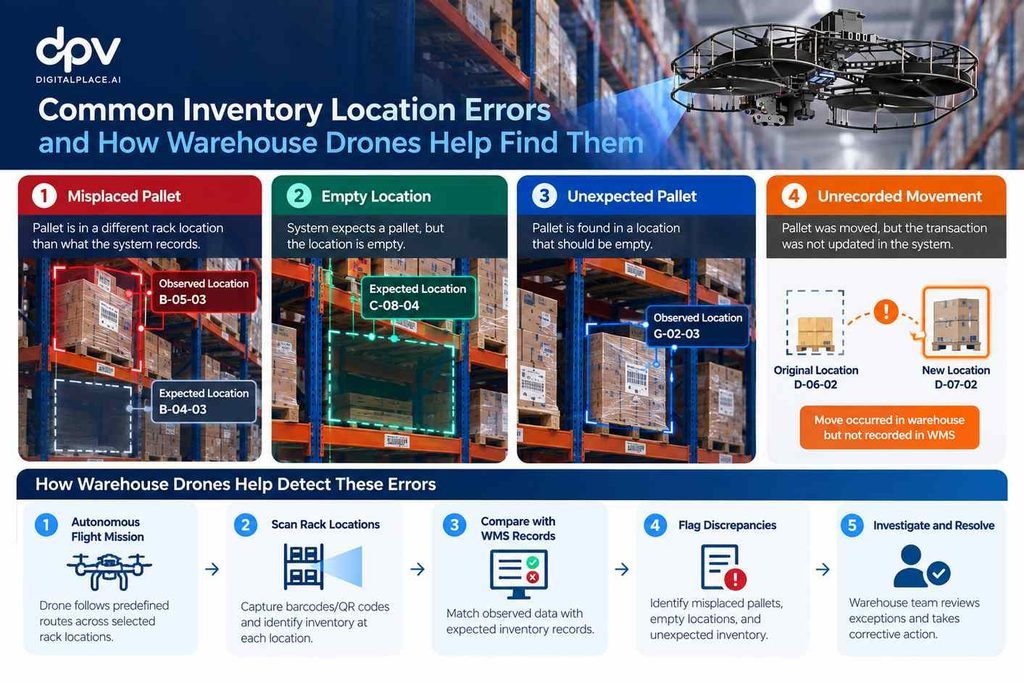
Expected Location vs Observed Location
One of the most useful ways to think about warehouse inventory discrepancy detection is through a simple comparison:
Expected location
What the WMS says should be there.
Observed location
What is actually seen during physical inspection.
For example:
Expected: Pallet 47281 → Rack D-06-02
Observed: Pallet 47281 → Rack D-07-02
This is a location mismatch.
Or:
Expected: Pallet 58302 → Rack F-03-05
Observed: Empty location
This is a missing-at-expected-location exception.
Or:
Expected: Rack G-02-03 → Empty
Observed: Pallet 66519
This is unexpected inventory.
A warehouse inventory drone can support this comparison by scanning identifiers at rack locations and linking each observation to the location where it was detected.
The real value is not the scan alone.
It is the combination of identity + physical location + expected system record.
Why Warehouse Drones Are Useful for Discrepancy Detection
Warehouse drones can follow predefined routes and repeatedly inspect selected rack zones.
During a mission, onboard cameras or scanning systems may capture QR codes or barcodes associated with pallets and storage locations. Those observations can then be matched to expected inventory records.
This can help identify patterns such as:
- pallets located in the wrong rack,
- expected stock not detected at its recorded position,
- unexpected stock in supposedly empty locations,
- high-bay locations that are difficult to inspect manually,
- and repeated location mismatches within specific warehouse zones.
The benefit becomes greater when missions can be repeated.
One scan provides a snapshot.
Recurring scans create a verification process.
That makes it easier to detect changes between one inspection and the next rather than waiting until an operational problem forces someone to investigate.
Picking Problems Are Often the First Visible Symptom
Warehouse inventory discrepancies can remain hidden until another process depends on the data.
Picking is one of the most obvious examples.
If a picker is sent to the wrong location, the warehouse may experience:
- additional walking or forklift travel,
- search time,
- delayed order completion,
- escalation to inventory-control staff,
- substitution with another pallet,
- or temporary uncertainty about whether the item is actually available.

When a Location Error Becomes a Picking Problem
A misplaced pallet can remain invisible in the inventory record until a picker depends on that location to complete an order.
The system sends the picker to this location.
The pallet may have moved, been picked, or be stored elsewhere.
One location mismatch can create several downstream actions
The hidden cost is more than the missing scan
The best time to discover a location discrepancy is before a picker depends on that location. Earlier physical verification turns misplaced inventory into an exception to investigate instead of a fulfillment problem to recover from.
The discrepancy itself may be small.
The operational impact can spread across multiple workflows.
This is why location accuracy matters beyond the inventory-control department. Accurate location records support picking, replenishment, allocation, staging, and fulfillment.
A wrong rack assignment can therefore create much more work than the original error suggests.
Drone Verification Changes the Investigation Workflow
Automation does not remove the need for people to investigate inventory discrepancies.
It changes which locations deserve their attention.
In a manual model, warehouse staff spend significant time collecting routine observations from many locations, including those that are already correct.
A drone-supported workflow can be more exception-oriented:
Scan rack locations → compare observations with system records → flag mismatches → investigate exceptions
If the expected pallet is found in the expected location, there may be little reason for someone to manually revisit it.
If the observation does not match the record, the warehouse team can investigate.
The root cause may involve receiving, putaway, internal movement, picking confirmation, damaged labels, or incorrect system transactions. The drone does not determine every cause; it helps narrow down where physical reality and digital records disagree.
As an AI-powered warehouse inventory drone technology partner, Digitalplace.ai can help automate recurring checks of pallet locations, moved inventory, empty slots, and hard-to-reach racks while keeping the resulting observations connected to existing inventory-control workflows.
Detection Speed Matters as Much as Accuracy
Two warehouses can report similar inventory accuracy percentages and still have very different operational performance.
One may detect a misplaced pallet within hours.
Another may discover the same problem one week later.
Eventually, both systems may be corrected.
But the second warehouse spent much longer operating with inaccurate information.
That is why inventory-control teams should consider not only accuracy percentages but also time to detection.
Useful measures can include:
- number of location mismatches detected,
- unexpected empty locations,
- misplaced pallets identified,
- percentage of selected rack locations successfully verified,
- time between physical movement and discrepancy detection,
- and time from detection to resolution.
Reducing detection delay can be just as valuable as improving the final inventory count.
From Finding Inventory to Verifying Reality
Misplaced pallets and empty locations are not unusual because warehouses are badly managed. They are a natural risk in environments where thousands of physical movements must remain synchronized with digital transactions.
The challenge is how quickly those mismatches can be found.
Manual cycle counting remains valuable, but recurring drone inspection can add another verification layer—especially across structured pallet racks, high-bay locations, and zones where repetitive checking is operationally expensive.
The goal is not simply to count more often.
It is to keep asking a more useful question:
Does the warehouse physically look the way the inventory system says it should?
When that answer becomes easier to verify, misplaced pallets and unexpected empty locations can become exceptions identified early rather than problems discovered during picking.




