A picker reaches the rack location the Warehouse Management System (WMS) has assigned. The pallet should be there, but the slot is empty. A colleague is sent to check the next aisle, a supervisor starts tracing the movement history, and the order sits on hold until someone finds the stock.
The pallet is probably still somewhere in the building. But the time and labour meant for fulfilling orders has already gone into looking for it. That search rarely shows up as an inventory-management cost, yet it chips away at productivity across the whole operation.
Search time usually disappears into general warehouse labour. Supervisor hours spent investigating are treated as part of the job, and late orders show up only as weaker fulfilment numbers. Each incident looks small on its own. Repeated week after week, they add up to a real operating burden.
In Singapore, that burden is heavier than in most markets. Logistics operators face a persistent shortage of frontline staff, from warehouse assistants to forklift operators, and night and weekend shifts are getting harder to fill. Space is expensive too: JTC’s warehouse rents rose another 1.0% quarter-on-quarter in Q3 2026, extending a run of industrial rental growth that has lasted 24 straight quarters. When every labour hour and every square foot costs more, wasted effort inside the warehouse costs more as well.
Manual cycle counting exists to catch gaps between physical stock and system records. The challenge is that every check needs people, equipment to reach upper rack levels, and coordination with everything else happening on the floor. Those constraints make it hard to count as often as the operation really needs.
For warehouse managers, supply chain directors and finance teams, the real question is not how fast inventory can be counted. It is how much it costs to keep inventory data accurate, and how much the business loses when that data no longer matches what is on the racks.
The hidden costs behind manual cycle counting
The easiest cost to calculate is headcount multiplied by counting hours. But the true cost of manual cycle counting goes well beyond scanning labels.
Staff walk between locations, get access to high racks, coordinate with equipment operators, and chase down anything that doesn’t match the system. Meanwhile, the warehouse still has to receive goods, replenish pick faces and ship orders.
To understand the financial impact, it helps to split these costs into two buckets:
- The cost of verifying inventory: labour, equipment use, travel time between locations, and disruption to other warehouse work.
- The cost of unresolved discrepancies: searching for pallets, extra handling, delayed shipments, and investigations that pull in several teams.
Manual counting doesn’t cause inventory errors. But when each check takes a lot of resources, checks happen less often. Location and recording errors then survive longer before anyone notices.
Digitalplace.ai helps warehouse operators automate repetitive checks of pallets and storage locations using warehouse inventory drones. The drones help surface discrepancies earlier, while investigation and corrective action stay with the warehouse team.
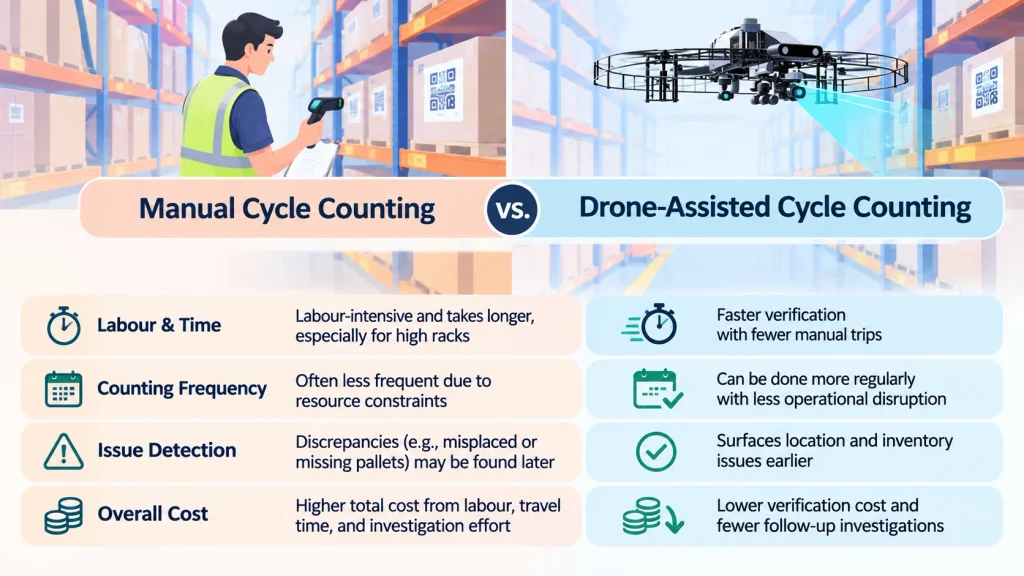
Manual cycle counting and drone-assisted inventory verification differ in more than just scanning speed. Traditional counting requires warehouse personnel to travel between storage locations, access high racks, and coordinate with equipment operators, making frequent inspections labour-intensive and potentially disruptive. Drone-assisted cycle counting can automate repetitive pallet identification and location verification, allowing warehouses to inspect suitable storage areas more regularly without increasing manual workload at the same rate. For Singapore warehouse operators facing high labour costs and limited manpower, the primary benefit is not necessarily an immediate reduction in headcount, but improved workforce capacity, earlier detection of inventory discrepancies, and fewer operational interruptions. However, the actual financial impact depends on warehouse configuration, inspection coverage, and how effectively detected discrepancies are investigated and resolved.
1. Labour cost is more than scanning time
Scanning one pallet label takes seconds. Completing a full round of manual cycle counting takes far longer.
Staff have to walk to each rack location, confirm the pallet’s identity, match it against the WMS and record the result. Depending on procedure, they may also check quantities, inspect label condition or call for a second pair of hands.
In a warehouse with thousands of storage locations, travelling between racks and preparing for each check can make up a large share of the total verification effort.
This cost also repeats. Every counting cycle takes people away from receiving, picking, replenishment or problem-solving.
When a business wants to count more often, it faces two options, each with a trade-off: add resources, or stretch the existing team further. Under that pressure, counts get postponed, narrowed in scope, or limited to the locations that seem most critical.
In Singapore, “just add headcount” is rarely a simple answer. Warehouse assistants, pickers and forklift operators are among the hardest roles to fill, and many operators now rely on agency and contract staff to cover peaks. Every hour spent on routine verification is an hour that scarce, increasingly expensive staff can’t spend elsewhere.
How warehouse drones can help
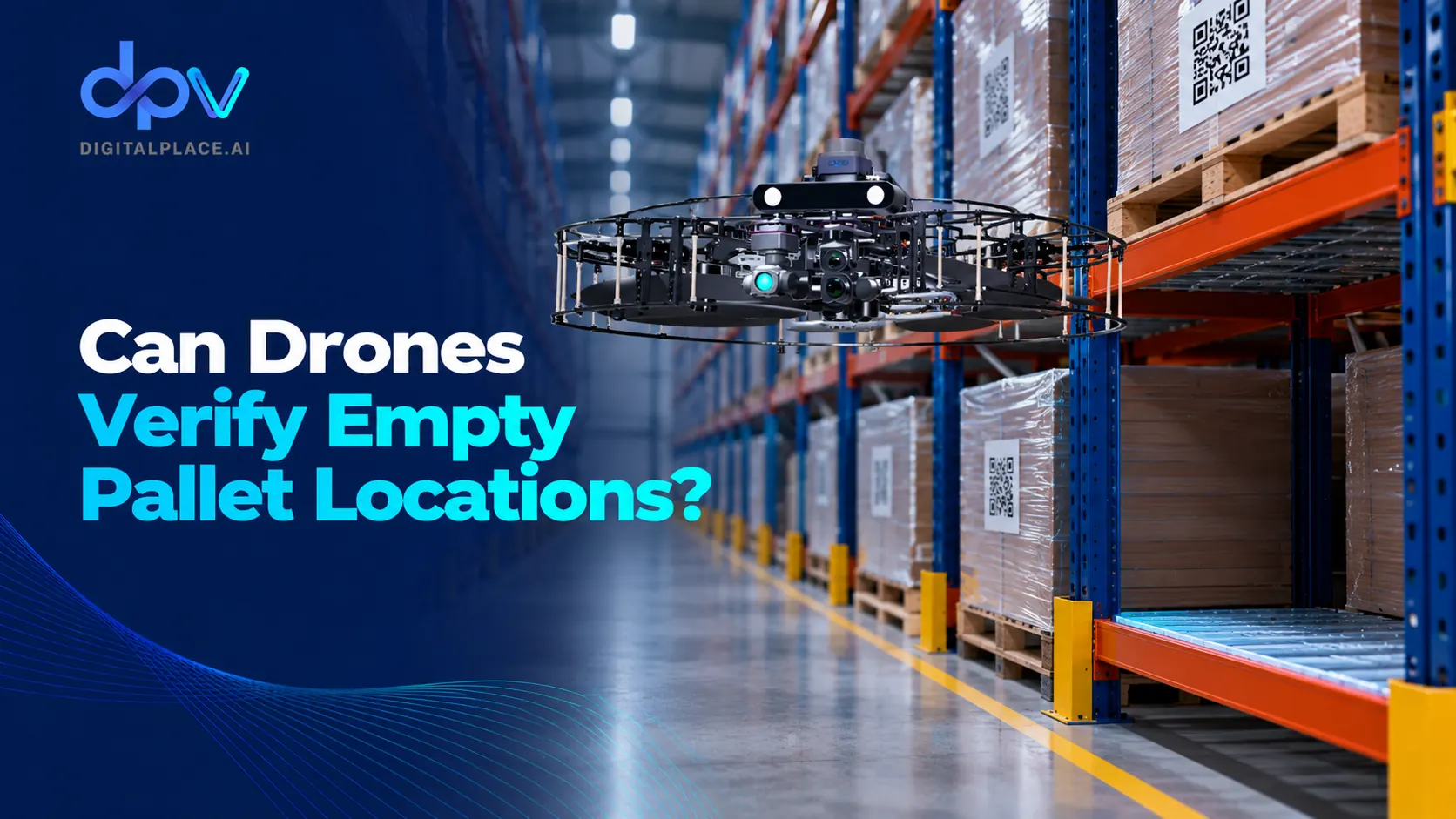
For suitable pallet-based inventory, a warehouse drone can automate part of the travel and identification work. The drone follows a pre-configured route and captures visual data or reads the QR codes on pallets at each rack location.
People are still needed to prepare missions, review results and handle findings that need investigation. But the number of manual trips for routine verification can drop.
This benefit needs to be framed carefully. Fewer hours spent on checks does not automatically mean a lower wage bill. In most cases, the main gain is capacity: staff can be redeployed to higher-value work, which matters in a market where the alternative is hiring people who are hard to find.
Direct savings should only be claimed where spending measurably falls, for example less overtime or fewer temporary workers.
2. High-bay checks cost more
Checking a pallet on the bottom beam and checking one several levels up serve the same purpose. The resources each one needs can be very different.
In high-bay warehouses, manual checks often require suitable access equipment, a trained operator and coordination with nearby activity. Setting up or waiting for that equipment can take longer than the check itself.
That equipment is also needed elsewhere. A reach truck or order picker used for counting may be the same one needed for put-away or replenishment. When one machine is shared, queues form and productivity drops.
So the real cost isn’t just running the equipment. It includes operator time, waiting time and the work that gets pushed back.
This matters especially in Singapore, where scarce industrial land pushes operators to build up rather than out. Multi-storey ramp-up facilities, such as Katoen Natie’s 400,000 sq ft Jurong Logistics Terminal 5 completed in Q1 2026, and tall racking are common ways to get more out of every square foot. With prime warehouse rents averaging S$1.88 psf per month in Q2 2026, operators use as much cube as they can. The trade-off is more stock sitting at heights that are slow and costly to check by hand.
How warehouse drones can help
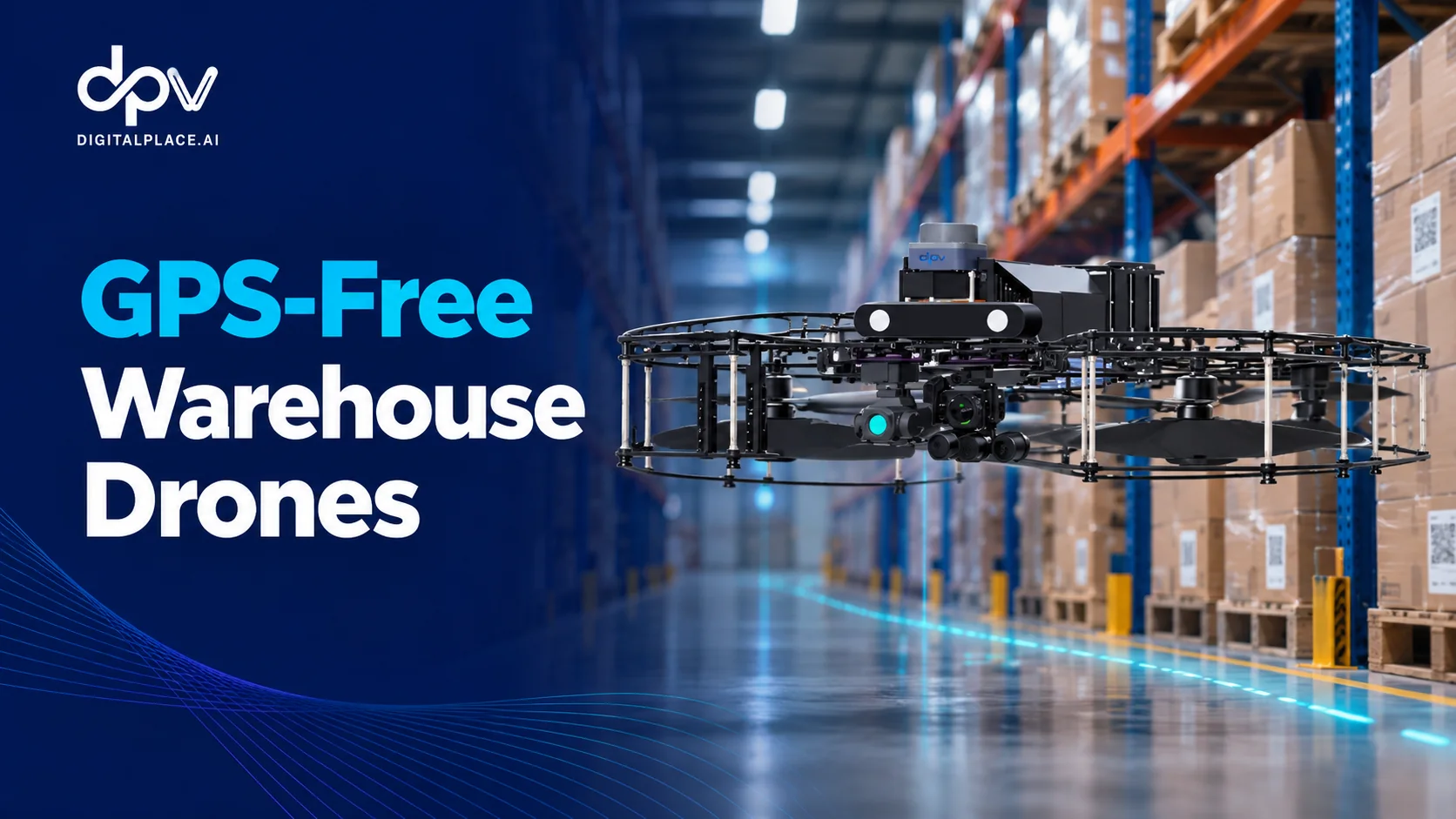
A warehouse drone carries the scanner up to the inventory location. For pallet-identity checks, there’s no need to lift a person to the top beam every time.
This is most relevant for warehouses that routinely verify pallet identity and location across multi-level racking. Results still depend on label readability, rack configuration, enough clearance to fly, and conditions inside the building.
It’s important to separate checking a pallet’s identity from checking everything on it. Confirming that a pallet’s QR code matches its assigned location is not the same as counting every carton or inspecting the condition of the goods.
If your manual procedure includes those extra steps, part of the work will still need a person on site.
How long can an inventory error go unnoticed?
One often-overlooked cost is how long a discrepancy survives before anyone finds it.
Imagine a pallet is moved just after a location was checked, and the move isn’t recorded in the WMS. From that moment, the system shows a location that no longer matches where the pallet actually is.
If that location is checked every seven days, the error could go unnoticed for almost a week. If it is checked daily, there’s a chance to catch it much sooner.
| Check frequency | Potential time until the error is found |
| Every 7 days | Almost 7 days |
| Daily | Almost 1 day |
Illustrative example, not measured performance. Assumes checks run on schedule, the error occurs just after the previous check, and it can be detected at the next one.
Checking more often shortens detection time, but it doesn’t necessarily speed up the whole fix. Once a discrepancy is found, the team still has to investigate, correct the record and confirm the physical position.
Put simply:
\text{Total time inventory data is wrong} = \text{Time to detect} + \text{Time to resolve}
Hidden costs can appear at three stages:
- Before detection: pickers and replenishment staff work from the wrong location.
- During investigation: staff and supervisors trace pallet movements, search for stock and reconcile records.
- When orders are affected: the business may face extra handling, delayed shipments or more customer service work.
Warehouse drones can make repeated checks more practical in suitable areas. The benefit only fully lands when faster detection is followed by timely correction.
3. Counting disrupts operations even when the warehouse doesn’t stop
Cycle counting doesn’t have to shut the warehouse down to drag on productivity.
Counters often share aisles with pickers, forklift drivers and put-away teams. Supervisors have to manage access, others wait for locations to free up, and some work gets rescheduled to avoid clashes.
This kind of disruption rarely sits in a single cost line. It shows up as longer task times, more coordination, or overtime at the end of a shift to clear what slipped.
In Singapore, that end-of-shift overtime is especially costly. Operators already struggle to staff nights and weekends, so work that spills over often lands on the same stretched team or on short-notice agency labour.
If a business only counts the counters’ hours, it will underestimate the true operating cost.
How warehouse drones can help
Drone-based checks can reduce repeated manual visits to pallet locations and reliance on high-reach access equipment.
Drone missions can also be scheduled for quieter periods, such as outside peak picking hours or in dedicated inspection windows.
Drones still have to follow safety procedures, warehouse traffic rules and clearance requirements. They don’t remove every source of disruption.
The benefit should be measured through observable indicators: fewer equipment conflicts, less waiting in aisles, simpler scheduling, and less interference with work around the inspection area.
4. Investigating discrepancies takes longer than counting
When the WMS says a location holds a pallet but the rack is empty, the work isn’t finished. That finding is where the investigation begins.
The team has to work out whether the pallet was moved, picked for an order, put away in the wrong slot, or booked against the wrong location ID. Some cases pull in floor staff, supervisors and the inventory control team.
The hidden cost grows when the investigation interrupts other work. Pickers pause orders, supervisors drop what they were doing, and several people search different aisles.
Even when the pallet turns up, the business has lost time and capacity without moving the original order forward.
Earlier detection makes tracing easier because the movement history is still fresh. Drone checks help flag which locations need follow-up, but they don’t on their own identify the root cause.
To measure improvement, track investigation time per discrepancy, time to resolution, repeat issues at the same location, and the number of orders affected before the record was fixed.
5. Infrequent checks make errors more expensive
An inventory error has two dimensions: how large the discrepancy is, and how long it lasts.
When a pallet moves without a WMS update, the wrong data keeps being used until the next check, or until someone goes looking for that stock. During that time, picking, replenishment and fulfilment decisions may all rest on inaccurate information.
The period between when an error occurs and when it is found can be called the error exposure window: the stretch of time in which operations are exposed to risk from mismatched inventory data.
The longer the window, the more chances the error has to affect warehouse activity. More frequent checks can shorten it, but only if results are reviewed and acted on promptly.
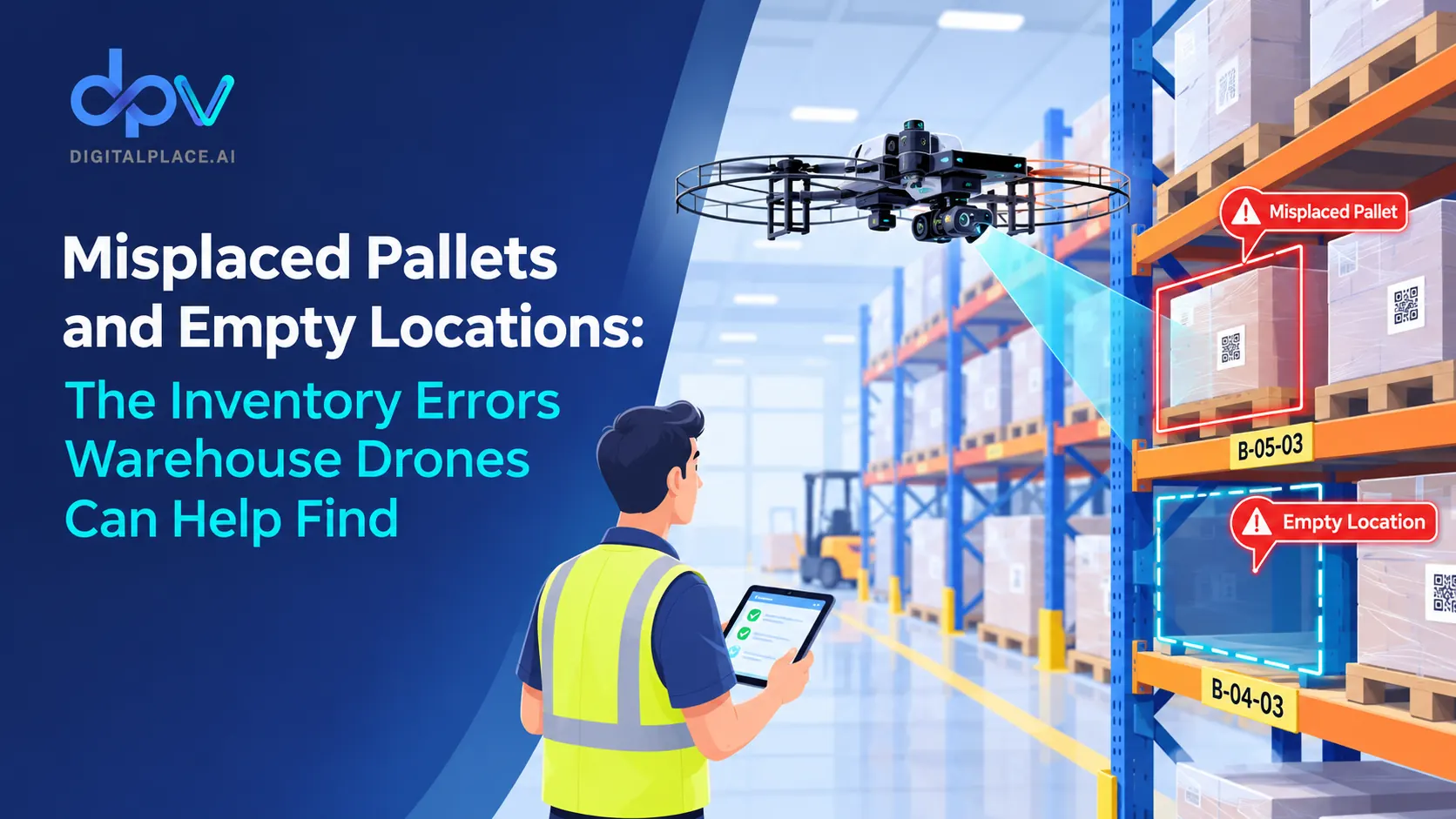
Digitalplace.ai supports inspection missions for specific aisles, high rack locations or wider areas of the warehouse. Using QR-based pallet identification and storage-location verification, the system helps flag pallets that have moved and slots that should be occupied but are empty.
This lets operators test higher verification frequency without growing manual checking effort in the same proportion. For Singapore operators who can’t easily add headcount, that distinction matters.
Not every location needs the same frequency. Fast-moving areas, locations with a history of discrepancies, and hard-to-reach racks may each warrant different priorities. The more effective approach is to match the inspection schedule to the operational risk of each area.
6. Mislocated pallets look like missing stock
A pallet doesn’t have to leave the building to become unavailable.
The goods may still be inside, but stored somewhere other than where the WMS says. When they’re needed for an order, nobody can find them.
This highlights the difference between stock that physically exists and stock that is operationally available. The warehouse owns the goods but can’t use them efficiently because the location data is wrong.
It is also different from permanent loss or inventory shrinkage. A misplaced pallet can usually be found and used again; damaged or genuinely lost goods need different handling.
Treating every location mismatch as an inventory loss will overstate the financial case for drones.
Drone-based location checks help surface issues that need investigating. Their economic value comes from less search time, faster recovery of available stock, and fewer unnecessary moves.
When inventory errors reach the customer
The impact becomes more serious when an order has already been accepted, but stock the system shows as available can’t be found.
The warehouse may have to find an alternative pallet, split the shipment or arrange a substitute. Customer service may also need to explain the delay.
For Singapore operators, this risk is sharper. Many serve as regional distribution hubs or third-party logistics (3PL) providers, fulfilling orders across Asia Pacific under tight service-level agreements. A missing pallet can mean a missed cut-off for an outbound flight or vessel, not just a late local delivery.
Depending on the case, extra costs may include:
- delayed or partial shipments
- additional picking
- expedited or air freight
- more customer service workload
- order cancellations or SLA penalties
Not every location mismatch ends in customer disruption, though. Financial impact should be calculated from documented incidents, not assumed for every case.
Inventory accuracy needs more than a successful QR scan
Reading a QR code is one part of inventory verification, not the only measure of accuracy.
Each scan also has to be tied to the correct rack location, compared against the WMS record, and presented in a form that’s easy to review. Label placement, lighting, flight stability and rack layout all affect the quality of the result.
That’s why evaluating a warehouse drone system on scan success rate alone isn’t enough.
A trial should measure:
- how many locations were successfully verified
- how many could not be checked
- how many findings needed investigation
- how much manual work was still required after the mission
Unreadable labels and incomplete coverage should be reported clearly. Management can then tell the difference between locations that are verified and those that still need follow-up.
Checking pallet identity, verifying location match and counting cartons are separate activities. Those boundaries should be stated upfront, so no one assumes one successful scan replaces the entire manual cycle count.
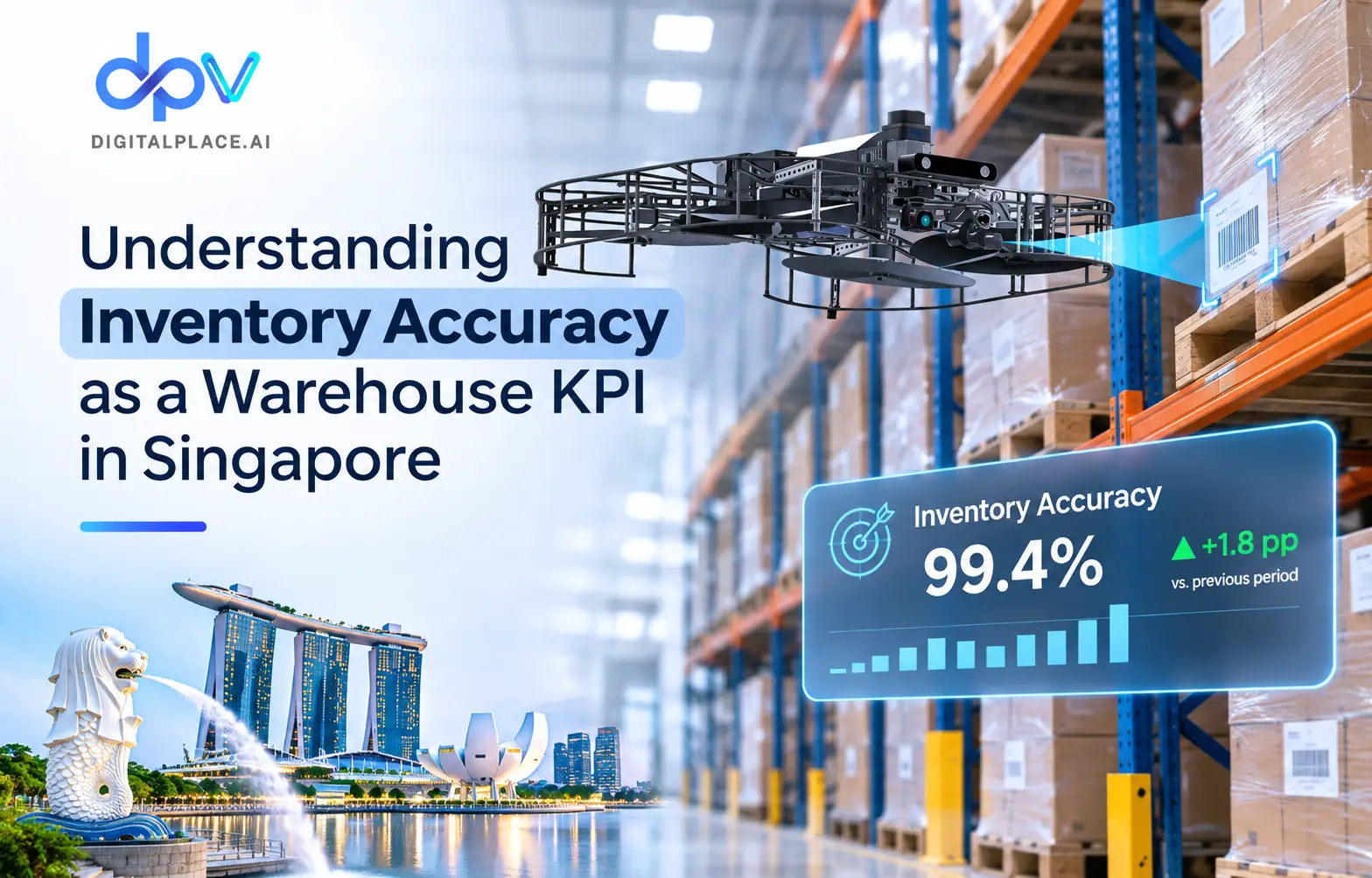
Understanding these distinctions is essential when evaluating warehouse inventory performance. For a broader explanation of measurement methods, accuracy dimensions, and industry benchmarks, see our guide to inventory accuracy as a warehouse KPI.
Regulatory and privacy considerations in Singapore
Indoor warehouse drones in Singapore generally don’t need CAAS operating permits, but operators still carry safety and data-protection responsibilities.
- Aviation rules. Since amendments that took effect on 13 November 2021, the Civil Aviation Authority of Singapore (CAAS) allows indoor unmanned aircraft operations without an operator or activity permit, apart from a few specified purposes such as organised sporting activities. CAAS’s guidance also notes that the owner or occupier of indoor premises is responsible for the safety of the people inside. Check the latest CAAS advisory circular before deployment, especially for facilities with openings to the outside or near an aerodrome.
- Workplace safety. Drone missions should be covered by the site’s existing risk assessment, with clear rules on flight zones, timing and how drones share space with people and forklifts.
- Personal data. If drone cameras may capture identifiable employees or visitors, the PDPA applies. The PDPC’s Advisory Guidelines on Selected Topics include a section on drones and other recording devices. Practical steps include notices at entry points, limiting capture to what’s needed, and clear retention rules for footage.
This section is general guidance, not legal advice. Confirm current requirements with CAAS, the PDPC or your legal adviser.
Turning hidden costs into a measurable business case
To evaluate an investment in warehouse drones, a business first needs to understand what its current verification process really costs.
Start with a defined set of locations. Measure preparation time, staff travel, access equipment use, the checks themselves, results review, and reconciliation when discrepancies turn up. In Singapore, use fully loaded labour rates, including CPF contributions for local staff, foreign worker levies where they apply, and agency premiums for temporary cover.
With that baseline in hand, compare it against a drone-assisted process covering the same scope. Include the full cost of implementation and operation: hardware, software, maintenance, deployment, training, integration, and any relabelling needed.
Also count mission preparation, results review, exception handling, and any manual checks that remain.
Separate the sources of benefit so ROI isn’t overstated
The benefits of warehouse drones fall into four categories.
| Benefit category | Example indicators |
| Direct cost savings | Lower overtime, temporary labour or access-equipment costs |
| Capacity gains | Staff hours redeployed to other warehouse work |
| Operational improvements | Less waiting time, fewer equipment conflicts, less disruption |
| Better inventory control | Faster detection, shorter resolution, fewer repeat discrepancies |
Assess each category separately to avoid double counting.
For example, an hour saved on searching for a pallet shouldn’t be counted in full as both a labour saving and a separate productivity gain without a clear basis.
A conservative financial model helps management make investment decisions based on realistic operating results, not theoretical potential.
Factor in Singapore government support
Singapore actively supports warehouse automation. Enterprise Singapore has a dedicated Warehousing and Tech team leading the national warehouse transformation effort. Schemes such as the Enterprise Development Grant (EDG) and Productivity Solutions Grant (PSG) can co-fund a share of qualifying automation and digitalisation costs.
Eligibility depends on the company, the project and the solution, so check directly with Enterprise Singapore. If support applies, model it as a separate line in the business case, so the project still stands on its own merits.
Validate through repeated inspections
A drone demo can show that the device follows a route and reads QR codes. A successful demo alone doesn’t prove long-term operational value.
A more representative trial runs repeated missions under normal warehouse conditions. It should assess inspection completion rates, finding quality, manual intervention needed, and how long it takes to turn findings into corrected inventory records.
Digitalplace.ai helps warehouse operators evaluate inventory drones through operational testing that accounts for facility conditions, verification processes and integration needs. The goal is to find where automating repetitive checks can reduce routine work and improve visibility of inventory locations.
That way, the investment decision rests on proven operational change and a fully costed implementation.
Reducing the hidden costs of warehouse inventory checks
Manual cycle counting still has an important role, particularly for irregular storage, damaged labels, or situations that need a hands-on physical check.
The problem isn’t that manual checks are ineffective. It’s that relying entirely on people for every routine verification builds up costs that often go unseen.
Travel between locations, high-rack access, equipment scheduling and repeated pallet searches can consume far more resources than the cycle counting budget shows. In Singapore, where frontline staff are scarce and every square foot is expensive, those costs weigh even more.
Warehouse drones offer a way to take on part of that load and make inventory checks more consistent in suitable environments. But their value isn’t determined by label-reading alone. Adequate coverage, data quality, and a team ready to act on discrepancies remain essential.
In the end, the biggest value of automated inventory verification isn’t counting pallets faster. It’s finding and fixing errors earlier, before they grow into more expensive operational disruptions.