Demand Forecasting for Retail
Demand forecasting for retail is the discipline of predicting what customers are likely to buy, where demand will happen, and when inventory should be ready. In modern retail, forecasting is no longer just about looking at last year’s sales and applying a simple percentage increase. Store demand changes because of promotions, payday cycles, seasonality, holidays, local events, weather, stock availability, customer behavior, and differences between one store location and another.
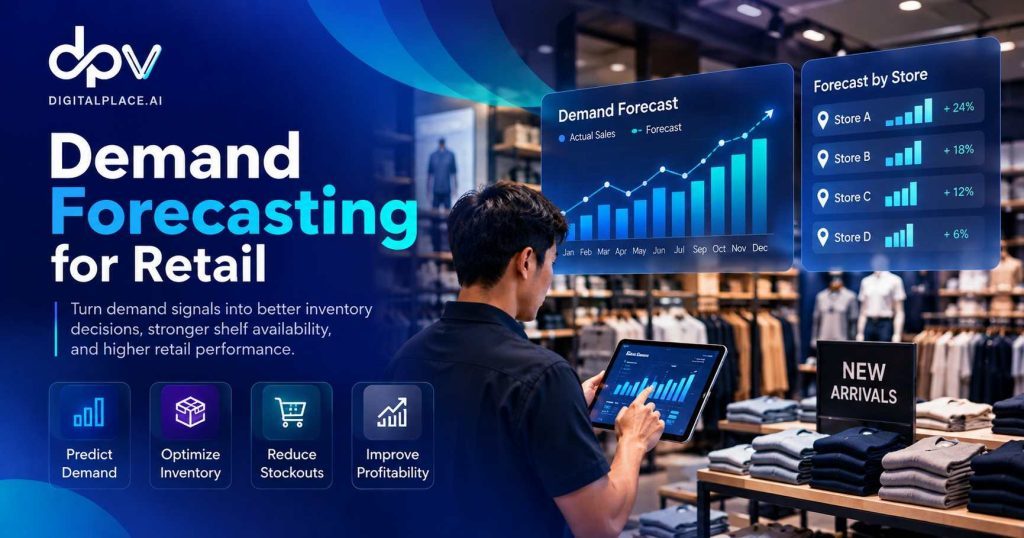
This category explores how retailers can use better demand forecasting to improve inventory decisions, reduce stockouts, avoid excess inventory, support replenishment planning, and make store operations more responsive. The focus is practical: how forecasting connects to real retail problems such as empty shelves, slow-moving stock, over-ordering, missed sales, warehouse pressure, and working capital trapped in inventory.
Digital Place helps retailers connect demand forecasting with inventory optimization.
Why Demand Forecasting Matters in Retail
Retailers often feel the impact of poor forecasting in two opposite ways. On one side, customers cannot find the products they want because stock runs out too early. On the other side, stores carry too much inventory of products that move slowly, forcing markdowns, transfers, returns to distribution centers, or rebalancing across locations. Both problems hurt profitability, but they come from the same root issue: demand signals are not being translated into better inventory decisions.
A strong forecast helps retailers answer operational questions before they become expensive problems:
- Which products are likely to sell faster next week?
- Which stores need more inventory, and which stores need less?
- Which items are at risk of stockout?
- Which products may become slow-moving or excess stock?
- How should promotions, seasonality, and local demand patterns affect replenishment?
What This Category Covers
Retail Demand Signals
Demand is shaped by many signals, not just historical sales. Articles in this category discuss how factors such as promotions, cannibalisation, seasonality, bulk buying, stockpiling behavior, store location, category movement, and local customer patterns influence what retailers should forecast.
Forecasting and Replenishment
Forecasting only becomes useful when it improves the next decision. For retail teams, that usually means better replenishment: how much to order, when to reorder, where inventory should go, and how to keep shelves available without overloading the store or warehouse with unnecessary stock.
As a retail AI partner, Digital Place supports retailers that want to move beyond broad averages and connect demand forecasting with inventory optimization, replenishment planning, and store-level execution. This helps teams understand not only what demand may look like, but also how that forecast should affect stock decisions across stores and categories.
Stockouts, Overstock, and Slow-Moving Inventory
This category also covers the operational consequences of poor forecasting. Stockouts lead to missed sales and disappointed customers, while overstock ties up capital and occupies shelf or backroom space. In many retail operations, the right answer is not only discounting, but also better allocation, redistribution, return-to-DC decisions, and inventory rebalancing across stores.
AI-Powered Forecasting
AI-powered demand forecasting can help retailers process more signals at a more granular level: by SKU, store, category, period, and demand pattern. Instead of relying only on broad averages, retailers can use forecasting models to identify more specific risks and opportunities across their network.
Digital Place works with retailers as a partner for demand forecasting and inventory optimization, especially when forecasting needs to become part of daily retail decisions. In practice, this means helping teams connect demand signals with automatic replenishment, stock allocation, on-shelf availability, and inventory productivity. The goal is not only to create a more accurate forecast, but to help retailers act on the forecast before stockouts, overstock, or slow-moving inventory become expensive problems across the store network.
Who Should Read These Articles?
This category is useful for retail business owners, inventory managers, merchandising teams, supply chain leaders, store operations teams, and decision-makers who want to understand how forecasting affects daily retail performance. It is especially relevant for retailers managing multiple stores, large SKU counts, frequent replenishment cycles, or recurring problems with stockouts and excess inventory.
Use this category as a practical guide to understand how demand forecasting works in retail, why it matters, and how better forecasting can support healthier inventory, stronger shelf availability, and more confident replenishment decisions.
From Forecasting to Better Retail Decisions
The goal of demand forecasting is not simply to produce a number. The real goal is to help retailers make better decisions before the problem appears on the shelf. When demand forecasts are connected to inventory planning, replenishment rules, store-level execution, and operational workflows, they become a practical tool for improving availability, reducing waste, and keeping working capital moving.
For retailers, better forecasting is not only about predicting demand. It is about turning demand signals into better actions.
