
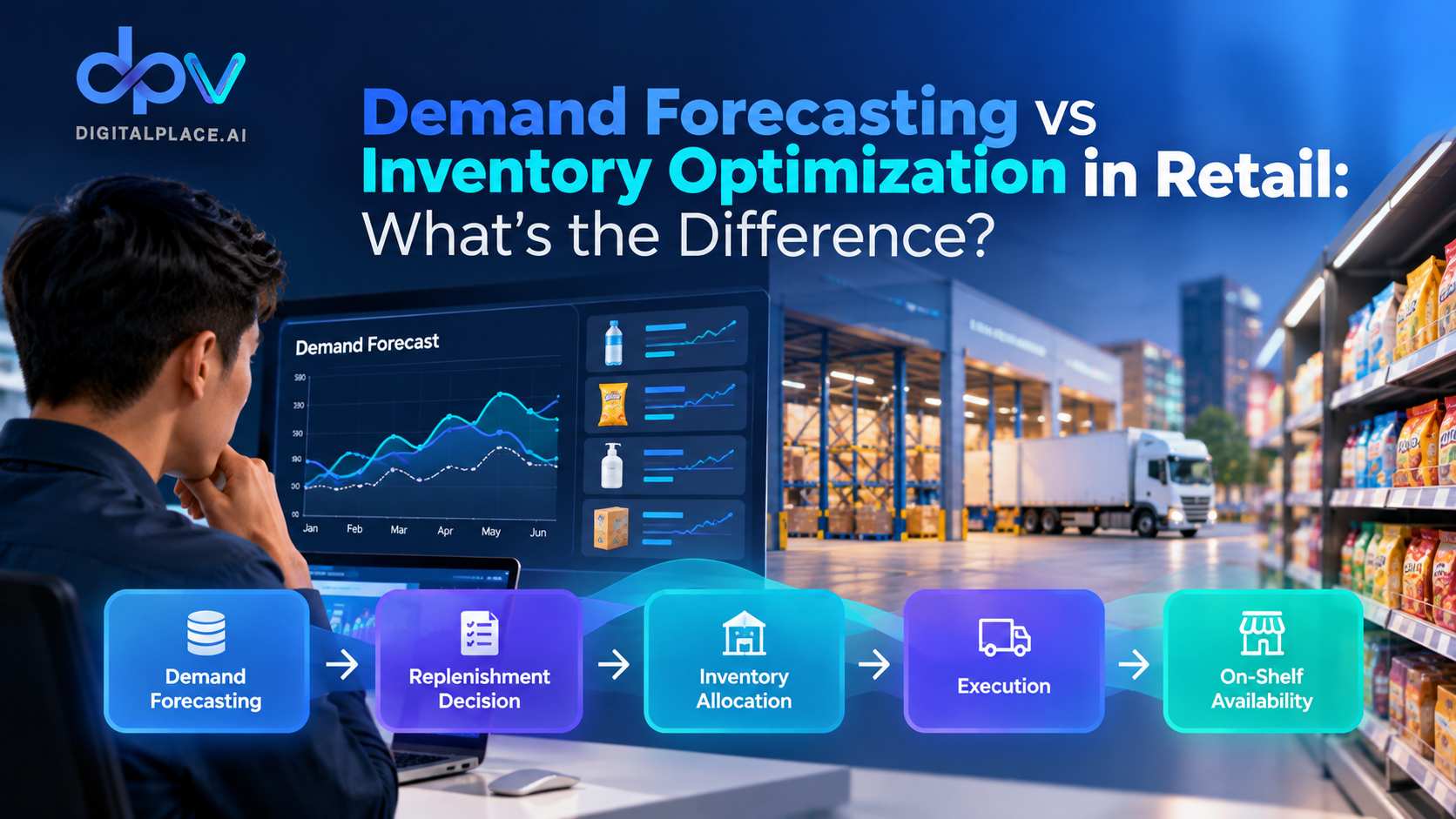
A retailer can have years of transaction data, experienced planners, a capable ERP, and reasonably accurate forecasts—and still end up with too much inventory in one store while another location runs out of the same product.
That happens because demand forecasting and inventory optimization solve different problems.
Demand forecasting asks:
“What are we likely to sell?”
Inventory optimization asks:
“Given what we are likely to sell, what inventory decision should we make?”
The distinction sounds simple, but it changes how retailers think about AI, replenishment, and inventory performance. A forecast can predict demand accurately without determining how many units should be ordered, when they should arrive, or where they should be positioned.
Inventory optimization begins where forecasting stops.
Read more :
Digitalplace.ai Inventory Optimization Software
What Is Demand Forecasting in Retail?
Demand forecasting estimates future customer demand using historical sales and other signals that may influence purchasing behaviour.
In retail, forecasting becomes more useful when it operates at the level where decisions are actually made:
SKU × location × time
rather than only predicting demand at category or company level.
Two stores selling the same SKU may behave very differently. One location may experience stronger weekday demand, while another peaks during weekends. A promotion may perform strongly in one outlet but have little effect in another. Seasonal patterns can also vary by area.
The goal of demand forecasting is therefore to estimate what each location is likely to need in the future.
But even a highly accurate forecast is still only a prediction.
It does not yet tell the retailer what to do.
What Is Inventory Optimization?
Inventory optimization takes expected demand and combines it with operational information to determine how inventory should be managed.
That can include decisions such as:
- how much inventory to reorder;
- when replenishment should happen;
- how much stock should remain as buffer or minimum display;
- whether the distribution centre has enough inventory;
- how stock should be allocated between stores;
- whether supplier purchase quantities should change.
A simple way to distinguish the two is:
Demand Forecasting = Prediction
Inventory Optimization = Prediction + Decision
The objective is not simply to reduce stock.
The real goal is to maintain product availability while avoiding unnecessary inventory.
That means balancing two common problems:
Stockout: customer demand exists, but the product is unavailable.
Overstock: inventory exists, but demand is not sufficient to justify the amount of stock being held.
Inventory optimization sits between these two extremes.
 AI-Powered Inventory Optimization
Demand Forecasting vs Inventory Optimization
Forecasting predicts what is likely to happen. Inventory optimization turns that prediction into a decision about how much, when and where inventory should move.
Estimates future demand using historical sales and relevant demand signals.
Converts demand expectations into replenishment, allocation and inventory decisions.
Prediction
Decision
A forecast becomes economically useful when it changes the inventory decision — and that decision improves availability, inventory productivity or financial performance.
A Forecast of 120 Units Is Not an Order for 120 Units
Imagine a model predicts that Store A will sell 120 units next week.
Should the retailer order 120 units?
Not necessarily.
Suppose the store already has:
- 70 units available;
- 20 units currently in transit;
- a minimum display requirement of 15 units;
- a two-day replenishment lead time.
The retailer cannot simply copy forecast demand into an order.
The replenishment decision must consider the forecast together with the current inventory position and operating constraints.
This is where inventory optimization turns prediction into action.
Digitalplace.ai can support retailers as a demand forecasting and inventory optimization partner by connecting SKU-by-location demand predictions with practical replenishment and allocation decisions, so forecasting becomes an operational input rather than simply another analytics output.
Why Forecast Accuracy Alone Is Not Enough
Forecast accuracy matters because poor predictions can lead to poor inventory decisions.
But the most accurate forecasting model does not automatically create the best inventory outcome.
Imagine two retailers.
Retailer A improves forecast accuracy significantly but continues using rigid replenishment rules. Stores still carry excessive safety stock, while distribution-centre allocation remains inefficient.
Retailer B achieves a smaller improvement in forecast accuracy but combines the forecast with inventory levels, lead times, minimum-order requirements, and store-level demand.
Retailer B may ultimately achieve better availability with less unnecessary inventory.
This is why inventory optimization should not be evaluated only through forecasting metrics.
Operational and financial outcomes matter too, including:
- out-of-stock rate;
- Days Sales of Inventory;
- product availability;
- lost sales;
- working capital;
- inventory holding costs;
- service level;
- margin.
Forecast accuracy is an important input metric.
It is not the final business outcome.
Replenishment Turns Forecasts Into Physical Inventory Movement
Replenishment is one of the clearest points where forecasting and optimization diverge.
Forecasting may say:
“Demand for this SKU is expected to increase.”
Inventory optimization needs to convert that into something operational:
“Send 24 additional units to Store A during the next replenishment cycle.”
The first statement informs.
The second can be executed.
This does not mean every decision must be fully automated.
Some retailers may allow routine replenishment decisions to run automatically while retaining a human approval gate for unusual cases.
This creates a different role for planners.
Instead of calculating thousands of recurring orders manually, they can focus more attention on exceptions.
Allocation Answers Another Question: Where Should the Stock Go?
Even the correct replenishment quantity does not solve every inventory problem.
A retailer may have enough inventory across its network and still experience stockouts because the inventory is sitting in the wrong locations.
Consider three outlets:
Store A: excess stock
Store B: normal inventory
Store C: running out
At company level, inventory may appear sufficient.
At customer level, Store C still loses sales.
The problem is therefore not always the amount of inventory.
Sometimes it is the location of inventory.
This is where allocation becomes part of inventory optimization.
Demand forecasting identifies where demand is likely to occur.
Inventory optimization determines where inventory should be positioned to serve that demand.
Demand Forecasting Needs More Than Historical Averages
Retail demand is rarely perfectly stable.
Simple historical averages can be useful, but they may struggle when demand changes because of promotions, seasonality, local behaviour, or unusual purchases.
Several effects can distort demand patterns.
Promotion impact
Sales rise temporarily because of promotional activity.
Stockpiling
Customers buy more during a promotion, then purchase less afterward because they already have enough stock at home.
Cannibalisation
A promotion on one SKU increases its sales but reduces demand for another similar product.
Halo effect
A promotion on one product increases demand for a complementary product.
Bulk sales
A large one-off purchase may look like a demand trend even though it should not become part of normal baseline demand.
Seasonality
Demand changes around holidays, weekends, festive periods, paydays, or local events.
These signals matter because distorted forecasts can eventually create distorted replenishment decisions.
Inventory Optimization Extends Beyond the Store
For many physical retailers, inventory moves through several levels:
Supplier → Distribution Centre → Outlet → Customer
Optimizing only store replenishment can leave problems elsewhere in the network.
A store may receive highly accurate replenishment quantities, but if supplier ordering into the distribution centre still relies on outdated assumptions, the DC may eventually carry too much inventory or be unable to support store demand.
This is why inventory optimization can become a network-wide decision problem.
Digitalplace.ai approaches demand forecasting and inventory optimization as one connected retail decision process. Historical transactions and other demand signals can first be used to estimate future requirements by SKU and location. Those forecasts can then be evaluated together with store and warehouse inventory, minimum display levels, minimum-order quantities, lead times, goods in transit, distribution-centre availability, and other operational constraints. From there, the system can support replenishment quantities and inventory allocation across supplier, distribution-centre, and outlet levels. The objective is not simply to produce a more sophisticated forecast, but to reduce the amount of routine calculation that planners must perform manually while preserving human review for exceptions, strategic decisions, new products, abnormal transactions, supplier disruptions, or other circumstances where business context remains important.
What Data Connects Forecasting to Optimization?
Demand forecasting mainly needs information that helps explain future demand.
Inventory optimization requires additional information about what the retailer can actually do.
Typical inputs may include:
- transaction history;
- SKU master data;
- warehouse inventory;
- store inventory;
- minimum display quantity;
- minimum order quantity;
- supplier or transfer lead time.
Additional information can make the decision more complete, including:
- promotion history;
- festive-event data;
- goods in transit;
- store information;
- warehouse capacity.
This illustrates the difference clearly.
A forecast needs to understand demand.
Inventory optimization needs to understand both demand and operational constraints.
From Prediction to Decision
The complete process can be viewed as a chain:
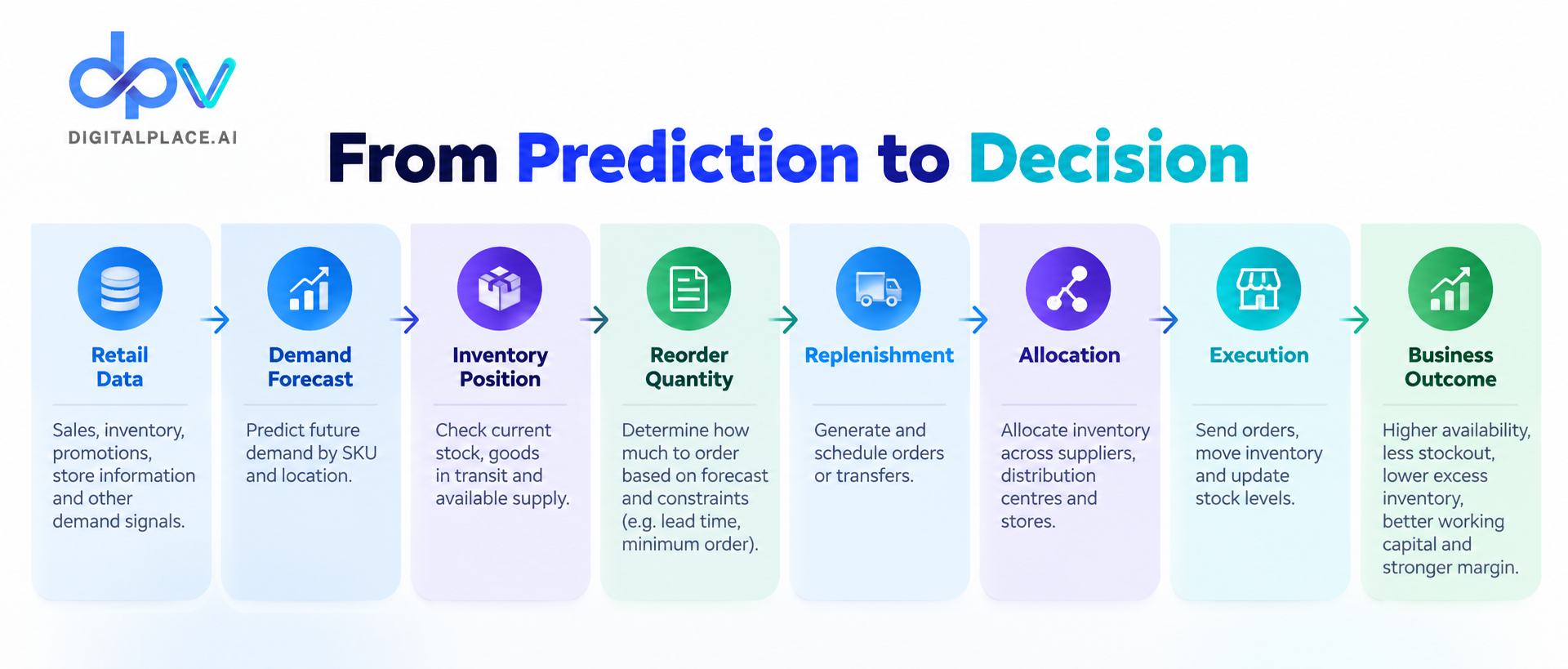
The business result sits at the end.
The key question is not only whether the system correctly predicted that demand would increase.
It is whether that prediction resulted in the right inventory decision.
The Difference Comes Down to Action
Demand forecasting and inventory optimization are closely connected, but they are not interchangeable.
Demand forecasting tries to predict what customers are likely to buy.
Inventory optimization determines how the retailer should respond to that expected demand.
Forecasting helps answer:
What is likely to happen?
Inventory optimization continues with:
How much should we order?
When should we replenish?
Where should the stock go?
How should inventory move through the network?
That is the practical difference.
For retailers, the real value does not come from producing a sophisticated forecast alone. It comes when that forecast leads to better replenishment, better allocation, better availability, and less unnecessary inventory.
The objective remains straightforward:
Right stock. Right place. Right time.




