

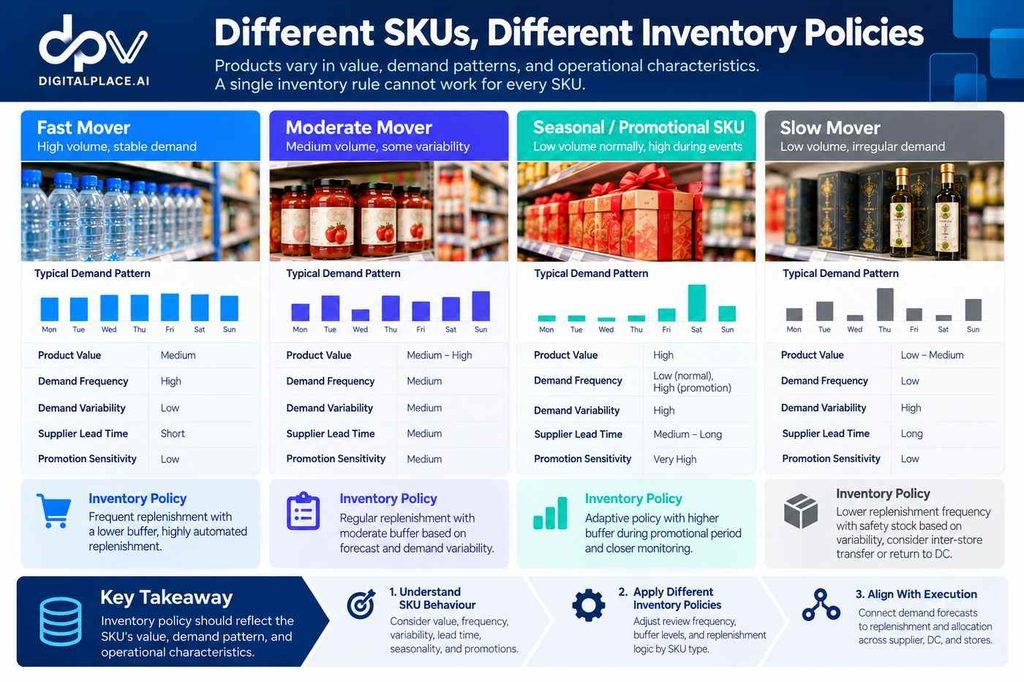
Take three products from the same supermarket shelf: bottled water, imported pasta sauce, and a festive gift pack. The water may sell every hour. The pasta sauce might move a few units each week. The gift pack may remain almost untouched for months before demand suddenly jumps during a holiday period.
Now imagine managing all three with exactly the same inventory rule.
The same safety stock. The same days-of-stock target. The same review frequency. The same reorder logic.
That is where a seemingly simple inventory policy starts creating complicated problems.
Retailers often standardize inventory rules because standardization makes operations easier to manage. But products behave differently, stores behave differently, and demand patterns change over time. When thousands of SKUs across hundreds of locations are forced through the same replenishment logic, the result is often familiar: excess stock on slow movers, shortages on fast movers, and working capital sitting in inventory that does not match where customers are actually buying.
Read more
AI Retail Company in Indonesia: What Retailers Should Look for in an AI Partner
Every SKU Carries a Different Type of Inventory Risk
The purpose of inventory optimization is not to minimize stock at all costs. It is to maintain enough inventory to satisfy demand while avoiding unnecessary capital tied up in products that move too slowly.
The challenge is that the balance between availability and inventory investment is different for every SKU.
A high-volume staple may be commercially important because even a short stockout can immediately translate into lost sales. A premium product may sell less frequently but represent significantly more working capital per unit. A promotional product can be relatively unimportant during normal weeks and suddenly become one of the highest-risk items in the assortment when a campaign starts.
Retailers therefore need to consider more than one dimension when deciding how a product should be replenished.
Some of the most useful dimensions include:
- sales or margin contribution,
- demand frequency,
- demand variability,
- supplier lead time,
- minimum order quantities,
- shelf or minimum-display requirements,
- promotion sensitivity,
- seasonality,
- and the importance of the SKU to customer availability.
A single rule rarely represents all of these conditions equally well.
Value Matters, but It Is Only the First Layer
Inventory segmentation often begins with economic importance.
An A-item might represent a SKU with high sales, high margin contribution, or significant inventory investment. B-items sit in the middle, while C-items contribute less and may justify simpler control.
This approach is useful because it prevents planners from spending equal effort on every SKU.
But value alone cannot determine the right inventory policy.
Consider two products that each generate roughly the same annual sales. Product A sells consistently throughout the year. Product B sells unpredictably, with sudden peaks during promotions and large drops afterwards.
Financially, they may appear equally important.
Operationally, they require very different replenishment strategies.
Digitalplace.ai, an AI-powered retail inventory optimization vendor, addresses this distinction by forecasting demand at SKU-location level instead of treating an entire product category or store network as a single demand pattern. The objective is to understand how each item behaves where the inventory decision is actually made.
Two SKUs Can Have the Same Average and Completely Different Demand
Average sales are especially deceptive when variability is ignored.
Suppose two products both sell an average of around 100 units per week:
| Week | Product A | Product B |
|---|---|---|
| 1 | 98 | 40 |
| 2 | 102 | 170 |
| 3 | 101 | 65 |
| 4 | 97 | 155 |
| 5 | 104 | 70 |
If a retailer looks only at average weekly demand, these two products appear similar.
They are not.
Product A is relatively stable. A replenishment system based on recent history may perform reasonably well.
Product B is volatile. Ordering around the average can repeatedly leave the retailer with too much stock after a peak and too little stock when demand surges again.
This is one reason a moving average may look mathematically sensible while producing weak inventory decisions.
Demand Variability Should Change the Inventory Policy
A more useful way to think about the assortment is to consider value and variability together.
A retailer might end up with combinations such as:
- High-value + predictable: important SKU, but relatively stable demand.
- High-value + volatile: commercially important and difficult to forecast.
- Lower-value + predictable: suitable for simpler replenishment logic.
- Lower-value + highly volatile: may require selective buffering, centralization, or a different service objective.
The point is not that every retailer needs the same segmentation framework.
The important principle is that different demand behaviour should lead to different inventory decisions.
A highly predictable SKU may not need the same level of protective inventory as an item with frequent demand shocks. A slow mover may not justify daily planner attention. A promotional SKU may need much closer monitoring during the campaign window than during normal trading weeks.
Inventory optimization therefore becomes less about applying the “best” universal formula and more about applying the right logic to the right inventory problem.
The Same SKU Can Behave Differently in Different Stores
Retail adds another complication: product behaviour is often location-specific.
A large pack of breakfast cereal might be a steady fast mover in a suburban supermarket serving families, but a relatively slow seller in a compact city outlet.
Cold beverages may have different sales patterns depending on store traffic, weather, nearby offices, schools, or transport hubs.
Premium imported products may perform strongly in one neighbourhood and remain long-tail inventory somewhere else.
This means the relevant planning unit is often not simply the SKU.
It is the SKU-location combination.
A network-wide average can hide these differences. One store may repeatedly sell out while another accumulates excess stock, even though total network inventory appears sufficient.
Segmentation Must Eventually Change the Replenishment Decision
Classifying products is useful only if the classification changes what the business does.
A retailer can create sophisticated ABC, XYZ, or demand-volatility segments, but the exercise creates little value if every segment eventually receives the same reorder policy.
Segmentation should influence decisions such as:
- how frequently the SKU is reviewed,
- how much uncertainty needs to be protected,
- whether replenishment can run automatically,
- which exceptions deserve planner attention,
- how inventory is allocated between outlets,
- and whether excess stock should remain, move to another store, or return to the distribution centre.
The segmentation therefore needs to connect to execution.
This is where Digitalplace.ai goes beyond forecasting alone. Its AI-powered inventory optimization approach connects demand prediction with replenishment quantities and inventory allocation across supplier, distribution centre, and outlet levels. Rather than stopping at “what will probably sell,” the system is designed to help determine what inventory action should follow from that forecast.
Promotions Can Temporarily Change a SKU’s Entire Behaviour
A product does not necessarily remain in one demand category forever.
Promotions are a good example.
A slow-moving SKU can suddenly become a fast mover when discounted. A promoted brand may reduce demand for competing products through cannibalisation. Customers may buy several weeks of stock during the promotion, followed by unusually weak demand after it ends.
Related products can also experience a halo effect.
These patterns mean that the replenishment policy that worked last month may be inappropriate this month.
Seasonality creates the same problem. Ramadan, school holidays, year-end festivities, local events, and weather can shift demand differently across products and locations.
Bulk sales can distort the picture even further. One unusually large transaction should not necessarily become the new baseline for ordinary consumer demand.
Static segmentation therefore has an expiration date.
Why Static Inventory Segmentation Eventually Breaks Down
Traditional segmentation exercises are often performed periodically: classify the assortment, assign rules, review again several months later.
That process can work when demand changes slowly.
Modern retail is less forgiving.
A product can move from predictable to volatile because of a new competitor, promotion strategy, supplier change, store format change, or shift in customer behaviour. A new SKU may quickly become a core seller. An established bestseller may decline.
The challenge is not merely creating the segmentation.
It is keeping the underlying inventory logic aligned with changing demand.
Machine learning makes this more practical because the demand pattern can be reassessed repeatedly. Sales history can be evaluated together with promotions, seasonality, location behaviour, stock positions, and other operational signals.
The result is a move away from fixed assumptions toward adaptive stock optimization.
Planners Should Spend More Time on Exceptions, Not Every SKU
There is also an important operational benefit.
A retailer with 10,000 SKUs across 200 locations already has two million SKU-location combinations.
No planning team can meaningfully review all of them every day.
Nor should they.
Stable products should require relatively little attention. Volatile products, important exceptions, unusual demand changes, and operational constraints deserve much more.
That changes the role of the planner from manually producing thousands of routine ordering decisions to managing the situations where human judgment adds the most value.
Digitalplace.ai can support this shift by automating routine forecasting and replenishment cycles while allowing retailers to retain human approval or business rules where needed. The system handles scale; planners remain responsible for the context that algorithms cannot fully understand.
The Goal Is Not More Inventory Rules
Ironically, better segmentation does not mean retailers need hundreds of increasingly complicated manual rules.
The goal is to reduce unnecessary complexity.
Predictable items should run quietly.
High-impact volatile items should receive closer attention.
Store-specific differences should remain visible.
Promotional and seasonal effects should not be flattened into a permanent average.
And working capital should follow demand rather than accumulate wherever old inventory parameters happen to send it.
The central question is therefore not:
“What is the best inventory rule?”
It is:
“What inventory decision makes sense for this SKU, at this location, under the demand conditions we expect next?”
Once retailers begin asking that question, inventory planning moves away from managing averages and toward managing actual demand.
And that is the foundation of effective retail inventory optimization.



