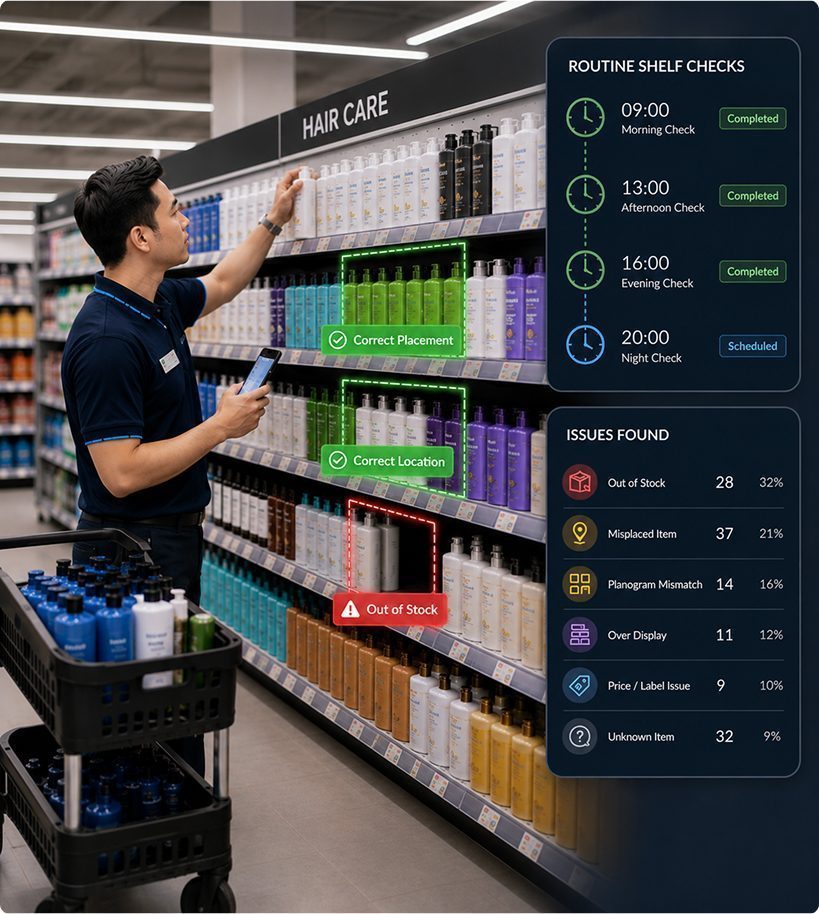
Detect out-of-stock items, misplaced SKUs, and planogram issues with AI-based scheduled shelf checks.
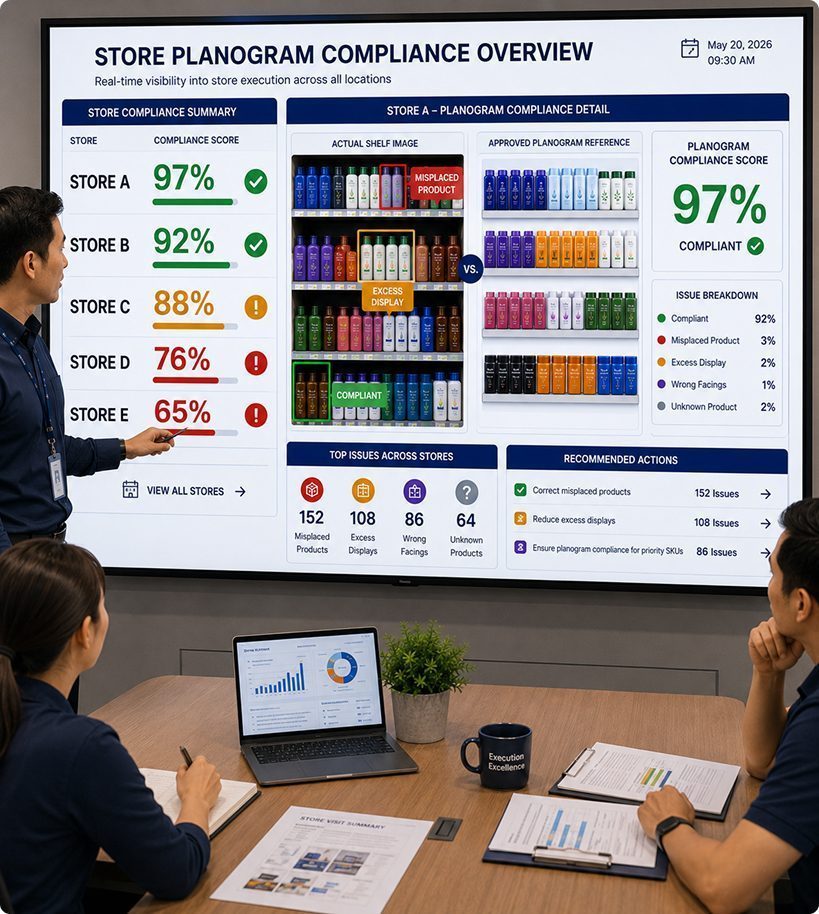
Give store and field teams a clearer way to manage shelf execution. Issue classification, compliance insights, and action priorities help reduce inconsistency across locations.
A comparison of shelf availability, planogram compliance, and operational efficiency.
Improve the accuracy and speed of routine shelf checks while giving store teams faster visibility into execution issues. Results shown below reflect average client implementations and may vary depending on store conditions, data quality, device setup, and implementation scope.
Identify products and their shelf locations with a high degree of detection accuracy during routine store checks.
Scheduled AI-powered shelf checks improve shelf availability, planogram compliance, and store-level execution across retail locations.
Retailers need practical AI to improve shelf visibility, spot execution issues earlier, and strengthen product availability across stores.
We help identify out-of-stock items, misplaced products, and planogram deviations during scheduled checks, enabling faster corrective action and more consistent store execution.
The solution helps detect products placed in the wrong location, as well as unknown or newly packaged items that do not match the approved display plan.
Store staff can run scheduled checks in the morning, afternoon, evening, or at any preferred frequency using a simple mobile workflow.
Early detection of shelf issues enables teams to quickly replenish stock, fix placement, and improve execution before sales are affected.
We provide retailers a structured approach to review shelf conditions, document issues, and boost store performance across all locations.
AI-powered on-shelf availability uses shelf images captured during routine store checks to identify whether products are available, missing, misplaced, or incorrectly positioned. It gives store teams a more structured way to identify shelf execution issues and take corrective action.
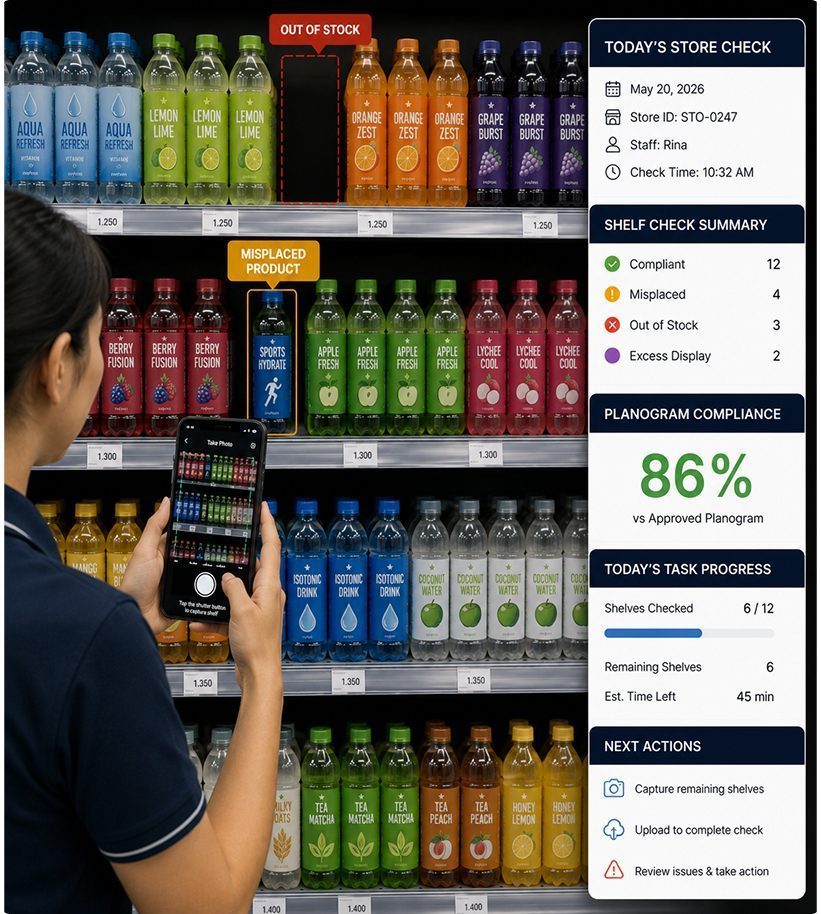
During a scheduled shelf check, store staff capture shelf images using a supported mobile device. AI analyzes the images to recognize products, shelf positions, facings, and relevant display conditions.
The detected shelf arrangement is then compared against the approved planogram or merchandising standard. Based on this comparison, the system identifies deviations such as missing products, incorrect placement, incorrect facings, over-display, and other shelf execution issues.
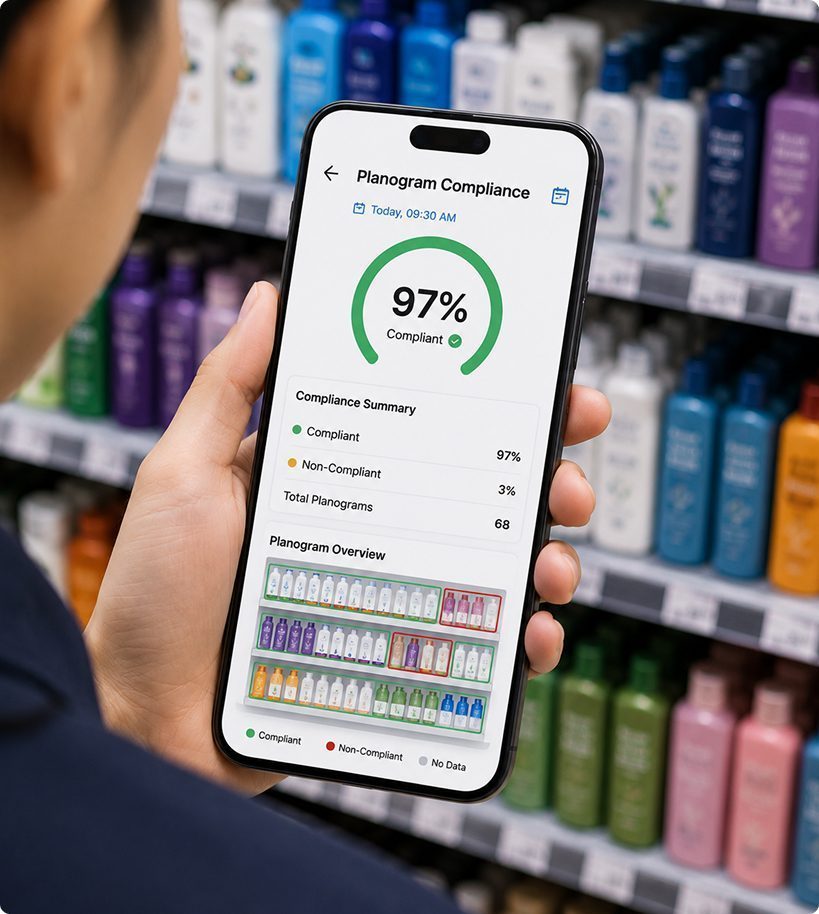
The results are summarized into a planogram compliance score, giving store and management teams a clear view of how closely the actual shelf matches the approved planogram and where corrective action is needed.
No. The solution is designed around scheduled shelf checks rather than permanent camera installations or continuous monitoring.
Retailers can define when checks should occur—for example at 09:00, 13:00, 16:00, and 20:00—based on store operating patterns and merchandising priorities. This allows teams to create repeatable checkpoints throughout the day without installing fixed cameras across every aisle.
The results therefore represent shelf conditions at the time each check is completed rather than continuous real-time monitoring that need continuous strong internet connection .
Shelf conditions can change significantly between store opening and closing as customers purchase products, items are replenished, and products are moved.
By introducing several structured checks during the day, retailers can identify execution issues at defined intervals instead of waiting for end-of-day audits or occasional manual inspections.
Each check can surface issues such as out-of-stock products, misplaced items, planogram mismatches, pricing or label issues, and unidentified products. Store teams can then focus corrective action on the issues detected during that specific check.
AI evaluates both product recognition and the product’s observed position within the shelf environment. Different conditions can therefore be classified separately rather than being treated as a generic shelf problem.
For example, a product may be recognized but positioned in the wrong location, indicating a misplaced item. An expected product may be absent from its designated shelf space, indicating an out-of-stock or availability issue. The shelf arrangement may also differ from the required merchandising structure, resulting in a planogram deviation.
Separating these issue types gives operations teams more actionable information about what needs to be corrected.
The challenge in multi-store operations is not only identifying shelf problems, but applying a consistent checking process across locations.
Scheduled AI-supported checks create a repeatable workflow in which stores can follow the same inspection frequency and issue classifications. Results can then be reviewed across locations to understand where execution problems occur more frequently and which stores or categories may require additional attention.
This makes shelf execution less dependent on individual inspection habits and provides management teams with a more consistent basis for monitoring store-level performance.
Performance can vary depending on the store environment and implementation setup. Important factors include image quality, shelf visibility, product similarity, packaging changes, assortment complexity, lighting conditions, planogram quality, camera angle, and the completeness of product reference data used by the system.
Operational discipline also matters. Consistent image-capture procedures, updated product information, and clearly defined checking routines can improve the quality of the analysis.
For this reason, successful implementation involves more than deploying an AI model. Product data, store workflows, check frequency, device setup, and exception-handling processes should be aligned so that detected shelf issues can translate into effective corrective action.