

On Friday afternoon, a supermarket manager notices that several popular products are running low. Extra stock is ordered before the weekend, when customer traffic typically increases. By Monday, some products have sold out, while others remain in the backroom. Fresh produce that looked perfectly acceptable on Friday is approaching the end of its selling window. Meanwhile, another store in the same retail chain has excess inventory of products that the first store desperately needed. Nothing unusual has happened. This is simply what grocery inventory management looks like when thousands of products, changing demand patterns, and replenishment constraints must be balanced every day.
The challenge is not just predicting what customers will buy. It is determining how much inventory each store needs, when it should arrive, and how to maintain product availability without tying up unnecessary working capital.
Why Grocery Retail Is Fundamentally Different from Other Retail Categories
Grocery retailers operate in an environment where product availability, inventory turnover, and operating efficiency must be managed simultaneously. Unlike many retail categories, grocery stores handle a combination of high-frequency purchases, relatively low-value individual transactions, thousands of SKUs, and products with widely different shelf lives. A forecasting mistake involving packaged beverages creates a different financial consequence from an identical mistake involving fresh vegetables.
Profitability makes these decisions even more important. According to FMI’s The Food Retailing Industry Speaks 2026, US food retailers recorded an average net profit margin of just 2.1% in 2025. Although margins vary across markets and business models, this illustrates how limited the financial cushion can be when inventory decisions go wrong.
For grocery retailers, small operational inefficiencies can accumulate across hundreds of stores and thousands of products, affecting both customer experience and financial performance.
The Same Product Can Have Very Different Demand Across Stores
Consider two supermarkets belonging to the same retail chain. Both sell the same brand of bottled milk, but one is located near an office district while the other serves a residential neighborhood. The office-area store may experience stronger weekday purchases, while the residential location may see higher demand during weekends. Even when their average weekly sales are similar, their daily inventory requirements can differ significantly.
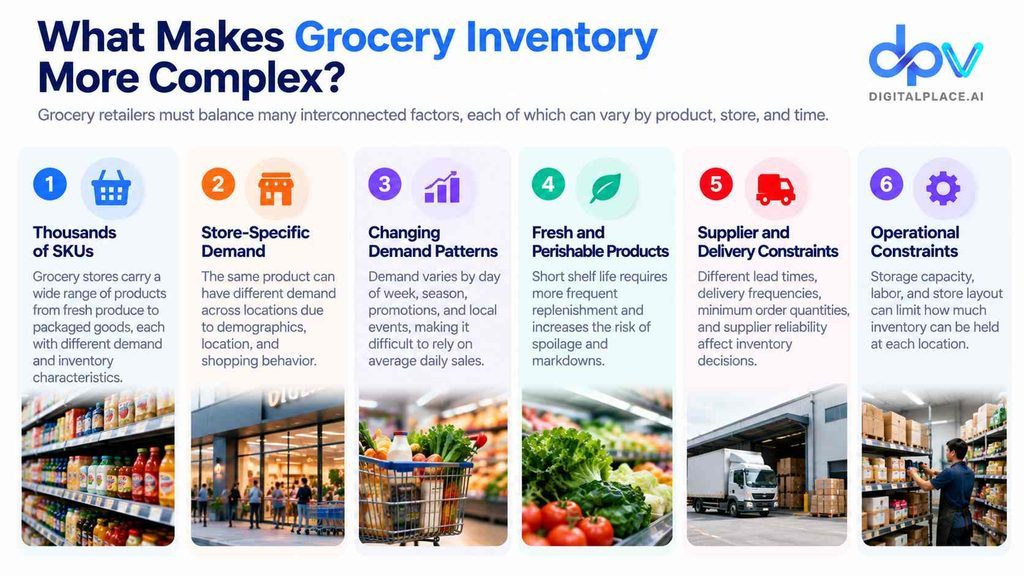
These differences become more pronounced when retailers consider local demographics, purchasing power, store size, competitor activity, promotions, and shopping habits. A centrally defined inventory rule may appear efficient from a planning perspective, but it can overlook meaningful differences between locations.
This is why SKU-level forecasting alone is insufficient. Grocery retailers increasingly need demand visibility at the individual store and day level.
Digitalplace.ai addresses this complexity through AI-powered forecasting that considers SKU-specific, outlet-specific, and day-of-week demand patterns to support inventory decisions.
Why Day-of-Week Demand Patterns Matter More Than Average Daily Sales
One of the most common limitations of traditional inventory planning is relying too heavily on average daily sales. An average is useful for summarizing historical performance, but it can conceal demand fluctuations that determine whether a product remains available throughout the week.
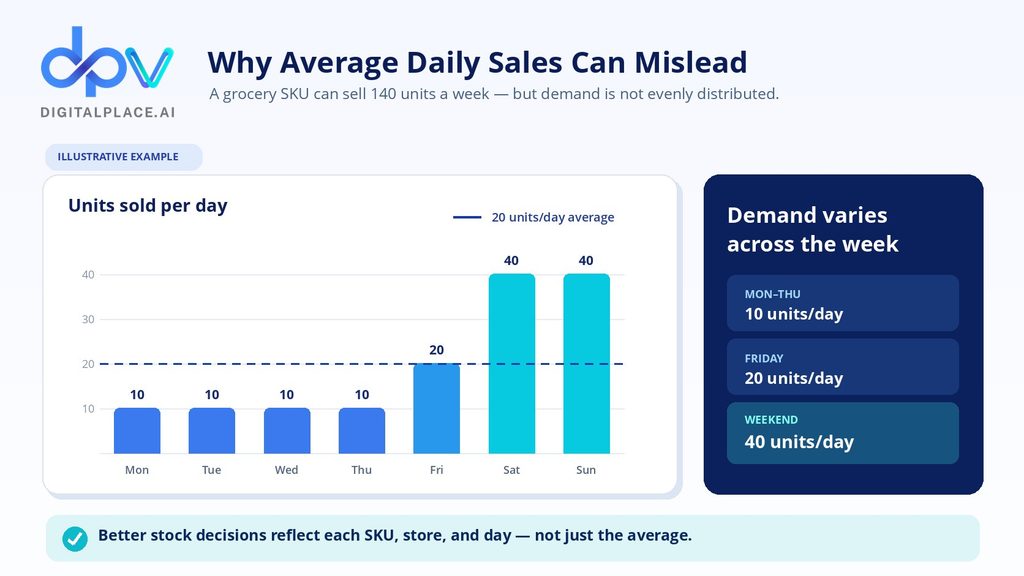
Consider a hypothetical grocery SKU with weekly sales of 140 units:
- Monday–Thursday: 10 units per day.
- Friday: 20 units.
- Saturday–Sunday: 40 units per day.
Its average daily sales are 20 units, yet demand varies substantially. A replenishment policy based only on that average may underestimate weekend requirements while creating unnecessary inventory during quieter periods.
Research published in the European Journal of Operational Research found that accounting for demand seasonality—including distinctions between weekdays and weekends—can improve retail inventory decisions and reduce costs. The study also demonstrated that relatively simple adjustments to demand patterns can create meaningful operational benefits.
For grocery retailers, daily demand patterns should influence not only forecasts but also the timing and quantity of inventory replenishment.
Fresh and Non-Perishable Products Require Different Inventory Strategies
Not every grocery SKU should be managed using the same inventory objectives. Fresh produce, bakery products, dairy, frozen food, beverages, and packaged groceries have different characteristics that affect stocking decisions. A product with a shelf life of several days requires a different approach from one that can remain sellable for months. For fresh products, ordering too much creates exposure to spoilage, quality deterioration, and markdowns. Ordering too little can lead to empty shelves and lost sales. Longer-life products provide greater flexibility, but excessive inventory still consumes storage capacity and working capital. Effective grocery inventory optimization must therefore consider product characteristics alongside expected demand.
The financial consequences of perishability are substantial. USDA Economic Research Service estimates based on historical supermarket data found an average retail loss rate of 11.6% across 31 fresh vegetable categories, although losses varied considerably by product. These historical US estimates illustrate why managing inventory quantities is particularly important for fresh categories.
The objective is not simply to minimize inventory. It is to maintain commercially appropriate availability while avoiding quantities that are unlikely to sell within the available selling window.
Supplier Lead Times and Delivery Schedules Add Another Layer of Complexity
Even an accurate demand forecast cannot guarantee product availability when replenishment constraints are ignored. Grocery retailers depend on suppliers and distribution centers with different lead times, delivery frequencies, minimum order quantities, and fulfillment capabilities. A product delivered daily requires a different inventory strategy from one replenished twice a week. Similarly, a supplier with an unpredictable lead time may require a different inventory buffer from a consistently reliable supplier. These factors interact with daily demand patterns, creating inventory requirements that cannot be determined from sales history alone. When retailers manage these variables independently, replenishment decisions may fail to reflect the actual conditions under which products must remain available.
For example, a store anticipating strong Saturday demand may need to receive inventory on Thursday if Friday delivery is unavailable. Ordering the correct quantity too late can still result in a stockout.
Inventory optimization must therefore connect demand expectations with practical replenishment constraints.
Why Fixed Minimum Stock and Safety Stock Rules Often Fail
Many retailers rely on minimum stock levels, reorder points, or safety stock parameters to manage inventory. These methods are not inherently ineffective; they provide structure and can work well when demand and supply conditions are predictable. Problems arise when parameters remain unchanged despite shifts in customer demand, product behavior, supplier performance, or delivery schedules. A minimum stock level calculated several months ago may no longer represent current requirements. Similarly, applying identical safety stock rules to different outlets can create excess inventory in slower-moving locations while leaving higher-demand stores understocked. The issue is not the existence of inventory rules, but whether those rules accurately reflect changing operational conditions.
Three questions can help retailers evaluate existing inventory parameters:
- Are stock targets differentiated by SKU and store?
- Do they reflect demand variation throughout the week?
- Are they reviewed when demand patterns or replenishment conditions change?
Moving toward adaptive stock optimization allows retailers to reassess inventory requirements using more relevant information rather than relying indefinitely on historical assumptions.
Grocery Retailers Need Better Inventory Decisions, Not Just More Inventory
When stores experience repeated stockouts, increasing inventory may appear to be the safest response. Yet holding more stock everywhere creates additional costs without necessarily resolving the underlying problem. What matters is whether inventory quantities reflect customer demand, product characteristics, and replenishment conditions.
A more effective approach requires retailers to evaluate several connected outcomes: product availability, inventory turnover, excess stock, spoilage, and working capital efficiency. Improvements in one metric should not come at an unreasonable cost to another.
Digitalplace.ai supports this approach through AI-powered inventory optimization that connects granular demand forecasting with adaptive stock optimization and automated replenishment planning. By considering inventory requirements across individual outlets and their supporting distribution centers, the solution helps retailers move beyond static stocking assumptions toward more coordinated inventory decisions. The objective is to improve product availability while managing inventory levels more efficiently across the retail network.
Ultimately, grocery inventory optimization is not about finding a single ideal stock level that works everywhere. It is about recognizing that every SKU, store, and day presents a different combination of demand, availability requirements, and operational constraints.
Retailers that account for these differences can make better replenishment decisions, reduce avoidable inventory inefficiencies, and protect profitability without relying simply on higher stock levels.



