
A retailer can have strong sales, experienced planners, a capable ERP, and years of historical data—and still hold too much of the wrong inventory in one place while running out of the right inventory somewhere else.
That is the uncomfortable part of inventory planning: the problem is rarely that retailers have no data. The problem is that demand changes faster than people can continuously translate that data into thousands of SKU-by-location decisions.
AI-powered inventory optimization is the use of machine learning and optimization models to predict demand and turn those predictions into inventory decisions: how much to order, when to replenish, where stock should sit, and how inventory should move across suppliers, distribution centres, and outlets.
The goal sounds simple:
Right stock. Right place. Right time.
The operational problem behind that sentence is not simple at all.
Read More :
The Six Demand Signals Behind Every Sale (That Averages Can’t See)
Why Retail Inventory Decisions Still Run on Guesswork (And What Replaces It)
Inventory Optimization Is Not the Same as Demand Forecasting
This distinction matters.
A demand forecast answers:
“What are we likely to sell?”
Inventory optimization must go further:
“Given what we are likely to sell, what inventory decision should we make?”
A model may predict that a particular SKU will sell 120 units next week. That forecast is only useful if the business can translate it into questions such as:
- How much should the store order?
- How much safety stock is necessary?
- Does the distribution centre have enough inventory?
- Should the supplier purchase order change?
- Should stock be reallocated from another location?
- Should replenishment happen now or later?
This is why forecasting accuracy alone is not enough.
Retailers do not make money because a forecast was statistically elegant. They make money when better forecasting produces better availability with less unnecessary inventory.
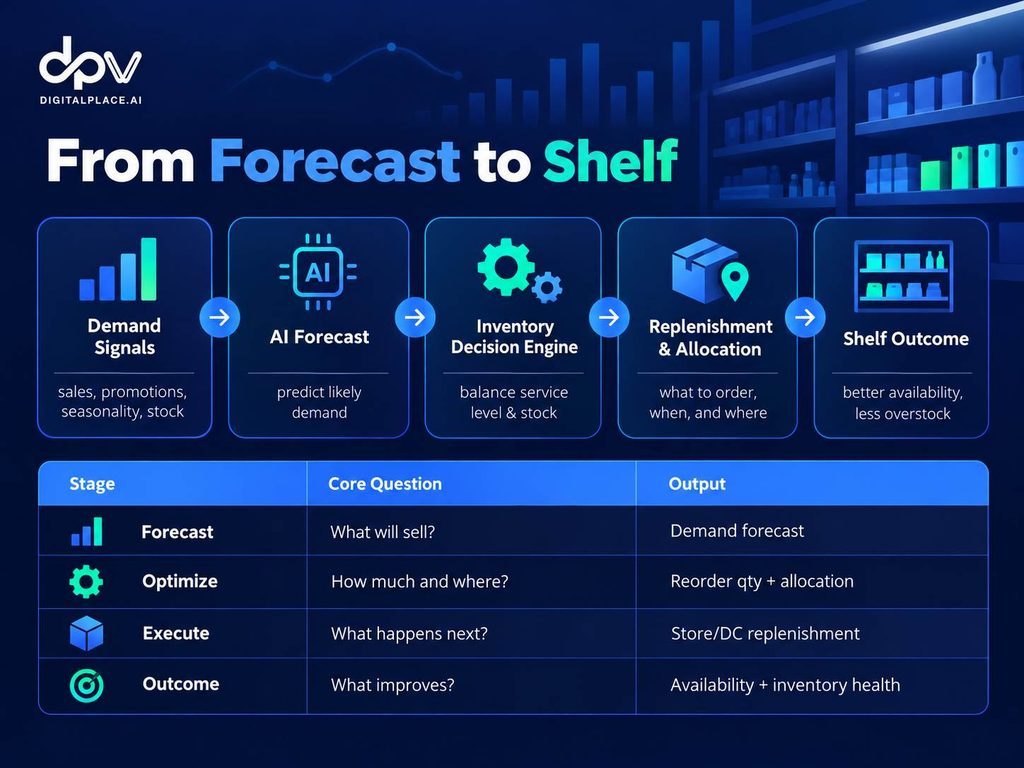
AI-powered inventory optimization sits between forecasting and execution. Demand signals such as sales history, promotions, seasonality, and current stock help produce a demand forecast, but the forecast itself does not decide what the retailer should do. The inventory decision engine translates that prediction into operational decisions—how much to order, where inventory should go, and when replenishment should happen.
The distinction matters because the business outcome is created further downstream. A more accurate forecast is valuable, but retailers ultimately need better shelf availability, healthier inventory levels, and less excess stock. Inventory optimization connects those objectives by turning predicted demand into replenishment and allocation decisions that can be executed across stores and distribution centres
Why Traditional Inventory Planning Starts to Break
Traditional methods are not inherently useless.
Average sales, moving averages, historical patterns, and planner experience can work reasonably well when demand is stable and the network is relatively simple.
The problem emerges when complexity grows.
A planner may be dealing with:
- hundreds or thousands of SKUs;
- multiple outlets;
- different local demand patterns;
- promotions;
- festive periods;
- supplier lead times;
- fast and slow movers;
- one-off bulk transactions;
- changing stock availability.
At this point, the problem is not that humans are poor decision-makers.
The issue is decision volume.
Human judgement does not scale comfortably to thousands of recurring combinations of SKU × store × day × promotion × lead time.
A store manager may know intuitively that a certain item tends to sell faster before a weekend. A planner may remember that another SKU spikes during a festive period. But as the number of products, stores, and variables expands, intuition becomes increasingly difficult to apply consistently.
The Real Enemy Is Not Just Stockout or Overstock
Inventory problems are often framed as two opposites:
Stockout: demand exists, but there is not enough product.
Overstock: inventory exists, but demand is insufficient.
That framing is correct, but incomplete.
The larger issue is misalignment.
Inventory may be available, but:
- in the wrong store;
- at the wrong distribution centre;
- too early;
- too late;
- in the wrong quantity;
- locked into a slow-moving SKU while a faster SKU is unavailable.
In other words, inventory optimization is not simply about reducing stock.
It is about improving the location, timing, and quantity of capital deployed into inventory.
That distinction matters because an aggressive stock-reduction programme can look successful financially while quietly increasing lost sales. Conversely, increasing availability everywhere can improve service levels while trapping too much working capital.
Optimization sits between those extremes.
Four Operational Pillars of AI-Powered Inventory Optimization
A practical AI inventory optimization system can be understood through four operational pillars.
1. Demand Forecasting
Machine-learning models predict expected demand at the level where operational decisions are actually made: SKU by location, rather than only at aggregate category or company level.
Granularity matters.
Two stores in the same city may sell the same product very differently because their customer mix, surrounding area, promotion response, local events, or seasonal pattern differs.
The objective is therefore not simply to know whether demand for a category will increase nationally. The model needs to help determine what individual locations are likely to need.
2. Automated Replenishment
The next step is generating replenishment quantities each planning cycle.
This is important because AI Retail becomes more valuable when it stops being only an advisory layer.
Forecast:
“We expect demand to increase.”
Replenishment:
“Therefore, send 24 more units to Store A and 11 more units to Store B.”
Some retailers may allow the system to execute directly. Others may retain a human approval gate.
Both approaches can work.
The important change is that planners move from manually calculating every order toward reviewing exceptions.
Digital Place can support retailers as an AI retail technology partner for inventory optimization by connecting demand forecasting directly with replenishment decisions. Instead of leaving AI as another reporting or analytics layer, the objective is to convert predicted demand into practical quantities by SKU and location. That can include recommendations for reorder timing, stock levels, allocation, and replenishment across the network. The value therefore comes not only from predicting what may happen next, but from improving what the retail operation actually does in response.
3. Network-Wide Allocation
A retailer does not really have an inventory problem at one location.
It has an inventory network.
Stock moves through:
Supplier → Distribution Centre → Outlet → Customer
Optimizing only one leg of this chain can leave value on the table.
For example, an excellent store-replenishment algorithm cannot fully solve the problem if the distribution centre itself receives the wrong quantity from suppliers.
Similarly, excess stock at the distribution centre does not necessarily improve availability if inventory is allocated incorrectly between outlets.
This is why multi-level inventory planning matters.
4. Built Around the Operation
Retail operations rarely look identical.
Minimum display quantities, supplier lead times, warehouse capacity, minimum-order constraints, case packs, promotional rules, and internal approval processes can vary significantly.
A system that ignores those realities may produce mathematically attractive recommendations that nobody can execute.
Inventory optimization therefore has to work with operating constraints, not around them.
Forecasting Demand Means Understanding What Distorts Demand
Historical sales are useful.
But they are not always the same thing as underlying demand.
Suppose a product sells 400 units during a promotion.
What should the algorithm learn from that number?
Perhaps:
- 250 units were normal demand;
- 100 came from promotional uplift;
- 30 were customers stocking up early;
- 20 were shifted from a substitute product.
Treating all 400 units as normal future demand would distort the next replenishment decision.
Promotions Can Affect More Than the Promoted SKU
Several effects make retail demand particularly difficult to model manually.
Halo effect
A promotion on one product may also increase demand for complementary products.
Stockpiling
Customers buy more than usual during a promotion, but demand falls afterward because they already have enough at home.
Cannibalisation
A promotion may increase sales of one SKU while reducing demand for a substitute.
Bulk sales
A large one-off order should not necessarily become part of the baseline used to forecast normal customer demand.
Seasonality
Demand can change around holidays, weekends, weather patterns, paydays, or local events—and those patterns may differ by location.
Demand volatility
A highly stable everyday product should not necessarily be treated the same way as an item with unpredictable spikes.
This is where machine learning can offer an advantage over simple averages: not because averages are mathematically wrong, but because retail demand contains more context than a single historical number can represent.
What Data Does AI Inventory Optimization Actually Need?
One reason AI projects get delayed is the assumption that a retailer needs perfect data first.
A more practical approach is to distinguish essential data from information that can improve the model further.
Core inputs may include:
- transaction history;
- SKU master data;
- warehouse inventory;
- store inventory;
- minimum display quantity;
- minimum order quantity;
- supplier or transfer lead time.
Additional context can improve forecasting and optimization:
- store information;
- promotion history;
- festive-event data;
- goods in transit;
- warehouse minimum and maximum capacity.
Several years of historical transactions can be valuable because they help the system identify annual seasonality, festive cycles, promotional responses, and year-over-year changes.
But waiting until every possible dataset is perfect can create another problem: nothing gets tested.
A better question is:
Do we already have enough data to establish a baseline and evaluate whether an improved decision model could create value?
For retailers that are not yet ready for a full rollout, Digital Place can also work as an AI retail technology partner by starting with historical-data simulation. Existing transactions, inventory levels, SKU information, lead times, and operational constraints can be used to compare current replenishment behaviour with an AI-driven scenario. That gives management a more concrete basis for discussing potential improvements in out-of-stock rates, Days Sales of Inventory, sales, and margin instead of relying only on broad industry assumptions about the benefits of artificial intelligence.
How Many Value Levers Are There in AI Retail?
There is no universal industry rule stating that AI Retail has exactly four, five, or six value levers.
For management purposes, however, a useful framework is to group the potential impact into six practical AI Retail value levers.
1. Revenue Capture
AI can reduce situations where customer demand exists but the retailer fails to convert it into a sale.
Inventory optimization contributes by improving availability and reducing stockouts.
2. Gross Margin
AI can support pricing, promotions, markdowns, and assortment decisions.
Inventory optimization also affects this lever because excess inventory can eventually require markdowns or create waste.
3. Inventory and Working Capital
This is the most direct value lever.
Better replenishment can reduce unnecessary inventory while maintaining or improving availability.
Capital that previously sat in slow-moving stock can potentially be deployed elsewhere in the business.
4. Store and Warehouse Execution
AI can help determine whether inventory that exists digitally is actually available where operations and customers need it.
Inventory records and physical inventory are related, but they are not always identical.
5. Customer Experience and Conversion
Product availability is part of customer experience.
An excellent store, website, promotion, or recommendation cannot convert a customer if the item is unavailable.
6. Workforce Productivity and Decision Quality
AI can reduce repetitive planning work and allow employees to spend more time on exceptions requiring judgement.
The interesting part is that these six levers are not isolated.
One inventory decision can affect several simultaneously.
One Inventory Decision Can Create Several Economic Effects
Consider a single improvement in replenishment accuracy.
It may:
- reduce stockouts;
- recover previously lost sales;
- lower excess stock;
- reduce storage requirements;
- improve cash flow;
- reduce markdown exposure;
- reduce waste;
- lower planner workload.
That is why inventory optimization should not be evaluated with only one KPI.
A forecast-accuracy improvement may be technically impressive but economically weak if DSI, stock availability, lost sales, or margin do not improve.
The system therefore needs to be evaluated at two levels.
Model metrics
How accurately is demand being predicted?
Business metrics
What changed because the prediction was used?
Those are not the same question.
The Planner’s Role Changes Rather Than Disappears
Automation does not eliminate every inventory decision.
It changes which decisions deserve human attention.
Instead of manually calculating replenishment for every SKU, planners can focus on exceptions such as:
- an unusual festival;
- a new product without sufficient history;
- a supplier disruption;
- sudden local demand;
- a strategic commercial decision;
- an abnormal bulk order.
This creates a different operating model:
AI handles repeatable decision volume.
Humans handle context, exceptions, and accountability.
The typical cycle becomes straightforward: sales and stock data come in, the model estimates future demand, replenishment quantities are generated for individual SKUs and locations, and the results are then used to replenish stores or create supplier orders.
Digital Place can therefore be positioned as an inventory optimization partner not because AI is intended to remove retail planners, but because it can change where their time is spent. Routine forecasting and replenishment calculations can increasingly be generated by the system, while human approval and intervention remain available for circumstances where business context matters. The result is a planning model in which teams spend less time repeatedly calculating ordinary orders and more time investigating exceptions, managing commercial priorities, and making decisions that genuinely require human judgement.
The Better Question Is Not “Can AI Forecast Demand?”
Machine learning can forecast demand.
That is no longer the most interesting question.
A retailer should instead ask:
Can the forecast change the inventory decision?
And then:
Did the inventory decision improve the business?
The complete chain should be visible:
Retail data → demand forecast → replenishment quantity → stock allocation → execution → business outcome
When those connections are missing, AI remains analytics.
When they work together, AI becomes part of retail operations.
That is the more useful definition of AI-powered inventory optimization: not a smarter spreadsheet, but a decision system designed to continuously align inventory with demand across the retail network.




