
The first inventory mistake can happen before a forecast is ever generated.
It can happen when a retailer decides which products deserve space in the assortment, how deeply each product should be stocked, and which stores should carry it. By the time planners notice slow-moving stock, repeated stockouts, or an unusual concentration of markdowns, the underlying problem may already be several decisions old. Forecasting can help predict demand for an item, but it cannot fully correct an assortment that was poorly designed in the first place.
Read more :
The Retail Inventory Lifecycle: Six Decisions That Determine What Ends Up on the Shelf
How Inventory Optimization Frees Working Capital in Retail
That is why assortment planning deserves to be treated as one of the earliest forms of inventory optimization rather than simply a merchandising exercise.
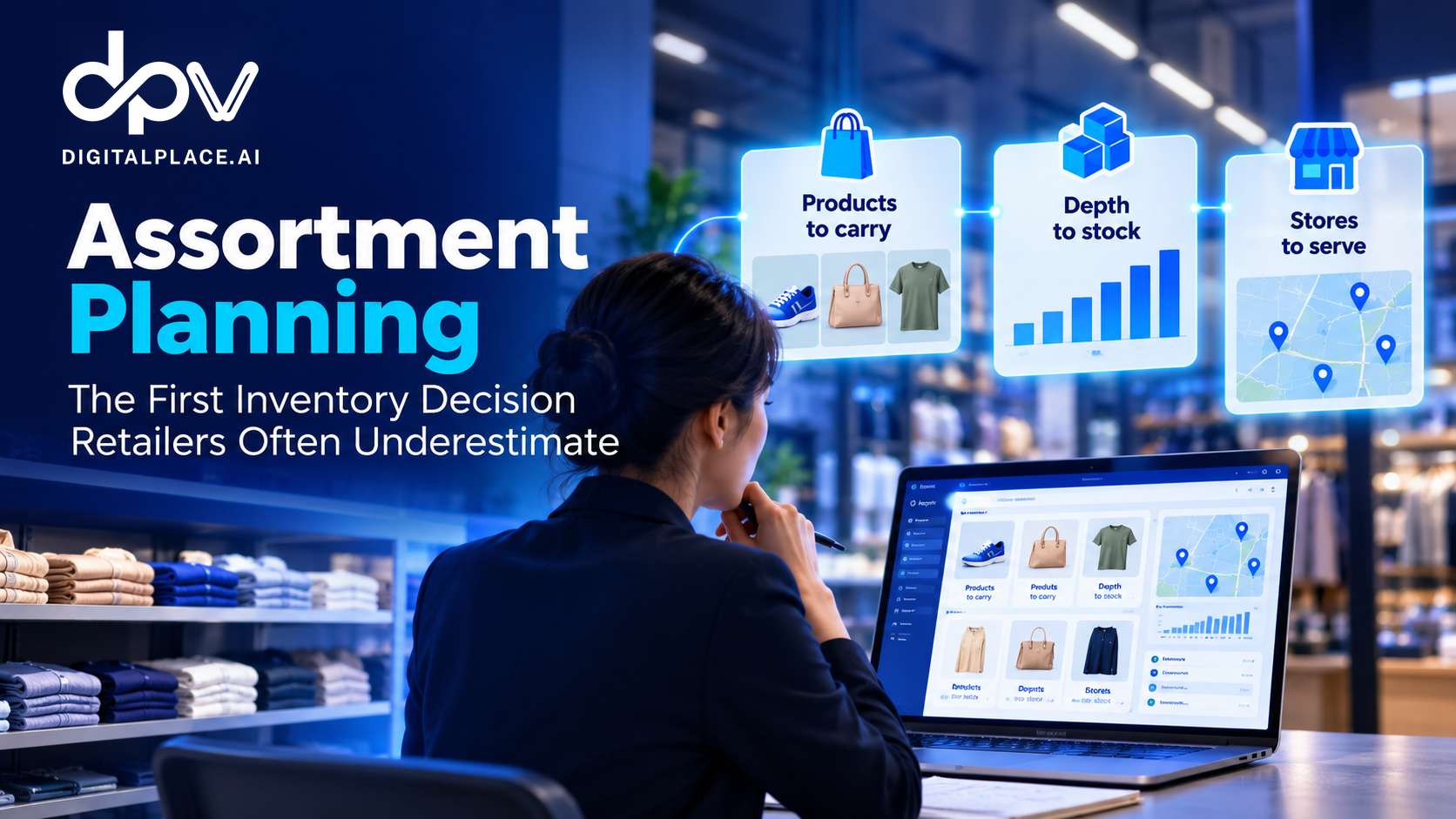
At its core, assortment planning answers three deceptively simple questions:
- Products to carry: Which SKUs should be included?
- Depth to stock: How much inventory should each product receive?
- Stores to serve: Which locations should carry each product?
Those three decisions determine much of what happens later in the inventory lifecycle. If a retailer selects products that do not fit local demand, buys too deeply, or distributes the same range across stores with very different customer profiles, the resulting problem may eventually appear as excess stock, unnecessary transfers, repeated markdowns, or low product availability.


Assortment Is an Inventory Decision Before It Is a Replenishment Decision
Replenishment generally receives more attention because its impact is immediate. A product approaches its reorder point, inventory declines, and the system must decide whether to replenish it.
Assortment planning works earlier and more quietly. Before a replenishment engine can decide how many units of a SKU a store needs, someone—or increasingly, a combination of people and algorithms—has already decided that the store should carry the SKU at all. If that first decision is wrong, an efficient replenishment system may simply continue supplying inventory that does not belong there. This is one reason retailers need to connect assortment planning with downstream inventory performance instead of treating assortment, forecasting and replenishment as isolated processes.
A retailer with hundreds of stores may also face an enormous number of SKU-location combinations. A product that performs exceptionally well in one cluster may consistently disappoint in another. The difference might come from store size, neighbourhood demographics, climate, local preferences, surrounding competitors, shopping missions or even differences in how customers use a particular store. A chain-wide sales average can hide all of these variations.
Digitalplace.ai supports retailers as an inventory optimization and auto replenishment partner.
Historical Sales Tell More Than Just Which Products Sell
The obvious starting point for assortment planning is historical sales, but simply ranking SKUs from highest to lowest sales is rarely enough.
A more useful analysis asks how consistently products sell, where they sell, how quickly they move after replenishment, whether demand changes during promotions, and whether inventory availability distorted the apparent demand. A SKU with low recorded sales, for example, may not actually have low demand if it was frequently out of stock. Conversely, an item with respectable sales may be occupying excessive shelf space relative to its sell-through.
AI can help retailers examine large combinations of historical signals and identify patterns that planners may struggle to see manually. This can include recurring underperformance in particular stores, persistent forecast misses, differences between stores within the same region, products that are repeatedly substituted for one another, or gaps where customer demand appears stronger than the current assortment suggests.
Useful signals can include:
- sell-through by SKU and store,
- stockout frequency,
- forecast error over time,
- promotion uplift,
- seasonality,
- sales velocity,
- inventory ageing,
- category contribution,
- product substitution,
- store-level over- and under-indexing.
The important point is that the purpose is not simply to identify the products with the highest historical sales. It is to understand why products perform differently and whether the current assortment still reflects how customers are actually shopping.
Persistent Forecast Misses May Be an Assortment Signal
Forecast accuracy is usually discussed as a modelling problem. Sometimes it is.
But repeated forecast misses can also reveal something about assortment design.
Suppose a particular SKU is regularly forecast to sell well in a group of stores, yet actual demand repeatedly falls short. A forecasting team might continue adjusting the model, adding more historical periods or refining seasonal parameters. But after enough repeated misses, planners should also ask a different question: Does this product belong in these locations at the current depth?
The same is true in the opposite direction. A product that repeatedly sells faster than expected may need more than a higher replenishment quantity. It may deserve additional shelf capacity, wider distribution, or a different initial allocation strategy.
This distinction matters because not every inventory problem should be solved at the replenishment stage. Sometimes the better response is to change the assortment itself.
For Digitalplace.ai, inventory optimization is not only about forecasting how many units may sell; it is also about connecting demand patterns with inventory decisions so retailers can identify when recurring stock problems may require a different assortment, allocation or replenishment response.
The Same Assortment Should Not Automatically Go Everywhere
One of the most common simplifications in large retail networks is assuming that stores of the same format should carry broadly the same range.
Operationally, this is convenient.
Commercially, it can be expensive.
A high-volume urban store, a suburban store serving weekly family shopping, and a smaller neighbourhood location may belong to the same retail banner but serve very different missions. Giving each store the same SKU range and similar stock depth can result in products being constantly replenished where they sell slowly while other products experience recurring stockouts elsewhere.
A more mature assortment strategy therefore moves from chain-level assortment toward localized assortment.
That does not mean every store needs an entirely unique range. Excessive localization can create operational complexity, fragmented purchasing and difficult planogram management. Instead, retailers can use clustering to group locations with similar demand behaviour and then vary parts of the assortment by cluster.
For example:
Core assortment
Products carried almost everywhere because demand is stable across the network.
Cluster assortment
Products selected for groups of stores with similar characteristics.
Local assortment
A smaller layer responding to highly specific local demand.
This creates a balance between efficiency and relevance.
AI Can Read Patterns, but It Cannot See Every Change Before It Happens
There is an important limitation to data-driven assortment planning: historical data is strongest at describing changes that have already created a measurable footprint.
Retail environments do not wait for datasets to catch up.
A new competitor may open several hundred metres from a store. A major office building may close temporarily. A new residential complex may bring thousands of households into the catchment area. Road access may change. A university may open nearby. A local event may create temporary demand that has no meaningful precedent in the historical data.
None of these changes needs to appear clearly in last year’s sales.
This is where human judgment remains important.
A store manager may know that a nearby competitor will open next month before the effect appears in transactions. A category manager may know a supplier is launching a product likely to reshape demand. A regional team may recognize a demographic change that is still too recent to be visible in historical patterns.
The useful distinction is therefore not AI versus humans.
It is:
AI is strong at detecting patterns that have already left traces in data. Humans remain essential for context that has not yet become data.
The best assortment process combines both.
Depth Matters as Much as Product Selection
Choosing the right product does not automatically mean choosing the right quantity.
A retailer can carry the correct SKU but still create excess inventory by stocking too deeply. Likewise, keeping too little inventory behind a strong-selling product can create recurring stockouts that eventually make the product look less successful than it really is.
Depth decisions should therefore consider not only expected demand but also replenishment frequency, supplier lead times, store capacity, minimum display requirements, safety stock and the remaining selling window.
This becomes particularly important for seasonal merchandise. The cost of carrying excess inventory near the beginning of a season may be manageable because there is still time to sell it. The same inventory position near the end of the season can be far more problematic because there is less time to transfer, return or sell the stock at full margin.
Assortment planning and inventory optimization are therefore closely linked through time. The same quantity can be healthy at one point in the selling cycle and excessive several weeks later.
Better Assortment Decisions Reduce Problems Downstream
A strong assortment does not eliminate every stockout or every excess inventory situation. Demand will still change, suppliers will still experience delays, promotions will still outperform or underperform expectations, and local conditions will continue to shift.
But better assortment decisions reduce the number of downstream problems that other inventory processes must correct.
The relationship can be viewed as a chain:
Assortment decision
→ Purchasing requirement
→ Initial allocation
→ Replenishment behaviour
→ Potential transfer or return
→ Possible markdown or liquidation
If the assortment is poorly aligned with demand, every later stage has to work harder. Inventory may need to be moved from one store to another, returned to the DC, discounted, or eventually liquidated. If the assortment is better aligned from the start, more inventory can sell through at the location and margin originally intended.
This is one reason assortment planning should feed on downstream results. Retailers should not simply ask which products sold last year. They should also examine which products required frequent transfers, which repeatedly created aged inventory, which stores consistently needed emergency replenishment, and where markdowns were concentrated.
Those operational outcomes contain information about whether the assortment itself was right.
As an inventory optimization and auto replenishment partner, Digitalplace.ai can help retailers connect forecasting, stock positions, store-level demand and replenishment behaviour so assortment decisions can be evaluated using more than historical sales alone. When recurring stockouts, excess inventory or persistent forecast misses appear in particular SKU-location combinations, those patterns can become signals for planners to reconsider not only the forecast, but also where a product should be carried, how deeply it should be stocked and how inventory should flow through the network.
Inventory Optimization Starts Earlier Than Most Retailers Think
It is easy to think of inventory optimization as something that begins when stock has already entered the network.
In practice, it begins much earlier.
Before deciding when to reorder a product, a retailer has already decided whether the product belongs in the assortment. Before deciding how many units to replenish, someone has already decided how deeply that product deserves to be stocked. Before diagnosing excess inventory, the business has already decided which locations should receive the product.
Those early decisions shape everything that follows.
The strongest assortment planning process therefore does not ask only:
“What sold before?”
It also asks:
“Where did it sell, under what conditions, how consistently, what inventory problems followed—and what has changed that the historical data may not yet know?”
That final question is where AI and human judgment become complementary rather than competing approaches.
Because the objective is not to build an assortment that perfectly reflects the past.
It is to build one that is better prepared for the demand that comes next.




