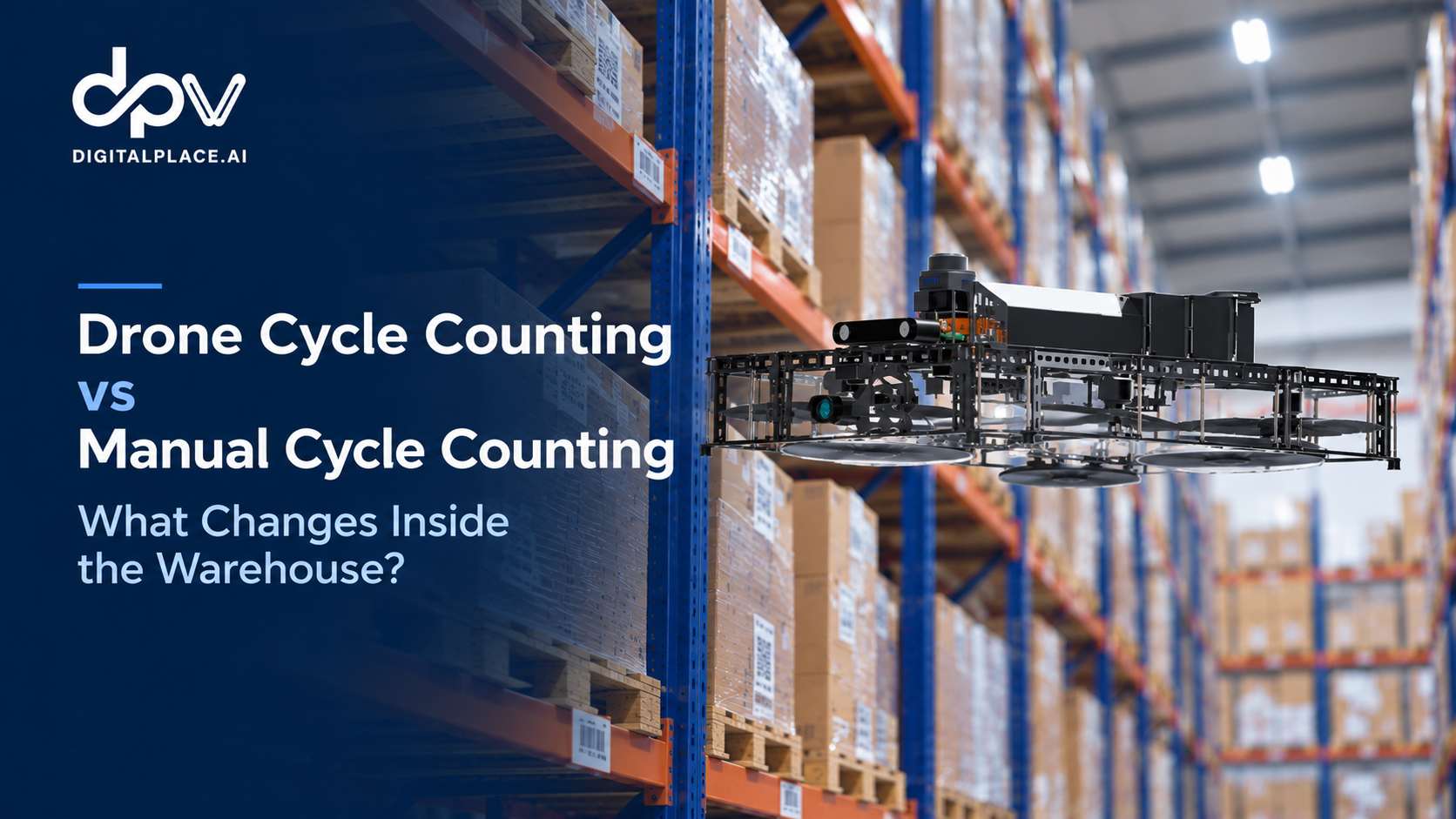
A cycle count can look deceptively simple from the outside: verify a location, confirm what is physically there, compare it with the system, and correct any discrepancy. But inside a warehouse, the way that count is performed changes much more than the counting step itself.
Manual cycle counting depends heavily on people moving through aisles, reaching rack locations, scanning labels, recording observations, and coordinating around normal warehouse activity. Drone cycle counting changes that operating model. The warehouse still needs inventory control, exception handling, and reconciliation, but the repetitive physical verification layer can become more automated and more repeatable.
That difference matters because inventory accuracy is not only about whether a count is correct. It is also about how frequently locations can be checked, how much operational effort is required, and how quickly discrepancies become visible.
Digitalplace.ai supports warehouse operators as an AI-powered warehouse inventory drone partner.
The comparison is therefore not simply “drone versus person.” It is about how the inventory-control workflow changes when routine physical verification no longer depends entirely on warehouse staff walking every aisle.
Read more
Drones for Warehouse Inventory: From Manual Cycle Counting to Daily Inventory Verification
Warehouse Inventory Accuracy: Why Manual Cycle Counts Find Errors Too Late
Manual Cycle Counting Starts With Human Movement
In a traditional manual cycle count, people are part of nearly every physical step.
A counter receives a list of locations or SKUs, travels to the required aisle, finds the correct rack position, scans or reads the label, checks the physical inventory, and records the result. If the location is difficult to access, the process may also require additional equipment or support from other warehouse staff.
For lower rack positions, this workflow may be relatively straightforward. But the workload grows as warehouses become larger, aisles become longer, and storage becomes more vertical. The actual act of scanning a label may take only seconds; much of the time is often spent moving between locations, waiting for access, positioning equipment, and navigating around normal warehouse traffic.
This is why manual cycle counting can become operationally expensive even when the counting method itself is simple.
The warehouse is not only paying for the count. It is also absorbing the movement, coordination, and interruption required to make the count happen.
Drone Cycle Counting Changes the Physical Work
Drone cycle counting shifts much of that repetitive physical movement from people to an autonomous or semi-autonomous system.
Instead of sending a person to every selected rack location, a warehouse drone can follow a configured route, move along rack faces, and capture QR codes, barcodes, or other location identifiers. The result can then be reviewed against expected inventory records.
The important change is not that humans disappear from the process.
They do not.
Warehouse teams are still needed to define counting priorities, investigate discrepancies, correct records, maintain labeling standards, and resolve operational causes behind mismatches. What changes is where human time is spent.
Manual cycle counting concentrates human effort on collecting observations.
Drone cycle counting can shift more of that effort toward reviewing and resolving exceptions.
Access Equipment Becomes a Bigger Difference at Height
The contrast becomes more visible in high-bay storage.
A person checking inventory at ground level can often walk directly to the location. But verifying a pallet several levels above the floor may require a lift, forklift, elevated work platform, or another controlled access method. That introduces more coordination, more equipment, and more safety considerations.
This makes high-rack counting disproportionately expensive compared with lower-level counting.
Drone-based inspection changes this because the scanner moves vertically instead of the employee. The drone can approach upper rack levels while the operator remains on the ground, provided the warehouse environment, rack geometry, labels, and flight path are suitable for the system.
That does not automatically make every warehouse suitable for drones. Narrow aisles, poor label visibility, loose wrapping, difficult airflow, irregular rack structures, or other obstacles can reduce feasibility.
But where the physical environment is suitable, high-bay inventory verification is one of the areas where the operational difference between manual and drone counting becomes easiest to understand.
Scan Frequency Can Change the Inventory-Control Model
One of the most important differences is frequency.
Manual cycle counts are often scheduled around available labor and operational priorities. If counting more locations requires more people, more hours, or more interruption, there is a practical limit to how often the warehouse can repeat the process.
This matters because an inventory discrepancy exists before someone discovers it.
A pallet may be moved on Monday, but if that rack location is not checked again until the following week, the warehouse can operate for several days with an inaccurate location record. The problem may only become visible when a picker cannot find the pallet or when a later cycle count finally reaches that location.
Drone automation can make recurring verification easier to schedule.
Instead of asking, “How many employees can we allocate to counting today?” the warehouse can increasingly ask, “Which areas should the drone verify on this mission?”
That opens the possibility of different inspection frequencies for different risk profiles. High-movement zones might be checked more frequently, while slower areas may remain on a longer cycle.
The result is not necessarily “continuous inventory” in the literal sense. It is simply a shorter gap between physical observations.
And that shorter gap can reduce detection delay.
Count Coverage Can Become More Consistent
Another difference is coverage.
Manual counts often need to be prioritized. A warehouse may select certain SKUs, certain racks, or certain zones because checking everything too frequently would be unrealistic.
That means the quality of inventory visibility partly depends on which locations happen to be included in the counting schedule.
Drone cycle counting can make broad or repeated coverage more practical, especially when a predefined route can be run again without recreating the workflow from scratch.
A drone mission can be designed around a full facility, a selected aisle, high-rack locations, or other operationally important areas. Over time, this can create a more systematic physical-verification routine.
Typical areas where drone-based counting can change the workflow include:
- high-bay pallet locations that are slow to access manually,
- fast-moving aisles where inventory shifts frequently,
- locations where empty-slot verification is important,
- zones with repeated inventory discrepancies,
- routine full-area scans used to support inventory accuracy,
- and targeted counts that need to be repeated more frequently.
The benefit is not simply “more scans.”
The benefit is a more repeatable relationship between what the warehouse system says and what is physically observed.

What Actually Changes When Cycle Counting Moves From Manual to Drone-Assisted?
The biggest difference is not simply who scans the inventory. It is how often locations can be verified, how much physical effort is required, and where warehouse teams spend their time.
The real change: from collecting every observation to investigating exceptions
Drone cycle counting does not remove inventory control. It changes where human effort is used: less time gathering routine observations, more time resolving the inventory exceptions that actually matter.
Inventory Count Becomes Location Verification
This is where the discussion moves beyond quantity.
A traditional inventory count often focuses on whether the physical amount matches the system quantity. But in a warehouse, location accuracy can be just as important.
Imagine the system says Pallet X should be in Rack A-04-02.
The pallet physically exists, but it has been moved to Rack A-05-02 without the system being updated.
A total inventory count might still say the warehouse has the correct number of pallets.
Operationally, however, the record is wrong.
The pallet may be unavailable to the picker who expects to find it at the original location. Someone may need to search nearby racks, contact another team, or investigate movement history before the order can proceed.
This is why drone cycle counting is better understood as part of a broader inventory verification process. The objective is not only to ask whether inventory exists, but whether the physical warehouse still matches the digital record.
Exception Handling Becomes More Important Than Routine Scanning
As physical verification becomes more automated, the role of inventory-control teams changes.
The warehouse still needs people, but the work can move away from repetitive scanning toward exception handling.
If the system expects a pallet and the drone confirms the same pallet at the expected location, there may be little reason for a person to revisit that position.
If something does not match, that is where human attention becomes valuable.
The discrepancy may involve an unrecorded move, an unreadable label, incorrect putaway, an empty location, or a transaction that was not completed correctly. Those are operational problems, not just scanning problems.
This creates a different workflow:
verify broadly, investigate selectively.
That is a major shift from a model where every observation requires someone to physically reach the location.
As an AI-powered warehouse inventory drone technology partner, Digitalplace.ai can help automate recurring rack and pallet verification while allowing warehouse teams to focus more of their effort on investigating inventory exceptions and maintaining accurate warehouse records.
Operational Disruption Can Be Reduced, Not Eliminated
Manual cycle counting often happens while the warehouse is still operating.
That means counters share the same aisles with forklifts, picking teams, replenishment activity, and other warehouse traffic. High-rack inspection can also require equipment that temporarily affects aisle access.
Drone counting can reduce some of this disruption because fewer people and less access equipment may be needed for routine verification.
However, “minimal disruption” should not be confused with “no operational planning.”
Drone missions still need to fit warehouse traffic patterns, safety procedures, flight-clearance requirements, and local operating rules. In some environments, missions may work best during quieter periods or scheduled windows.
The difference is that recurring counts can become less dependent on organizing a labor-heavy counting exercise.
Manual Counting Still Has a Role
Drone automation does not make manual cycle counting obsolete.
There are situations where people remain the better option.
Irregular storage, damaged labels, mixed loose inventory, cartons without consistent identification, congested aisles, or locations that are unsuitable for autonomous flight may still require manual inspection. Humans are also essential when a discrepancy needs physical investigation beyond what a camera can determine.
The practical future is therefore more likely to be hybrid.
Drones can perform repetitive, structured verification across suitable rack locations, while people handle irregular cases, exceptions, root-cause investigation, and corrective action.
This is a more realistic way to evaluate the technology than assuming every inventory task should be automated.
What Really Changes Inside the Warehouse?
The biggest change is not simply that a drone replaces a person with a scanner.
It is that inventory verification becomes easier to repeat.
Manual cycle counting is constrained by labor, walking time, access equipment, and operational coordination. Drone cycle counting can reduce some of those constraints, potentially allowing warehouse teams to inspect selected locations more frequently and more consistently.
The workflow shifts from:
people collecting every observation → people investigating the observations that do not match.
That can change how warehouses think about inventory accuracy.
Instead of waiting for the next scheduled manual count to discover that a pallet has moved, a location is empty, or a rack record is incorrect, the goal becomes to shorten the time between a physical change and its detection.
Ultimately, the comparison between drone cycle counting and manual cycle counting is not really about who—or what—can scan a barcode faster.
It is about creating a warehouse where the gap between physical inventory and digital inventory records is discovered earlier, investigated faster, and allowed to remain inaccurate for less time.




