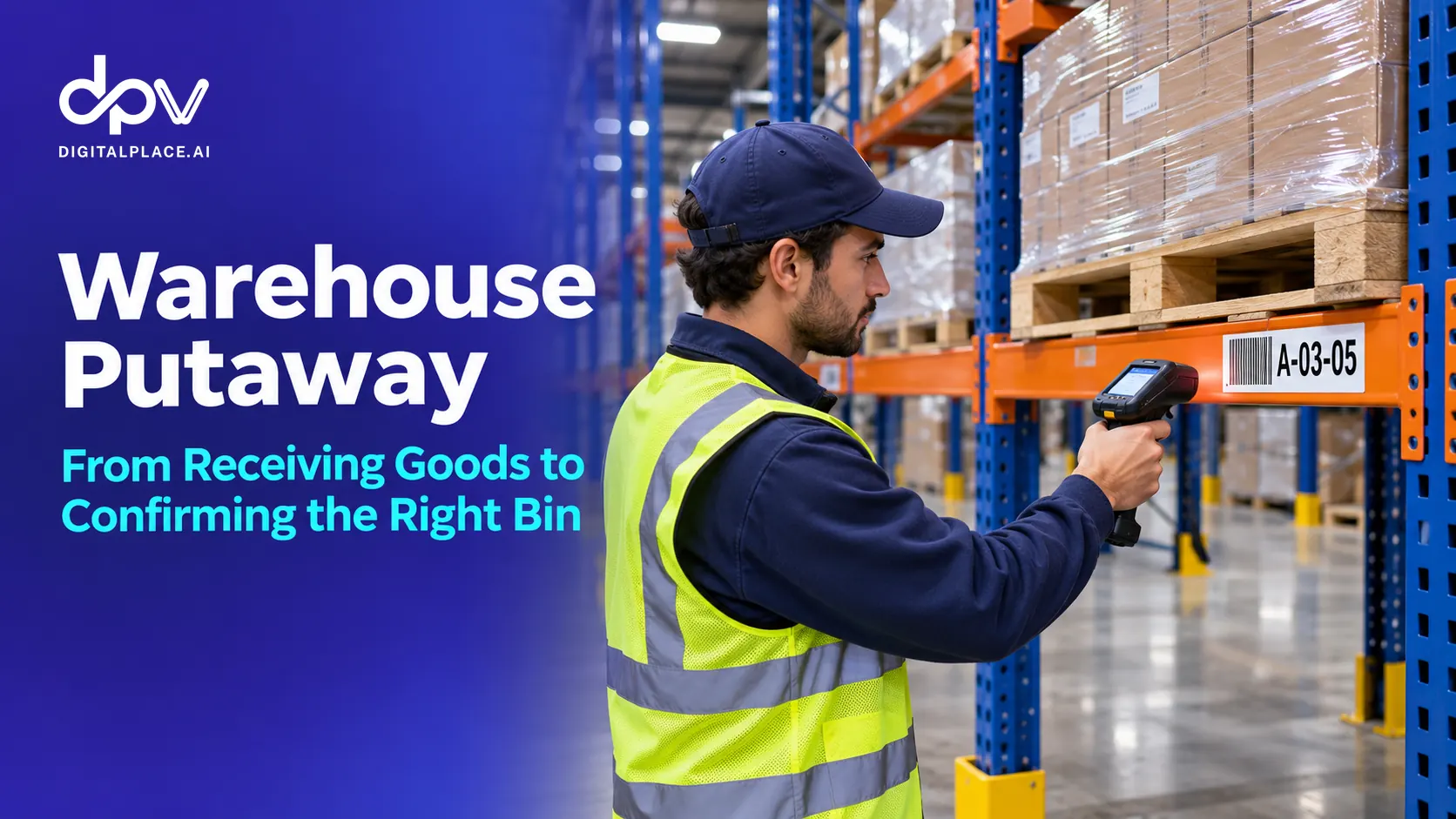
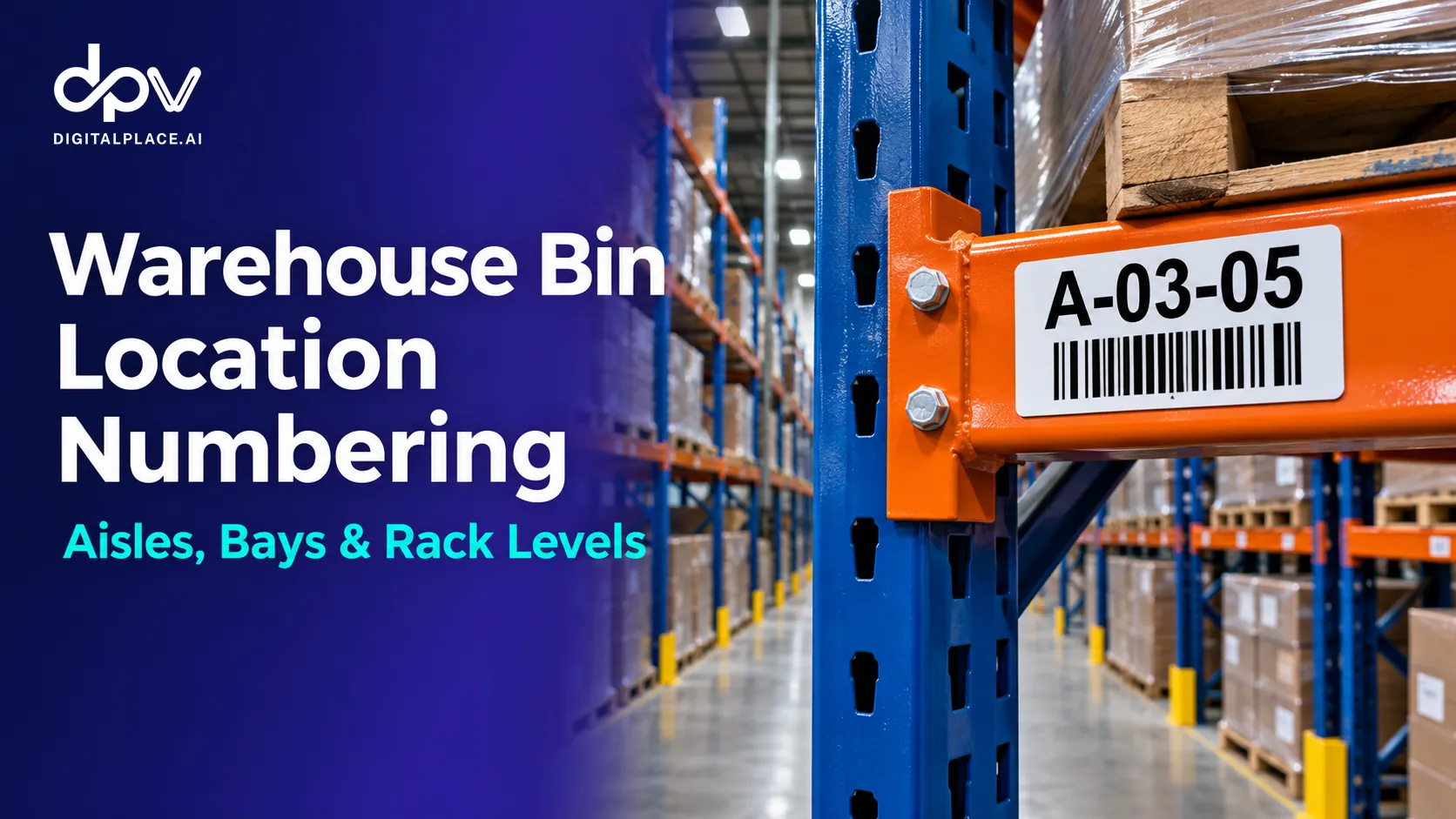
A carton is scanned successfully at A-03-05. The warehouse management system (WMS) expects it at A-03-04. Which part of the scan tells the team that the carton is one level too high?
The QR code on the carton identifies what the operator found. The rack address tells the operator where it was found. To spot the error, the warehouse needs to record both pieces of information together. A perfectly readable carton label can still produce an incomplete inventory record if nobody confirms the location.
A warehouse bin location numbering system gives each storage position a unique address. The best test of that address is practical: can a new picker read it, walk to the rack, and identify exactly which position to check?
How to read a warehouse bin location code
In this example warehouse, the address follows the sequence aisle → bay → level. An aisle is the passage between racks. A bay is one section of rack between two upright frames. A level is a storage height within that bay. Here, the warehouse numbers its levels from the bottom up, starting at 01.
Part of A-03-05 | Meaning in this warehouse | What the picker does |
|---|---|---|
A | Aisle A | Find the aisle entrance marked A. |
03 | Bay 03 | Follow the bay signs to the third bay. |
05 | Level 05 | Look up to the fifth storage level in that bay. |
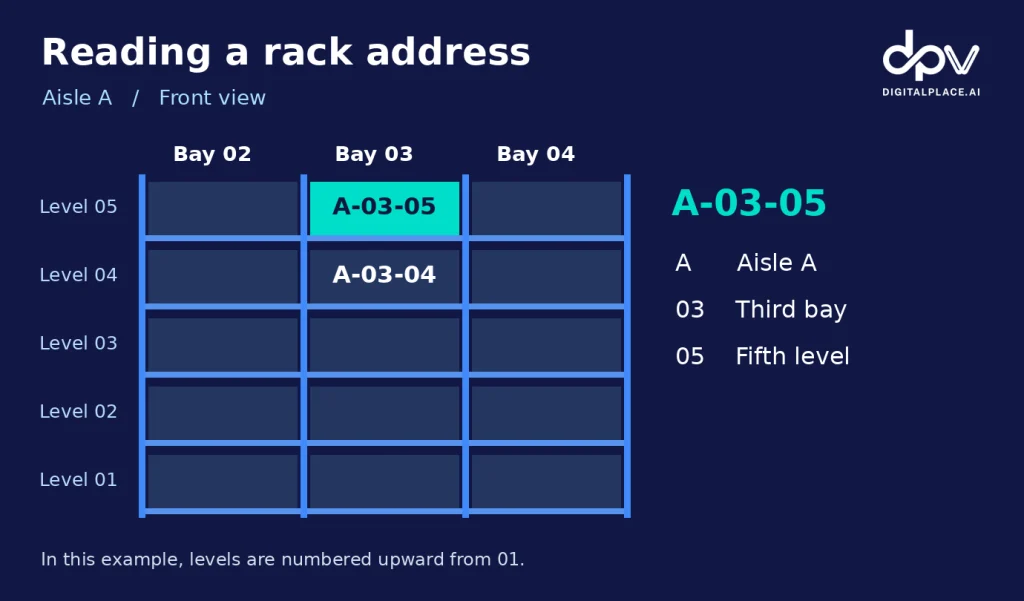
In this layout, A-03-04 and A-03-05 share the same aisle and bay. Only the height changes. Moving one bay to the right at the same height would take the picker to A-04-05.
That distinction matters because warehouses choose their own conventions. At another site, the last two digits might identify a position along the beam. Document what each segment means and use the same sequence on the rack, in the WMS, and on picking instructions.
How to design a numbering system that identifies one physical position
Start with one rack face and work outward. Decide where bay numbering begins, how it continues down the aisle, and how someone entering from the opposite end can tell which way the numbers run. A sign such as “Aisle A · Bays 01–12 →” gives a picker more information than the letter A alone.
Next, check two places where a three-part code can become ambiguous.
Two rack faces share an aisle. Suppose both sides of Aisle A have a Bay 03. If each side also has five levels, A-03-05 could lead to two different positions. One option is to assign odd bay numbers to one face and even numbers to the other. Another is to add a rack-face identifier. If you use left and right, define them from a fixed entrance so they mean the same thing to staff approaching from either direction.
Two pallets fit side by side on one level. If the WMS needs to track each pallet independently, the address must distinguish those positions. For example, A-03-05-01 and A-03-05-02 can identify the first and second pallet positions on the same beam. The team can then release one position for an incoming pallet while the other remains occupied.
Use a consistent format, including leading zeros. A-03-05 and A-3-5 may look equivalent to a person, but a printed label, spreadsheet import, and WMS lookup should all use the exact address the warehouse has approved.
What belongs on a rack label and what belongs on a carton?
Racking location labels identify places. A rack label stays in position when the inventory moves. A carton label travels with the goods. Keeping those identities separate allows the same rack position to hold cooking oil today and canned tomatoes next week without changing its address.
| Label | What it identifies | What a successful read tells the team |
|---|---|---|
| Rack location label | A fixed storage address, such as A-03-05 | Which location was scanned |
| Carton QR label | The item, lot, or individual carton encoded in the QR | Which goods or identifier were observed |
| Carton and location recorded together | An observation tied to a place and time | Whether the observed goods match the WMS expectation for that position |
There is one detail worth checking before relying on carton scans: what does the QR actually identify? If every carton of the same cooking oil carries the same SKU code, a scan confirms the product type. To tell two identical cartons apart, the warehouse needs a unique carton identifier. To establish which pallet a carton belongs to, it also needs a recorded carton-to-pallet relationship.
What happens when the carton is one level too high?
Suppose carton C-418 has a unique QR code. The WMS assigns it to A-03-04. During a rack check, an operator reads C-418 at A-03-05, one level above its expected position. The warehouse still has the carton, but a picker sent to level 04 can leave empty-handed.
The supervisor now has a specific discrepancy to investigate. First, confirm the rack address and carton ID. Then check the latest putaway or transfer record. If the carton was intentionally moved and the transaction is still open, complete the location update. If the operator stored it in the wrong position, follow the site’s procedure for an authorized move. A quantity adjustment alone would leave the picker with the same wrong address.
Digitalplace.ai illustrates how warehouse drones verify inventory locations. On a configured route, a readable carton QR can be associated with the rack position where it was observed. That gives the inventory team a specific location to review. If the QR cannot be read, the identity of the carton at that position remains unconfirmed.
Where should warehouse bin location labels go?
Position warehouse bin location labels where operators can identify the destination at the point of work. Consider a beam with two pallet positions. A single label halfway between them invites guesswork. Place each label consistently in relation to its own position and use a directional marker where the association would otherwise be unclear.
For high racks, a ground-level panel can list addresses for the levels above. Make the level number prominent and test the panel from the operator’s normal working position. There is an important limitation: scanning a ground-level code for level 05 records the selected address. The team still needs a way to confirm that the goods were physically placed on level 05. This is particularly relevant when an operator confirms the actual bin during warehouse putaway.
If your team is evaluating InfiniDrone from Digitalplace.ai, test one representative aisle with its usual carton orientation, stretch wrap, lighting, and neighboring labels before rolling out the design across the warehouse. Include two adjacent positions containing the same SKU. That is a useful test of whether the team can distinguish the locations even when the products look identical.
Test one aisle before printing the remaining labels
Give a picker who did not design the numbering system three tasks:
- Find
A-03-05from the opposite end of the aisle. Can the picker reach the correct rack face, bay, and level without asking for directions? - Identify the position directly below it. In the example layout, the answer is
A-03-04. Check that the physical label and the WMS agree. - Confirm a carton at the wrong level. Place a test carton at level 05 while the test record expects level 04. Can the workflow capture both the observed location and the mismatch?
The third task is the most revealing. A system that only reports “scan successful” leaves the supervisor with another question. A system that reports “Carton C-418 expected at A-03-04, observed at A-03-05” gives the team a location it can investigate before the next pick.