Ask a warehouse manager when they last fully trusted the stock figures in their system, and you’ll usually get a pause. The team isn’t careless; stock simply moves faster than anyone can check it. A pallet gets put away in the wrong bay. A picker takes from the nearest location instead of the assigned one. A return lands wherever there’s space.
Cycle counting is how well-run warehouses close that gap. Instead of shutting down once a year for a full stocktake, they count a small, planned slice of inventory every day, so errors surface while they’re still cheap to fix.
Digitalplace builds drone-based inventory verification for warehouses, so this guide pays extra attention to the part of cycle counting that is hardest to keep up with: high-bay locations that need a forklift, a second person and a quiet moment on the floor before anyone can check them. Below, you’ll find what cycle counting is, the main methods (including ABC cycle counting), a step-by-step process, the KPIs worth tracking, and where automation fits.

What is cycle counting?
Cycle counting is an inventory auditing method where a warehouse counts a subset of its locations or SKUs on a recurring schedule, compares the result with the system record, and corrects any differences. Over a defined period, often a year, every item or location gets counted at least once, and high-value or fast-moving items get counted much more often.
The key difference from a full physical inventory is continuity:
| Full physical inventory (stocktake) | Cycle counting | |
|---|---|---|
| Frequency | Once or twice a year | Daily or weekly, in small batches |
| Operations | Usually paused or heavily restricted | Continue while counting |
| Error detection | Months after the error happened | Days or weeks after |
| Root-cause analysis | Hard; too many errors at once | Practical; errors are fresh and traceable |
| Staffing | Large one-off team, often overtime | Small, routine effort |
A full stocktake tells you what went wrong this year. Warehouse cycle counting tells you what went wrong this week, while you can still find out why.
Cycle counting methods
There’s no single right method. Most warehouses combine two or three, depending on their SKU mix, rack layout and how much labor they can spare.
1. ABC cycle counting
The most common approach. Items are ranked by value or movement and split into classes, each with its own count frequency. (More on this in the next section.)
2. Random sample counting
A random set of locations or SKUs is selected each day. It’s simple and unbiased, which makes it useful for checking overall accuracy. The weakness: important items can go uncounted for too long purely by chance.
3. Control group counting
A small, fixed group of items is counted repeatedly over a short period. Because the items don’t change, any recurring difference points to a process problem (a receiving step, a unit-of-measure mix-up, a putaway habit) rather than a one-off mistake. It’s a diagnostic tool more than a long-term program.
4. Opportunity-based counting
Counts are triggered by events: a location hits zero, stock drops below the reorder point, or a replenishment task brings someone to the location anyway. It costs little extra effort because the counter is already there.
5. Location- or zone-based counting
Instead of counting by SKU, the warehouse counts by area: aisle by aisle, or rack zone by rack zone. This method catches what SKU-based counts often miss: location errors. The quantity might be right, but the pallet is in the wrong bay, or a location the system marks as empty is actually full. Location-based counting is also the method that automates most naturally, because a scanner (or a drone) can follow the physical layout of the racks.
ABC cycle counting: how to classify items and set frequency
ABC cycle counting applies the Pareto principle to inventory. A small share of SKUs usually drives most of the value or movement, so those SKUs deserve the most attention.
Step 1: Rank your SKUs. Use annual consumption value (units moved × unit cost) or pick frequency, whichever better reflects your risk.
Step 2: Split them into classes. A common split:
- A items: roughly the top 10–20% of SKUs, often 70–80% of value
- B items: the next 20–30%
- C items: the remaining 50–70%, low value or slow-moving
Step 3: Assign count frequencies. A typical starting point is A items monthly, B items quarterly and C items twice a year.
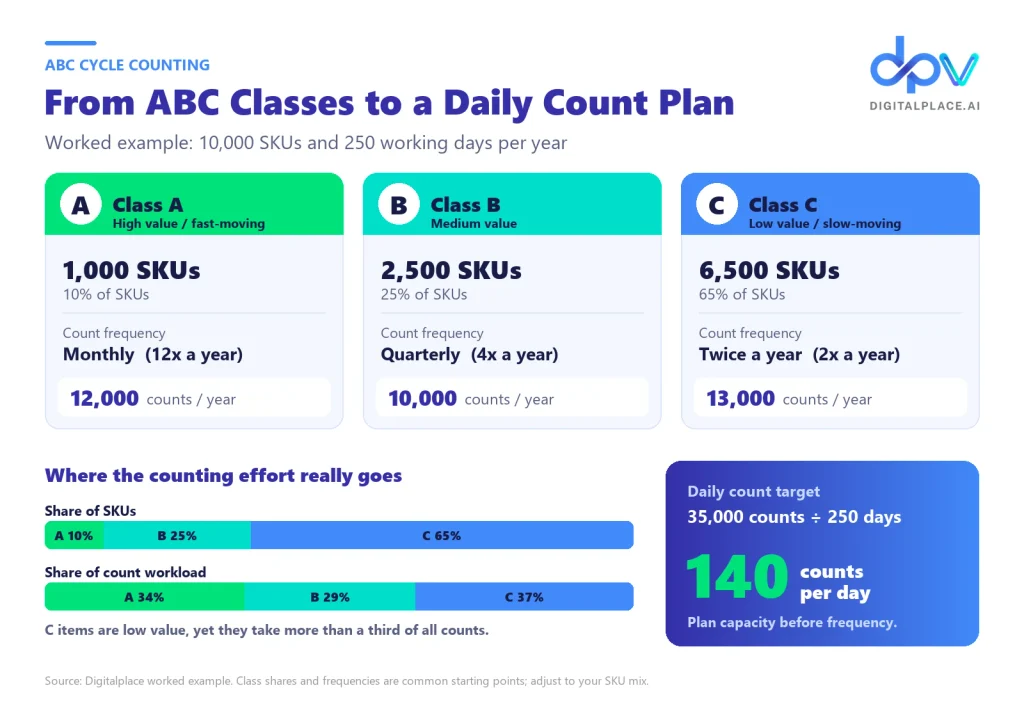
Here’s what that looks like for a warehouse with 10,000 SKUs and 250 working days a year:
| Class | SKUs | Counts per year | Total counts |
|---|---|---|---|
| A | 1,000 (10%) | 12 | 12,000 |
| B | 2,500 (25%) | 4 | 10,000 |
| C | 6,500 (65%) | 2 | 13,000 |
| Total | 10,000 | 35,000 counts / 250 days = 140 counts per day |
That daily number is your real planning figure. If your team can’t sustain 140 counts a day alongside receiving, putaway and picking, the plan will slip, and C items are usually the first to be skipped.
Step 4: Review the classes regularly. Seasonal products, promotions and new SKUs change the ranking. A quarterly reclassification keeps the plan honest.
ABC counting has one blind spot: it is built around items, not places. A perfectly counted A item can still sit in the wrong location. That’s why many warehouses pair ABC counting with periodic location checks across the whole facility.
How to run a cycle count, step by step
- Define the scope. Pick today’s SKUs or locations from your ABC plan, random sample or zone schedule.
- Time it well. Count during low-activity windows, or temporarily hold movements for the locations being counted.
- Use blind counts. Counters record what they see without seeing the system quantity. This removes the temptation to “confirm” the expected number.
- Record the result digitally. Scanning location and pallet labels is far more reliable than writing on count sheets and keying them in later.
- Compare with the system. Flag every difference above your tolerance (for example, any variance on A items, or more than 2% on C items).
- Recount the variances. A second count, ideally by a different person, confirms whether the difference is real.
- Find the root cause. Was it receiving, putaway, picking, a unit-of-measure error, or an unrecorded move? Without this step, the same errors return next month.
- Adjust and approve. Post the correction in the WMS with a reason code and an approver.
- Report. Track accuracy and completion so you can see whether the program is actually working.
Cycle counting KPIs to track
A cycle counting program is only as good as the numbers that show whether it’s working. These fit naturally into your wider set of warehouse KPIs:
- Inventory record accuracy (IRA): counted SKUs or locations that match the system (within tolerance) ÷ total counted × 100. Many warehouses aim for 97% or higher.
- Location accuracy: locations where the right item sits in the right place ÷ locations checked. This is often lower than IRA, and often ignored.
- Count variance: the absolute difference between counted and system quantities, in units and in value.
- Adjustment rate: how often counts lead to a stock correction. A rising rate points to an upstream process problem.
- Cycle count completion rate: counts completed ÷ counts scheduled. If this sits well below 100%, your frequency plan exceeds your capacity.
Watch the last one closely. A cycle counting plan that looks great on paper but only reaches 60% completion is quietly turning back into an annual stocktake.
Common warehouse cycle counting problems
Most programs don’t fail because of the method. They fail because counting competes with everything else happening on the floor.
- High-bay racks are slow to reach. Upper levels need a forklift or order picker, an operator and a spotter. These counts get postponed first.
- Counting disrupts operations. Blocking an aisle for a count delays picking and replenishment, so counts get pushed to nights or weekends.
- Moved pallets go unnoticed. Quantity-based counts don’t catch a correct pallet in the wrong location, and misplaced pallets and empty locations can stay hidden for weeks.
- Human error and fatigue. Repetitive counting at height, under time pressure, leads to skipped labels and transcription mistakes.
- Manual data entry. Count sheets keyed in hours later add another layer of errors and delay.
- Labor cost adds up. The hidden costs of manual cycle counting go well beyond wages: equipment time, interrupted workflows and the cost of errors found too late.
Automating cycle counts: scanners, RFID and drones
Automation doesn’t replace a good counting method; it makes the method sustainable. Each option solves a different part of the problem:
- Handheld barcode or QR scanners remove manual data entry and are the baseline for any modern program. They still need someone to reach every location.
- RFID can read many tags at once, but it requires tagging every pallet or item and installing readers, which is a bigger investment and harder to coordinate across suppliers.
- Fixed cameras work well for specific zones like dock doors, but covering every rack face is rarely practical.
- Inventory drones fly along the aisles and scan location and pallet labels at every rack level, including high-bay positions, without forklifts or staff working at height.
That last category is where Digitalplace works. Its warehouse inventory drone follows predefined flight paths between racks, reads QR or barcode labels and confirms pallet locations. It runs without GPS and without new Wi-Fi infrastructure. Setup comes down to measuring the aisles and racks once, configuring missions in a web platform, and then running scans as often as needed. Results can be reviewed in the platform, uploaded, or connected to the warehouse’s WMS.
The time difference is significant. In Digitalplace’s own comparison, checking 500 bin locations manually takes more than 90 minutes, at least two people, a forklift and some interruption to warehouse operations; a drone covers the same 500 locations in about 15 minutes with one person, and every scanned location comes with photo proof.
Drones fit best in a specific kind of warehouse:
- QR-labelled pallets in structured racking (QR modules of at least 3 mm)
- Aisles at least 2 m wide, rack levels at least 0.6 m high, racks up to 20 m
- Clear flight paths with no loose wrap or hanging material, and airflow below 5 m/s
- Standard temperatures between 10°C and 45°C (cold storage isn’t a current fit)
They’re strongest for location-level verification and full-pallet checks: moved pallets, empty locations, high-bay zones and full-facility scans. For a detailed side-by-side, see our guide to drone cycle counting vs manual cycle counting.
In practice, the most effective setup combines both: ABC cycle counting keeps item-level accuracy under control, and scheduled drone scans keep location accuracy high across the racks people rarely have time to reach. Digitalplace calls this daily inventory verification: a short, routine check that replaces the big, disruptive count.
Building a cycle counting program that lasts
Cycle counting works when it’s small, frequent and honest about capacity. Start with a clear ABC split, set frequencies your team can actually sustain, use blind counts and recounts, and always chase the root cause, not just the adjustment. Then look at where your counts keep slipping. For most warehouses, that’s the high-bay locations.
If that sounds familiar, Digitalplace can assess whether your racks, labels and aisles are a good fit for drone-based cycle counting. Explore the warehouse inventory drone or get in touch to plan a pilot.
FAQ
A physical inventory counts everything at once, usually once a year, and often pauses operations. Cycle counting checks a small part of the inventory on a regular schedule while the warehouse keeps running, so errors are found and fixed much earlier.
ABC cycle counting ranks SKUs by value or movement into A, B and C classes and counts each class at a different frequency. High-value A items are counted most often, while low-value C items are counted least.
Many warehouses target an inventory record accuracy of 97% or higher. Location accuracy, meaning the right item in the right place, is worth tracking separately because it is often lower.
Yes. Inventory drones scan QR or barcode labels on racks and pallets to verify locations, including high-bay positions, without forklifts. They work best in warehouses with QR-labelled pallets, clear aisles and standard temperatures.