
Six oat drink cartons face the aisle. Every label points forward, the price tickets are straight, and there is no gap for a shopper to notice. Yet the breakfast aisle has a shelf issue. Original Oat 1 L should occupy the first three positions and Barista Oat 1 L the next three. This morning, Original has two. Barista has four.
A shopper can still buy either variety. What has changed is how much space each one gets and which carton sits above the third Original price ticket. An instruction to “fill the shelf” would be hard to act on. The shelf is already full.
Planogram compliance checking means comparing the products on a shelf with the approved layout for that store. A useful audit tells the person working the aisle exactly what to change and gives the supervisor a way to verify the result. Here is how that works for the missing Original facing, from the first recording to the follow-up check.
Confirm which planogram applies to the bay
Before asking anyone to move a carton, check the store, fixture and effective date on the planogram. A compact branch might have a narrower breakfast bay than the flagship store. A promotion might also have an approved layout of its own. A clear recording compared with the wrong plan can send a colleague to undo a display that was correct in the first place.
For this example, the shift supervisor confirms that the current layout for Bay 4, middle shelf, calls for three Original facings followed by three Barista facings. A facing is one product front visible to the shopper. Three cartons standing one behind another occupy one facing. That distinction matters here because moving a carton from the back of one lane to the front of an adjacent lane may restore the layout without bringing any new stock onto the shop floor.
Record the shelf from the shopper’s side
Start the shelf video far enough back to show the full run of six facings, its shelf edge and a recognisable bay marker. Move steadily across the section, keeping the pack fronts in view. The words “Original” and “Barista” matter more in this case than the brand logo they share. If glare hides the variant name, take a closer view while keeping the wider recording for context.
The first usable frame shows Original, Original, Barista, Barista, Barista, Barista. Keep that frame with the store, bay and capture time. It answers a question a close-up of the misplaced carton cannot: which of the four Barista cartons is occupying Original’s space?
Across multiple stores, reviewing every second of every aisle recording would give supervisors another time-consuming job. Digitalplace.ai’s On-Shelf Availability & Planogram Compliance solution uses scheduled shelf checks to flag issues such as misplaced products, gaps and planogram mismatches. With mobile shelf video, a team can review a flagged section, confirm the variant and location, and send the relevant evidence to the person responsible for that aisle.
Compare the facings and choose the right action
Record one placement issue for position three. Original’s missing facing and Barista’s extra facing describe the same carton in the same place. Opening two replenishment tasks could send one colleague to fetch more Original while another fills the space with Barista again.
Both products were available when the shelf was recorded. The finding concerns their placement and the space allocated to each. Digitalplace.ai explains how a shelf can pass an availability check and still fail a layout check in Planogram Compliance vs On-Shelf Availability.
| What the camera sees | What the planogram expects | What store staff should do |
|---|---|---|
| Original occupies positions 1 and 2. Barista starts at position 3. | Original should also occupy position 3. | Check the variant and pack size in that position. Look for another sellable Original carton behind the front row or in the backroom. |
| Four Barista fronts are visible across positions 3–6. | Barista has three facings, in positions 4–6. | Move the extra Barista carton behind a matching facing if there is room, or return it to the correct backstock location. |
| A follow-up image shows three Original fronts but cuts off the right edge of the bay. | The full sequence should show three Original followed by three Barista. | Capture all six positions so the supervisor can verify the neighbouring SKU as well. |
Give one person a specific correction
“Fix oat drinks” leaves the colleague on the shop floor to repeat the audit. A useful assignment fits on a phone screen and tells them where to go, what to change and what to capture afterwards.
Breakfast aisle, Bay 4, middle shelf. Move the Barista Oat 1 L carton out of position 3. Restore Original Oat 1 L to positions 1–3 and keep Barista in positions 4–6. Send a new image showing all six facings before the next shift handover.
In this case, the aisle colleague finds a third Original carton behind the first. They use it to restore position three and move the extra Barista carton behind its own front row. There is no need to open a case in the backroom.
What if those first two cartons are the only Original stock left? The colleague can correct the misplaced Barista, record the remaining gap and request replenishment. Original is still available in two facings, but the planned third facing cannot yet be restored. Keep that distinction in the handover so the next shift knows what is missing and why the task remains open.
Verify the fix before closing the task
Take a second image from the aisle after the correction. Use the same bay marker and include the full shelf width covered by the first recording. The reviewer should be able to identify the location, both 1 L variants and the complete three-plus-three sequence. A photo of three Original cartons in someone’s hand proves that stock was found. The evidence needed to close this task is those cartons in their approved positions.
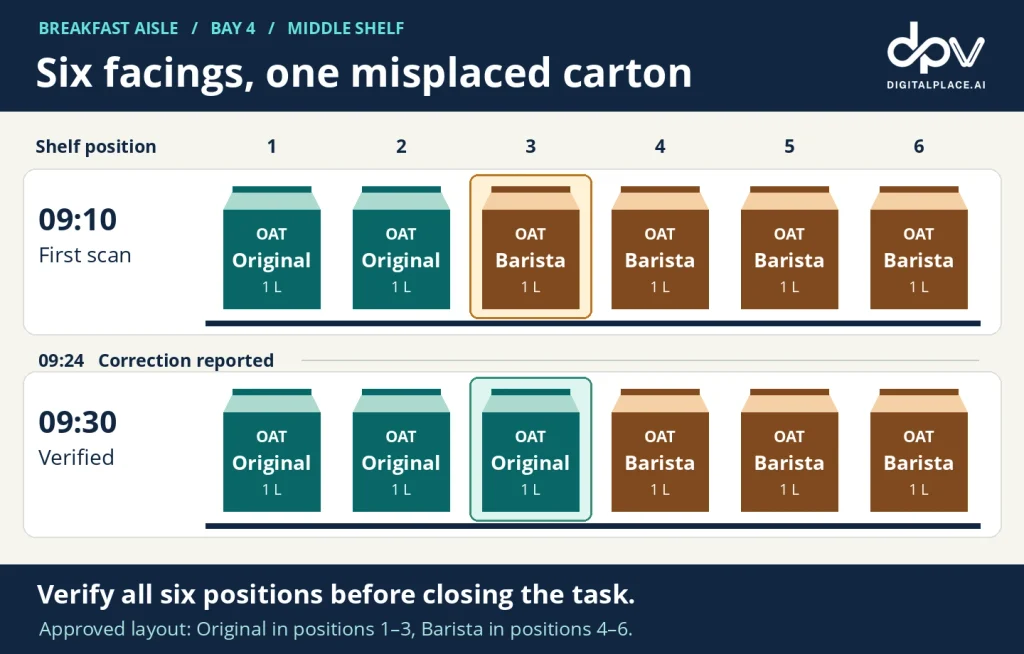
Suppose the first recording was taken at 09:10. The colleague reports the move at 09:24, and the supervisor verifies the new shelf image at 09:30. Record 09:24 as the reported correction time and 09:30 as the verification time. If the shift manager later asks how long it took to confirm the shelf was back to plan, the answer is 20 minutes from detection. If the image is blurred or shows a different bay, request another capture and retain the original finding.
What if the same facing is wrong again tomorrow?
A repeat mismatch deserves a different question. What prompts the next person stocking the shelf to put Barista back in position three? Watch one refill before assigning another routine correction. The versions might look nearly identical from the top of an open case. The shelf-edge ticket might sit on the boundary between two lanes. Or the replenishment team might be working from an older copy of the plan.
The answer determines who can prevent a repeat. An outdated layout goes to the person distributing planograms. An unclear ticket goes to the colleague maintaining shelf labels. If the shelf physically cannot hold the approved facings after a packaging change, the merchandising team needs the bay measurement and pack width before issuing a revised plan.
For a supervisor reviewing several branches, track how many due corrections have a verified follow-up and how often the same SKU and bay reappear in later checks. That gives the morning team two useful lists: shelves someone still needs to visit, and shelves where a correction has already failed to hold.