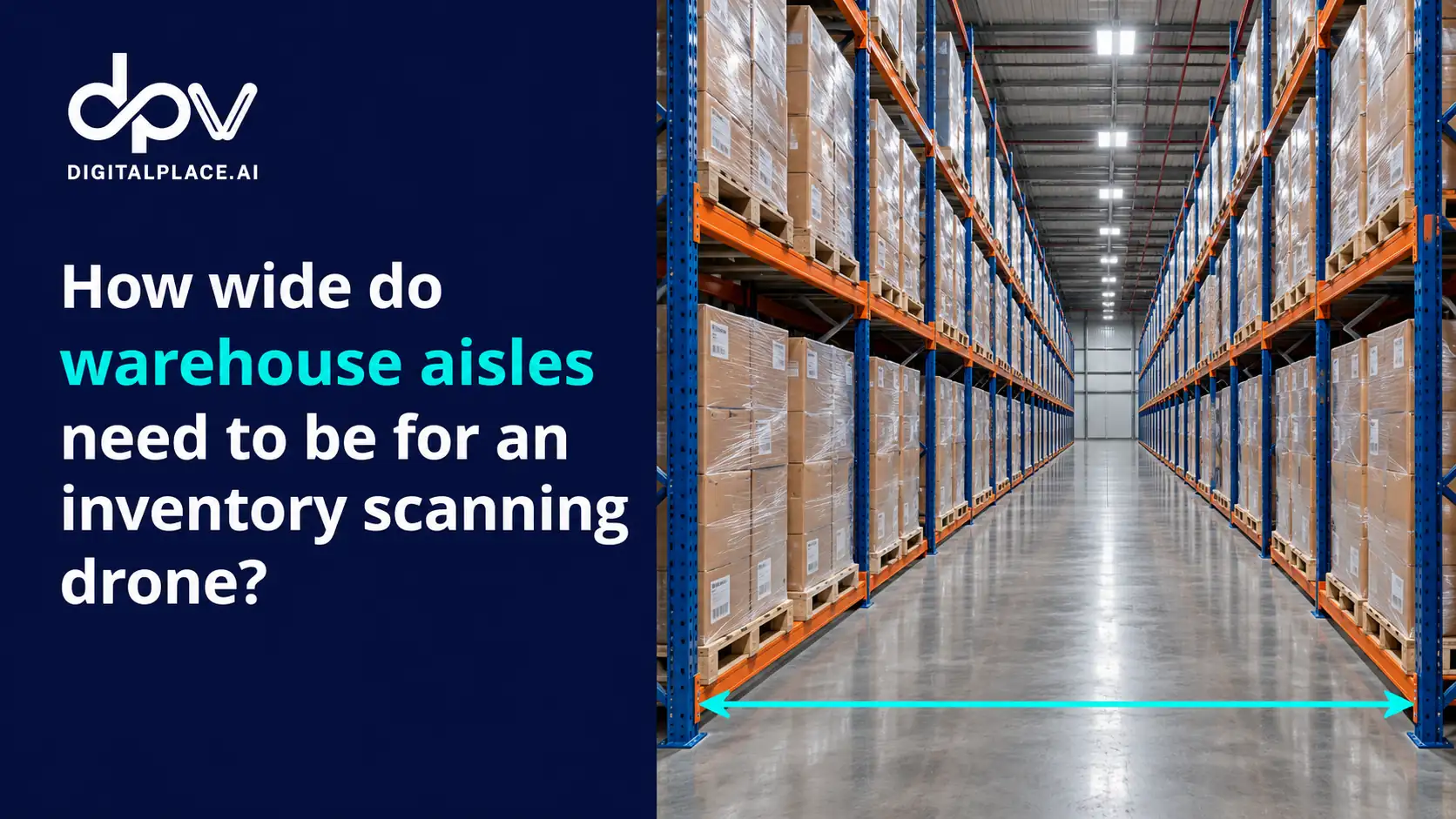
Digitalplace.ai specifies at least 2 metres of clear width between opposing rack faces for its inventory scanning drone. For a first site assessment, measure the narrowest point along the proposed route with the racks loaded as they would be on a normal shift. A floor plan showing 2.2 metres between racks can still leave less than 2 metres where a load projects into the aisle. The figure is specific to this system. Other drone models may have different requirements.
How to measure the clear aisle width
Start with one aisle where your team regularly checks stock at height. Record the distance across the aisle from one rack face to the other. Then look along the route at the levels the drone would scan. A pallet sitting slightly forward on an upper beam can reduce clearance even when the floor below is clear. Record where the tightest point occurs, at which level, and what projects into the gap.
Read more
Warehouse Inventory Drones in Singapore: From Manual Cycle Counting to Daily Inventory Verification
Understanding Inventory Accuracy as a Warehouse KPI in Singapore
Consider an illustrative example from a grocery distribution centre in western Singapore. Its floor plan shows a 2.20-metre aisle. At one bay, a pallet load extends 15 centimetres beyond the rack face on one side. Directly opposite, cartons extend another 10 centimetres into the same gap.
| Measurement at the same bay and height | Width |
|---|---|
| Distance between rack faces | 2.20 m |
| Space occupied by the two overhangs | 0.15 m + 0.10 m |
| Clear width at the narrowest point | 1.95 m |
That bay falls 5 centimetres short of the width requirement. The supervisor now has a specific decision to make. If the loads can be repositioned under the site’s usual handling procedures, the team can measure the gap again. If these cartons routinely overhang because of their dimensions, an adjacent aisle may be a better pilot location. A reading of exactly 2 metres meets the stated width criterion. The remaining site checks still apply.
What else determines whether the aisle is suitable?
A tape measure answers the width question. It cannot tell you whether a camera will see the labels or whether the route stays clear at the top beam. The deployment specifications give the site team several other conditions to check before selecting an aisle.
| Site check | Current deployment guidance |
|---|---|
| Rack geometry | Rack height up to 20 m, with at least 0.6 m between rack levels. |
| Flight space | Check the route at every proposed scan level for pipes, sprinklers, protruding loads and dangling stretch wrap. Include floor storage in the walk-through. |
| Airflow | The specified upper limit is 5 m/s. Check the proposed route where wall or ceiling fans direct air towards the racks. |
| Operating temperature | The system has been tested in standard warehouse environments at 10–45°C, with or without air conditioning. Cold or frozen areas below 10°C and extremely dusty sites fall outside the current recommended conditions. |
| Label readability | The specified minimum is 3 mm per module. For a QR code, a module is one small square in the pattern. Measure the square itself rather than the overall sticker. |
For a Singapore food distributor choosing between an ambient grocery aisle and a chilled aisle, temperature can settle the choice before width does. A chilled aisle operating at 4°C falls outside the recommended range even if it has ample clearance. An ambient aisle with repeated high-bay counts is a more useful place to assess the first route, provided its geometry, airflow and labels also meet the requirements.
Can the drone read the cartons from that aisle?
Stand at the aisle face and check which carton labels are visible after putaway. A QR code may scan perfectly at receiving, then face the neighbouring carton once the load is wrapped and racked. The system supports one-dimensional barcodes, although the supplier recommends QR codes because a conventional barcode may need a larger printed label for reliable capture.
Suppose a carton expected in bay A-03-04 is scanned in A-03-05. The supervisor has a specific location to check against the latest movement in the warehouse management system (WMS). If a scan returns no readable code, the next question is different: is the bay empty, or is the label hidden? Keep that location open for verification before assigning it to an incoming pallet.
Which aisle should a Singapore distribution centre pilot first?
Choose an aisle that meets the dimensional requirements and supports a recurring operational decision. For example, a distribution centre supplying supermarkets in Tampines and Bedok could select an ambient reserve aisle used to replenish its picking locations before morning outlet deliveries. A scan after putaway gives the supervisor time to investigate a misplaced carton before the picking team needs it.
Digitalplace.ai configures repeatable scanning missions to the measured aisle layout and rack heights. The drone navigates indoors without GPS, and a standard deployment requires no new warehouse Wi-Fi infrastructure. The team can review scan results on the platform or link them to its WMS, depending on the integration.
For the pilot, record the narrowest clearance, how many expected labels were read and how long staff spent resolving exceptions. Those figures answer two questions the operations manager needs to settle: does this aisle meet the flight requirements, and does scanning it help the team find stock in time for the next delivery?