

A product can be available in the inventory system and still be missing from the shelf. A customer can stand beside the right aisle and struggle to find what they need. A warehouse can hold enough stock while its team spends hours locating misplaced pallets.
These are everyday retail problems that depend on understanding what is happening in a physical location.
Physical AI retail solutions bring artificial intelligence closer to those conditions. Cameras, scanning devices, interactive kiosks, sensors, and autonomous equipment can help retailers observe their surroundings, interpret information, and respond through staff workflows or automated actions.
The opportunity extends across customer service, shelf execution, checkout, and warehouse operations. Choosing the right application requires a practical assessment of store conditions, connectivity, operating costs, and the value of solving a particular problem.
What Are Physical AI Retail Solutions?
Physical AI generally refers to systems that perceive physical environments and use that understanding to guide interactions or actions. Autonomous machines are a clear example: they gather information about their surroundings and use it to navigate or perform tasks.
In retail, the wider solution landscape also includes technologies that support parts of this process. Computer vision can identify a shelf gap and notify an employee. An AI kiosk can interpret a customer’s question and provide relevant assistance. An inventory drone can navigate warehouse aisles and capture stock-location data.
These applications have different levels of autonomy. A conversational kiosk does not become an autonomous physical system simply because it sits inside a store. However, it can serve as the customer-facing interface within a connected retail environment, particularly when linked to relevant product, store, and service information.
For retailers, the useful question is how each application connects observation or interaction to a measurable operational improvement.
Where Physical AI Can Support Retail Operations
AI Kiosks for Customer Assistance
Customers regularly need help finding products, understanding promotions, comparing options, or navigating store services. During busy periods, employees may already be handling checkout, replenishment, and other customer requests.
An AI kiosk provides an additional assistance point. Through a conversational interface, it can help shoppers access approved information and navigate common questions.
Digitalplace’s AI Avatar can be deployed through self-service kiosks and other touchpoints to support product information, promotions, discovery, and store assistance.
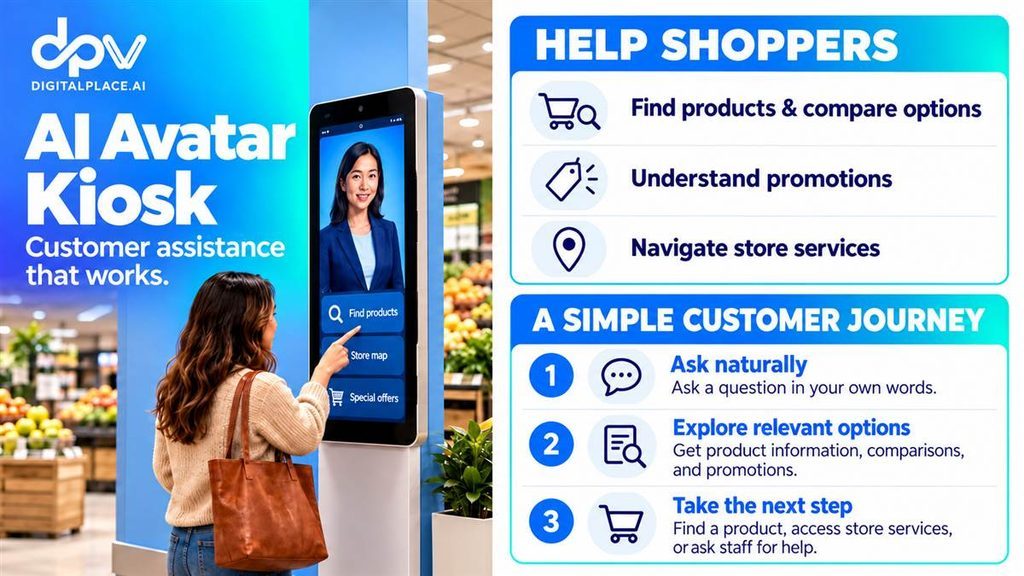
The quality of the experience depends on more than the screen or avatar. Product information must be maintained, answers must reflect the intended store context, and customers need a clear route to human assistance when the system cannot resolve a request.
Connectivity also deserves attention. A kiosk that uses cloud-based conversation services or live inventory lookups may lose some functionality during an outage. Retailers should establish which capabilities remain available locally and what customers see when connected services are unavailable.
Scheduled AI Shelf Scanning
Shelf availability problems can remain hidden between manual checks. Products may be misplaced, missing from their assigned position, or displayed differently from an approved planogram.
Scheduled AI shelf scanning allows employees to capture shelf images during routine store checks. Computer vision then helps identify issues that require attention.
Digitalplace’s On-Shelf Availability and Planogram Compliance solution follows this approach, using scheduled checks to support more consistent shelf execution. Local processing options can also support operation without continuous internet connectivity, depending on the device and deployment.
This model can suit retailers whose teams already follow regular inspection and replenishment routines. Its effectiveness depends on image quality, scanning frequency, and whether employees act on the findings. An issue that develops between scans may remain undetected until the next check.
Fixed Cameras and CCTV for Shelf Monitoring
Fixed-camera shelf monitoring offers another approach. Where camera coverage and image quality are suitable, computer vision can analyze shelf conditions repeatedly throughout the day.
This can be useful in areas where products move quickly and more frequent detection would enable faster replenishment. It may also reduce the need for employees to capture images manually.
However, an existing CCTV installation is not automatically suitable for detailed shelf analysis. Cameras positioned for general security coverage may not provide the angle, resolution, or unobstructed view needed to distinguish products and shelf positions. Shoppers, promotional displays, lighting changes, and layout changes can further affect visibility.
Connectivity requirements depend on the architecture. Cloud-based systems that continuously send images or video for analysis need a sufficiently reliable internet connection to maintain timely monitoring. Interruptions can delay uploads, analysis, and alerts unless the system includes an effective local fallback.
Edge processing can analyze footage within the store and reduce dependence on continuous cloud transmission. Research on edge-based video analytics identifies bandwidth consumption and latency as important reasons to process video closer to its source.
This distinction matters for retailers operating across multiple cities or countries. A deployment should be designed around the connection quality available at each location. Successful performance in one well-connected store does not establish readiness across the entire network.
Warehouse Inventory Drones
In warehouses, checking high racks and verifying pallet locations can require substantial staff time and access equipment.
Inventory drones can automate parts of this inspection process by following configured routes and capturing identifiers from storage locations. The resulting observations help teams investigate differences between physical stock locations and system records.
Digitalplace’s Warehouse Inventory Drone supports recurring stock-location verification through scheduled scanning missions.
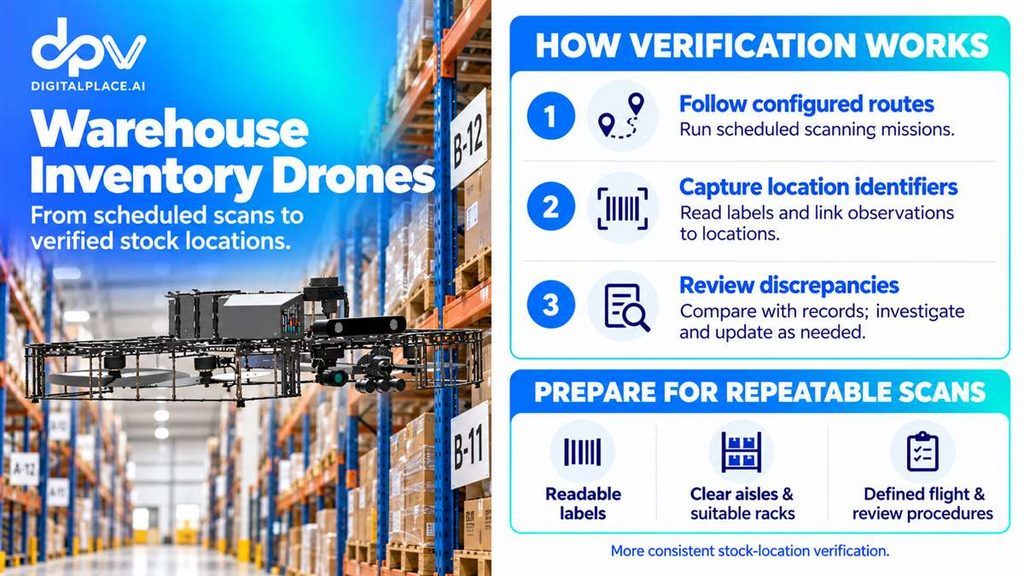
Suitability depends on warehouse conditions. Label readability, aisle clearance, rack configuration, and flight procedures need to support repeatable scans. Teams also need a process for investigating discrepancies and updating records where appropriate.
The operational benefit comes from making inventory verification more consistent and useful for warehouse decisions.
Smart Shelves and Sensor-Based Monitoring
Shelf sensors can provide another source of physical-store information. Depending on the design, weight sensors or electronic identifiers can help detect changes in product presence or quantity. AI can use those signals to support exception detection or replenishment decisions.
Sensors alone are not necessarily AI. Their value within an AI solution depends on how the data is interpreted and connected to action.
Retailers should assess installation requirements, calibration, maintenance, and compatibility with different packaging or shelf formats. For some categories, the additional sensing infrastructure may be justified. For others, a simpler inspection method may meet the operational need.
Autonomous Checkout and Mobile Retail Robots
Autonomous checkout systems can combine sensing, product recognition, and transaction workflows to reduce friction in suitable store formats. Mobile robots can also support tasks such as inspection or movement through physical spaces.
These applications require careful evaluation of store layout, exception handling, integration, and ongoing support. A retailer must be able to manage situations the system cannot confidently resolve.
Their relevance depends on the task and operating environment. They belong in the broader physical AI landscape, but they are separate capabilities that should be assessed on their own merits.
Why Continuous Monitoring May Be a Difficult Fit for Tight Retail Margins
A technology can provide more frequent visibility without producing enough additional value to justify its cost.
For retailers operating on thin margins, fixed-camera shelf monitoring requires a complete cost assessment. Depending on the deployment, expenses may include cameras, installation, networking, local computing equipment, cloud processing, subscriptions, maintenance, and adjustments after store-layout changes.
Cloud-heavy deployments can add recurring connectivity and processing requirements. Local processing reduces some of those dependencies, but introduces equipment and support needs at store level.
The financial question is whether faster detection leads to useful action often enough to cover these costs.
Consider a shelf-monitoring system that identifies a gap shortly after it occurs. If staff cannot replenish the product until their next scheduled round, the benefit of immediate detection may be limited. The same system could be more valuable in a busy location where employees can respond promptly and the affected products sell quickly.
Continuous monitoring is most useful when the retailer can turn frequent observations into timely, economically valuable action. Scheduled scanning may be a more proportionate starting point where inspection rounds already match the pace of store operations.
How to Choose the Right Physical AI Retail Solution
Start with a specific operational problem.
A retailer facing repeated product-information questions may prioritize an AI kiosk. A retailer struggling with inconsistent shelf checks may begin with scheduled scanning. A distribution center spending excessive time verifying high-rack locations may assess inventory drones.
For each use case, establish five things:
- The baseline: How is the task handled today, and what does it cost?
- The required frequency: Does the problem need continuous monitoring or periodic checks?
- The operating conditions: What connectivity, devices, layouts, and data are available?
- The response workflow: Who acts on the result, and how quickly?
- The success measure: What improvement would justify continued investment?
A pilot should include representative operating conditions. For a multi-location rollout, that may mean testing different store formats, connection quality, staffing patterns, and product assortments.
Measure Business Value Beyond Detection Accuracy
Technical accuracy matters, but it is only one part of performance.
Shelf-monitoring evaluation should include whether findings are correct, whether employees resolve them, and whether availability improves. Kiosk evaluation should examine whether customers complete their intended tasks and receive appropriate assistance. Drone evaluation should consider inspection time, usable coverage, and discrepancy resolution.
Financial assessment should use benefits that can be demonstrated.
Recovered sales should be translated into gross profit when evaluating returns. Staff time saved should be distinguished from actual labor-cost reductions: time released for other tasks has operational value, but it does not automatically reduce payroll.
A credible business case accounts for implementation, recurring expenses, maintenance, and the effort required to keep the system useful.
Connecting Customer Assistance, Shelf Execution, and Warehouse Visibility
Digitalplace.ai supports practical retail applications across AI kiosk and avatar assistance, on-shelf availability, and warehouse inventory drones.
These applications address different operational needs. Their value depends on selecting a suitable workflow, preparing the required information and infrastructure, and measuring what changes after deployment.
For retailers exploring physical AI retail solutions, a focused pilot provides a way to test those assumptions before expanding.
Discuss your retail use case with Digitalplace.ai to identify a practical starting point for customer assistance, shelf execution, or warehouse inventory verification.
Frequently Asked Questions
Does physical AI in retail always require robots?
No. Robotics is one application. Retail environments also use computer vision, sensors, and interactive interfaces to support parts of the observation, decision, and action process. The level of autonomy varies by solution.
Is an AI kiosk part of physical AI retail?
An AI kiosk can be part of a connected physical retail solution by helping customers interact with store information and services. Its role depends on its capabilities and integrations; physical placement alone does not make it an autonomous system.
Does CCTV shelf monitoring always need internet access?
No. Cloud-based analysis depends on connectivity for transferring data and receiving results. Edge-based systems can process footage locally, although remote dashboards, synchronization, and other connected services may still require internet access.
Can scheduled shelf scanning be more suitable than continuous camera monitoring?
Yes. Scheduled scanning may fit retailers whose inspection routines and response times do not require continuous observation. The choice depends on product movement, staffing, coverage needs, connectivity, and total cost.
How should a retailer begin?
Choose one measurable problem, document the current workflow, and test a suitable solution under representative conditions. Use the pilot to verify operational benefits and recurring costs before scaling.



