
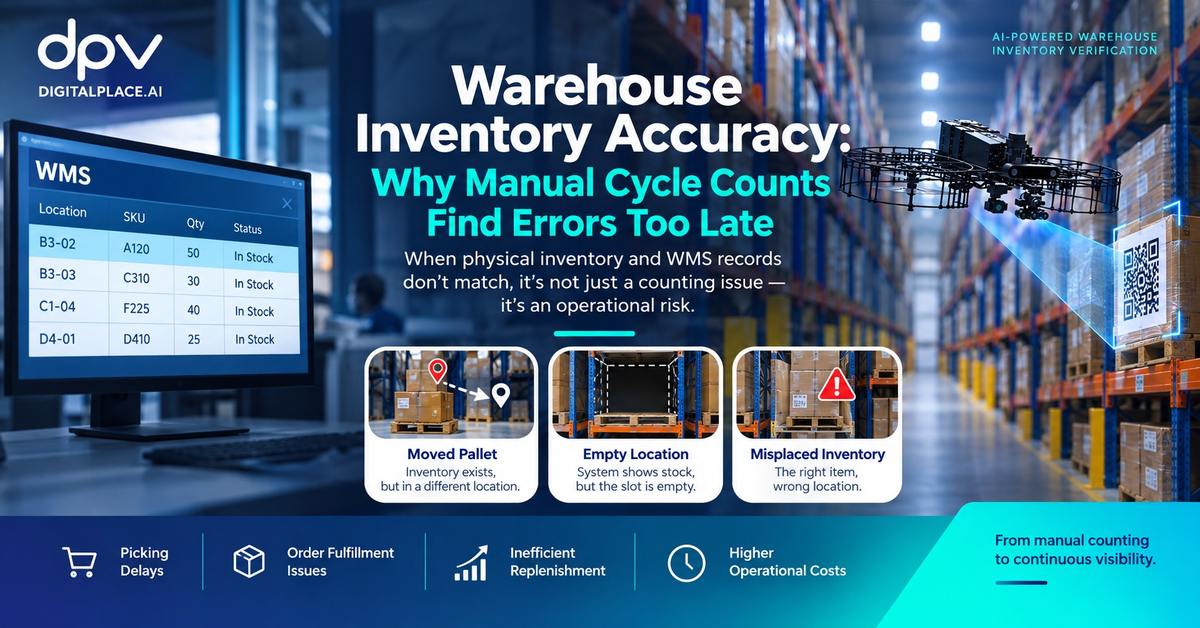
A warehouse can look perfectly organized while its inventory records are already wrong.
A pallet may have been moved two aisles away but still appear in its original WMS location. A rack position may be physically empty even though the system shows available stock. Another pallet may sit in the correct aisle but on the wrong level. None of these situations necessarily creates an immediate alarm.
That is the problem with inventory record inaccuracy: the warehouse can continue operating while physical reality gradually separates from what the system believes is true.
Read more :
The longer that gap remains undetected, the more processes begin to depend on incorrect information. Picking teams search for inventory that is no longer there. Replenishment decisions are made from unreliable location data. Orders can be delayed because the warehouse only discovers the discrepancy when someone actually needs the stock.
Inventory accuracy is therefore not only a counting issue. It is a timing issue.
When Physical Inventory and WMS Records Stop Matching
A warehouse management system records transactions.
When inventory is received, the WMS records where it should be stored. When a pallet is moved, the system should record the new location. When goods are picked or shipped, the recorded quantity should change accordingly.
In an ideal process:
Physical inventory = inventory recorded in the WMS
But warehouses operate through thousands of physical movements every day.
A pallet can be placed temporarily in another position. A move can be completed physically but not correctly recorded. A location can remain marked as occupied after inventory has already been removed. A product can be placed in the wrong rack or level.
The WMS is not necessarily malfunctioning.
The problem is that the digital record reflects what was recorded as happening, while the warehouse contains what actually happened.
That distinction becomes increasingly important as warehouse operations become faster and more complex.
Digitalplace.ai approaches this gap from the perspective of recurring physical verification. Its AI-powered warehouse inventory drone is designed to scan configured warehouse areas, read QR-coded inventory, verify pallet locations, confirm empty locations and identify inventory that has moved from its expected position. Rather than relying only on periodic manual counts to discover discrepancies, Digitalplace’s approach creates another layer of observation between physical warehouse activity and the WMS. The purpose is not to replace the warehouse management system, but to provide more frequent evidence of what is physically present and where it has actually been observed.
Why Inventory Errors Are Often Discovered at the Worst Time
Inventory inaccuracies can remain hidden because they do not always interrupt the warehouse immediately.
Imagine a pallet that should be at Location B3-02 but has accidentally been placed at B3-04.
The WMS still shows B3-02.
Until someone needs that pallet, operations may continue normally.
The error becomes visible when a picker arrives at B3-02 and finds an empty location.
At that point, the discrepancy is no longer simply an inventory accuracy problem. It has become a fulfillment problem.
Someone must investigate. Nearby locations may need to be searched. A supervisor may be involved. The picking task may be delayed while the warehouse determines whether the stock is missing, misplaced or incorrectly recorded.
Empty Locations Can Create the Same Problem
The opposite situation is also possible.
The WMS indicates that inventory is stored in a particular location, but the location is physically empty.
This may happen because a movement was not recorded correctly, inventory was removed during another activity, or the system was not updated after a previous transaction.
Again, the problem may remain invisible until the location is needed.
Manual cycle counting eventually detects these situations, but eventually is not always soon enough.

When Does a Warehouse Inventory Error Become an Operational Problem?
The WMS Records What Should Be There. Operations Need to Know What Is Actually There.
Inventory record inaccuracy appears when a warehouse system and the physical warehouse no longer describe the same reality. The inventory may still exist, but it may be in another rack position, an expected location may be empty, or the correct item may have been placed in the wrong slot. The longer the difference remains invisible, the more likely downstream warehouse processes are to encounter it.
Three Ways Inventory Records Can Drift from Physical Reality
Select a warehouse situation to see why the same inventory discrepancy can create different operational consequences.
The Same Error Can Have a Very Different Impact Depending on When It Is Found
Inventory accuracy is not only about whether discrepancies exist. It is also about how long operations continue using an inaccurate record.

The Limitation of Periodic Cycle Counting
Cycle counting remains an important warehouse control process.
It allows warehouse teams to compare system records with physical inventory without waiting for a full annual stocktake.
However, manual cycle counting has a structural limitation: every additional count requires additional effort.
Employees must travel through the warehouse, identify assigned locations, access the relevant rack position, scan or record inventory and investigate differences.
For high-bay storage, that task may also require lifting equipment or additional safety procedures.
As a result, warehouses must make decisions about counting frequency.
Some locations may be checked regularly. Others may be checked less frequently based on ABC classification, inventory value or historical discrepancies.
This creates a verification interval.
If a location is checked today and an error occurs tomorrow, that discrepancy can theoretically remain undetected until the next scheduled count.
The longer the interval, the larger the window in which warehouse decisions can rely on incorrect information.
Inventory Accuracy Affects More Than Counting
Poor inventory accuracy has downstream consequences because warehouse processes depend on knowing both what inventory exists and where it is located.
Picking
A picker expects the WMS location to correspond with the physical warehouse.
When that assumption fails, picking becomes search activity.
The employee may check adjacent locations, ask another team member for assistance or report an exception.
Each individual incident may take only a few minutes. Across a large operation, repeated exceptions create avoidable friction.
Fulfillment
If inventory cannot be found quickly, the warehouse may delay order completion.
The system may indicate that stock is available while operations cannot physically locate it.
This distinction between system availability and physical availability can become particularly important when order turnaround times are tight.
Replenishment
Replenishment decisions also depend on accurate inventory information.
If a location appears occupied when it is actually empty, replenishment may not happen when required.
If inventory has moved but the system still associates it with the original location, warehouse teams may make decisions using an incomplete picture of the physical facility.
From Counting Inventory to Verifying Inventory
The conventional model treats inventory accuracy as something that is periodically checked.
A more dynamic model treats inventory accuracy as something that is continually maintained through recurring verification.
This does not necessarily mean scanning every warehouse location every minute.
It means reducing the time between a physical discrepancy occurring and the warehouse becoming aware of it.
That changes the management question.
Instead of asking:
“When is the next cycle count?”
the warehouse can ask:
“Which locations need verification today?”
A fast-moving area might be verified daily. High-value storage may receive more frequent checks. Locations with repeated discrepancies may be monitored more closely. High-bay inventory can be included in scheduled scanning missions without requiring the same manual access process each time.
The objective is not simply more counting.
It is fresher inventory evidence.
Why Location Verification Matters as Much as Quantity
Inventory accuracy discussions often focus on quantity.
But in warehouse operations, location accuracy can be equally important.
A pallet can physically exist inside the facility while still being operationally unavailable because nobody knows where it is.
Consider a simple example:
The WMS expects Pallet A120 at B3-02.
The pallet physically exists at B3-04.
From a total inventory perspective, the quantity may still be correct.
From an operational perspective, however, the record is wrong.
This is why location verification adds another dimension to inventory accuracy.
Digitalplace.ai’s warehouse drone inventory solution combines inventory identification with physical location verification. During configured missions, the drone can scan QR-coded pallets while following mapped warehouse routes, allowing the observation to be associated with a rack position rather than treating the QR code as an isolated identifier. This supports use cases such as identifying moved inventory, confirming empty pallet slots and performing recurring full-facility or selected-area verification. For high-rack warehouses, the same approach also reduces the need to repeatedly send staff or lifting equipment to elevated positions simply to confirm what is stored there.
Recurring Verification Changes Exception Management
One of the most important benefits of more frequent verification is not the elimination of warehouse mistakes.
It is earlier discovery.
Suppose a pallet is moved to the wrong location on Tuesday.
With a periodic count, the warehouse might not discover the issue until the next scheduled cycle count or until a picker searches for the pallet.
With recurring verification, the error can potentially be detected during the next scan of that zone.
The original mistake still happened.
But the error detection window becomes shorter.
That changes the way warehouse teams manage exceptions.
Instead of discovering accumulated discrepancies during a large counting exercise, the team can investigate smaller numbers of recent exceptions.
A moved pallet becomes a specific operational issue to resolve.
An empty location becomes a verification task.
A mismatch between expected and observed inventory can be reviewed while the event is still relatively recent.
What Should a Warehouse Measure?
A warehouse evaluating recurring inventory verification should look beyond counting speed.
The more useful measures include how long discrepancies remain undetected, how often pickers encounter unexpected empty locations, how many pallets are found outside their expected positions, how much time is spent searching for inventory and how frequently high-risk or high-value zones can realistically be verified.
These measures help connect inventory accuracy with operational performance.
A system that enables a warehouse to identify discrepancies earlier may create value even if manual investigation is still required afterward.
Automation does not necessarily remove people from the process.
It can change where people spend their time.
Instead of repeatedly collecting data, employees can focus more on investigating and resolving exceptions.
Inventory Accuracy as a Recurring Operational Process
Warehouse inventory accuracy should not be treated only as a periodic audit problem.
The physical warehouse changes continuously.
Pallets move. Locations become empty. Orders are picked. Replenishment occurs. Temporary placements become permanent mistakes.
The verification process therefore needs to reflect the speed at which the warehouse itself changes.
Digitalplace.ai positions its AI-powered warehouse inventory drone as part of this shift from periodic manual counting toward recurring inventory verification. The drone can perform repeatable scanning missions for selected areas or broader facility checks, identify QR-coded inventory, verify physical locations, confirm empty slots and surface discrepancies for warehouse teams to investigate. Connected with warehouse data and WMS workflows, this creates an additional physical verification layer rather than a replacement for existing systems. The goal is to help warehouses reduce the time between inventory reality changing and their digital records catching up with that change.
That may be the most important way to think about warehouse inventory accuracy.
The problem is not simply that records occasionally become wrong.
The real operational risk is how long the warehouse continues believing they are right.




