
Retail is one of those businesses where enormous sales numbers can hide surprisingly small room for error.
Consider four major grocery and convenience retailers operating in Indonesia. In 2025, Alfamart, Indomaret, Alfamidi, and MPPA collectively generated more than Rp271 trillion in sales. Yet their combined bottom-line profit was only around Rp7 trillion, equivalent to roughly 2.6% of sales based on their publicly reported financial results. Individual performance varied—Alfamart and Indomaret generated net margins of roughly 2.5–2.7%, Alfamidi was somewhat higher, while MPPA remained loss-making—but the broader picture is clear: moving enormous volumes of merchandise does not necessarily leave retailers with a large margin for operational mistakes.
That is why small operational problems matter. A few percentage points lost through excess inventory, stockouts, inefficient replenishment, unnecessary markdowns, misplaced inventory, or repeated manual work can have consequences that are disproportionately large relative to the profit ultimately retained by the business.
This is where the conversation about an AI retail company in Indonesia becomes more interesting.
The question is no longer simply whether artificial intelligence can be used in retail. It clearly can. The more useful question is whether AI can understand the operating realities of Indonesian retailers and convert data into decisions that improve availability, inventory productivity, store execution, warehouse visibility, and customer experience.
What Is an AI Retail Company?
An AI retail company applies artificial intelligence specifically to decisions and workflows found in retail.
That distinction matters.
A general AI platform may be excellent at generating text, analysing documents, answering questions, or processing large datasets. Retail operations, however, involve a more specialised set of problems. A retailer may need to predict demand for thousands of SKU-location combinations, determine replenishment quantities, recognise products from shelf images, detect inventory discrepancies in warehouse racks, or provide customers with product information inside a physical store.
These problems require more than an AI model. They require an understanding of how stores, distribution centres, merchandising teams, inventory planners, and frontline employees actually work.
AI Should Connect Data to an Operational Decision
The most useful retail AI does not stop at producing an interesting prediction.
A demand forecast, for example, has limited operational value if no one knows how that prediction should change the next purchase order or replenishment quantity. A computer-vision system that detects an empty shelf creates little value if the store team cannot identify what action should happen next.
Retail AI therefore works best when it connects three stages:
Observe what is happening → determine what it means → recommend or trigger an operational action.
That action might involve replenishing a store, redistributing inventory, correcting a planogram, investigating a warehouse discrepancy, or giving a customer the product information they need.
Digitalplace.ai focuses on practical AI for physical retail operations, from inventory planning to shelf execution and warehouse visibility.
Why Retail AI in Indonesia Requires a Local Approach
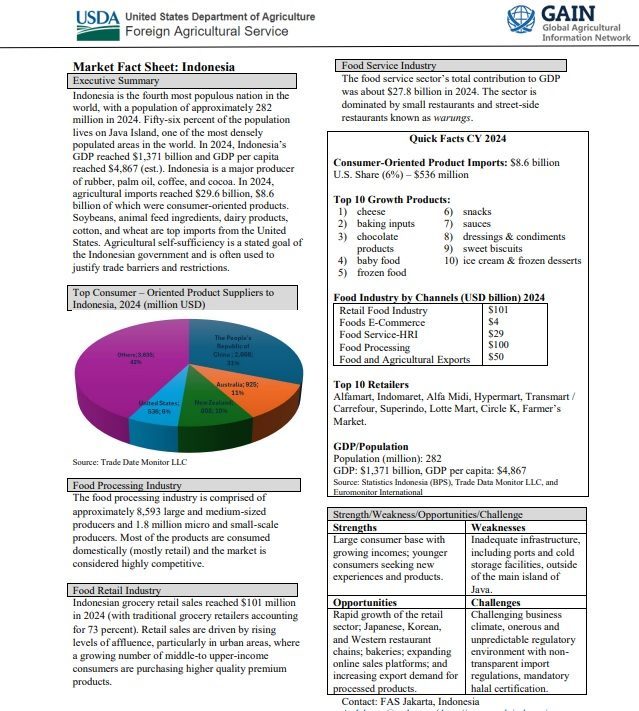
Indonesia is an attractive retail market partly because of its scale. The USDA Foreign Agricultural Service estimated the country’s grocery retail sector at approximately US$101 billion in 2024. At the same time, the market remains highly fragmented: traditional retail still accounted for roughly 73% of grocery retail, while convenience stores continued to expand as shoppers increasingly favoured nearby and flexible shopping formats. (USDA Apps)
Scale alone, however, does not describe the operational challenge.
A retail network may span dense metropolitan areas, secondary cities, residential neighbourhoods, tourist destinations, industrial areas, and locations much farther from major distribution centres. The same SKU can behave very differently from one store to another.
Demand also changes sharply around local events.
Bank Indonesia reported that retail sales increased 10.3% month-to-month in March 2026, supported by stronger seasonal demand during Ramadan and Eid. In April, retail sales subsequently contracted 11.6% month-to-month as demand normalised after the festive period. (Badan Pusat Statistik)
For an inventory planner, that kind of movement is not simply an interesting macroeconomic statistic. It illustrates why a historical average is often insufficient for deciding how much inventory each store should hold.
Connectivity adds another layer. Indonesia’s 4G mobile broadband coverage is estimated to reach approximately 99% of the population, yet Komdigi reported in September 2026 that 3,493 villages were still categorised as blank spots or areas with weak signals. The ministry also noted that coverage figures do not always reflect actual service quality and reliability on the ground. (Infradigital)
This does not mean retail AI in Indonesia needs to work without the internet everywhere. It means technology architecture should reflect real operating conditions rather than assuming every device, store, and warehouse has perfect connectivity at every moment.
These are only a few of the challenges. Margin pressure, geographically distributed store networks, promotional demand, inventory positioning, store execution, workforce productivity, perishables, and connectivity each deserve deeper discussion on their own.
Related reading: 10 Retail Challenges in Indonesia — and Where AI Can Actually Help.
Where Can AI Create Practical Value for Indonesian Retailers?
The most visible forms of AI are not necessarily the ones that create the largest retail impact.
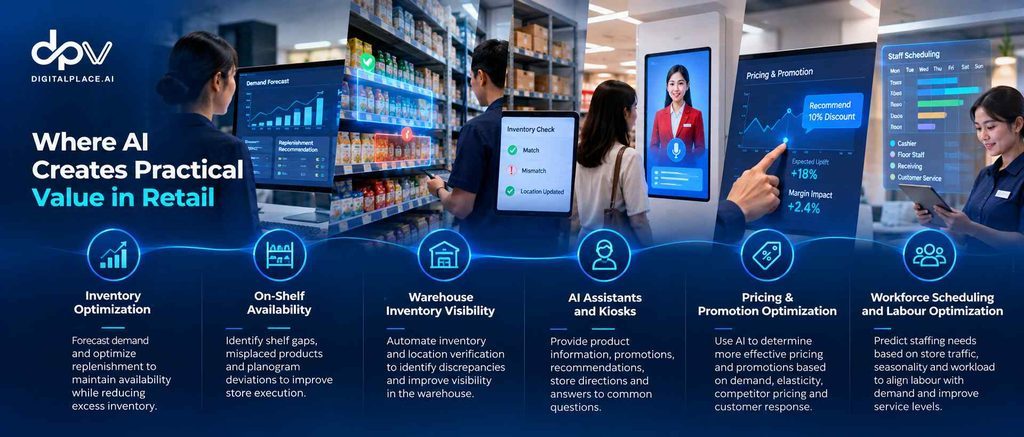
For many retailers, the biggest opportunities sit behind everyday operations: inventory, replenishment, availability, warehouse verification, merchandising, and access to product information.
AI-Powered Inventory Optimization
Inventory creates a fundamental retail trade-off.
Order too little and the retailer risks losing sales because products are unavailable. Order too much and cash becomes tied up in inventory that may remain in stores or warehouses longer than necessary.
AI-powered inventory optimization can analyse historical sales together with signals such as promotions, seasonality, local store patterns, current stock levels, and other relevant variables to estimate demand at a more granular level.
The forecast is only the beginning.
The more valuable step is converting expected demand into decisions about how much inventory is required, when replenishment should happen, and where available stock should be positioned.
This becomes especially relevant for retailers managing large combinations of stores and SKUs. A decision process that works manually for 20 products in one location becomes very different when planners have to consider thousands or millions of SKU-location combinations.
On-Shelf Availability and Store Execution
A product can exist inside the retailer’s inventory system and still be unavailable to the shopper.
It might be sitting in the backroom.
It might have been placed on the wrong shelf.
The shelf location may be empty while replacement stock is available elsewhere in the store.
Or the product arrangement may have drifted away from the approved planogram.
AI-powered computer vision can help retailers conduct scheduled shelf checks and identify conditions such as shelf gaps, misplaced products, and planogram deviations. The goal is not simply to create more shelf data. The goal is to give store teams earlier visibility into issues that require corrective action. (Digital Place On-shelf Availability)
This distinction is important because inventory availability and on-shelf availability are not always the same thing.
Warehouse Inventory Visibility
The same physical-versus-digital gap can occur upstream in the distribution centre.
A warehouse management system may indicate that a pallet belongs in a particular location, while the pallet has physically been moved to another rack. An apparently occupied slot can be empty. Inventory can exist but be difficult to locate quickly.
Manual cycle counting helps verify these discrepancies, but repeated checks across large warehouses and high racks consume time and labour.
AI-assisted drones and computer vision can automate scheduled inventory and location verification, helping warehouse teams identify discrepancies and improve visibility without relying entirely on repeated manual checks. (Digital Place Drone Inventory Warehouse)
AI Assistants and Intelligent Kiosks
Retail AI also reaches the customer-facing side of the store.
A shopper may want to know whether a product is suitable for a particular need, how two products differ, whether a promotion applies, where an item is located, or what alternatives are available.
The traditional answer is to ask a member of staff. But staff availability and product knowledge can vary by category, location, and shift.
AI assistants and intelligent kiosks can provide another access point for product information, promotions, recommendations, directions, and frequently asked questions. Their role does not need to be replacing store employees. In many environments, the more practical goal is helping customers and frontline teams retrieve information faster.
AI-Powered Pricing and Promotion Optimization
AI can also help retailers make better pricing and promotion decisions, especially in categories where customers are highly price-sensitive and promotional activity has a direct impact on margin. Instead of relying only on historical averages or broad discount rules, pricing systems can analyse factors such as historical sales, price elasticity, competitor pricing, inventory position, promotion history, and customer response to estimate how demand may change at different price points. The objective is not simply to recommend higher or lower prices. It is to help retailers understand when a discount is likely to create genuinely incremental demand, when it may only shift purchases forward, and when a promotion could erode margin without producing enough additional volume to justify it. For retailers operating on thin margins, even modest improvements in pricing and promotion decisions can have a meaningful financial effect when repeated across thousands of SKUs and transactions.
AI Workforce Scheduling and Labour Optimization
AI can also be applied to workforce planning, particularly in store networks where staffing requirements change by location, day, hour, season, and customer traffic pattern. Rather than scheduling employees primarily from fixed templates, retailers can use historical transaction volumes, expected foot traffic, promotional calendars, local events, delivery schedules, and workload patterns to estimate how many employees may be needed during different periods. A store may require more checkout capacity during an evening peak, more floor staff during a major promotion, or additional receiving support when larger deliveries are expected. Better scheduling does not necessarily mean reducing headcount; it can mean aligning available labour more closely with actual workload. For retailers with large store networks, this can improve service levels while reducing unnecessary overtime, understaffing during busy periods, and labour hours that are poorly matched to customer demand.
For retailers in Indonesia, Digitalplace.ai combines inventory optimization, scheduled shelf visibility, warehouse inventory automation, and AI-assisted customer interaction into a retail-focused technology portfolio rather than treating each AI capability as an isolated experiment.
What Should Retailers Look for in an AI Retail Company in Indonesia?
The quality of the algorithm matters, but implementation determines whether that algorithm ever becomes useful to an operating business.
When evaluating an AI retail partner, retailers should look beyond demonstrations and ask how the technology fits actual stores, warehouses, people, systems, decision processes, and commercial realities.
Important considerations include:
- Retail domain knowledge. The provider should understand concepts such as SKU-level demand, replenishment, stock allocation, on-shelf availability, planogram compliance, warehouse locations, and store execution—not only generic AI terminology.
- Granularity. Retail decisions frequently need to happen at SKU, store, shelf, or warehouse-location level rather than only through national or regional averages.
- Integration with existing workflows. Useful AI should work with the retailer’s existing data and operational processes rather than creating another dashboard that teams must monitor separately.
- Ability to operate under real infrastructure conditions. Device specifications, connectivity, data availability, and store operating environments should be considered during solution design.
- Local implementation and support. Retail AI rarely succeeds through software deployment alone. Retailers should consider whether the provider can support implementation locally, understand operational practices in the market, respond when integration or store-level issues emerge, assist with training and onboarding, and continue supporting the solution after the pilot moves into production. This becomes increasingly important when deployments involve multiple stores, warehouses, devices, and operational teams.
- Measurable outcomes. A pilot should define business and operational metrics before deployment, such as stockout reduction, inventory productivity, shelf-checking time, forecast performance, replenishment automation, or warehouse counting efficiency.
- Flexible commercial models. Traditional software pricing based purely on licences, users, or locations may not always align with the way retailers evaluate AI investments. In some cases, more flexible structures—including pilot-based pricing, phased deployments, usage-based models, or outcome-based pricing—can reduce the financial risk of adoption and connect part of the commercial model to measurable business results. Outcome-based pricing, however, works best when both parties can clearly define the baseline, target metric, attribution method, and external factors that may influence the result.
- Scalability. A solution that performs well in five stores must still be operationally and economically sensible when expanded across hundreds or thousands of locations.
The most impressive AI demonstration is therefore not necessarily the most valuable retail implementation.
The better question is: what decision becomes better after the AI is introduced?
From AI Pilot to Retail Operations
Many AI projects begin with a proof of concept.
That is reasonable. Retail environments contain too many variables to assume that a system should immediately be deployed across an entire network.
But a successful pilot should test more than whether the technology technically works.
Suppose a retailer pilots an inventory optimization system in 20 stores. The project should not end with the conclusion that the model can generate forecasts. It should examine whether planners can use those forecasts, whether replenishment recommendations fit actual operational constraints, whether product availability changes, how inventory levels respond, and how exceptions are handled.
The same principle applies to computer vision.
Recognition accuracy matters, but the operational workflow matters too. Who performs the shelf check? How often? How quickly can issues be reviewed? Which problems should be prioritised? What happens after an out-of-stock or planogram deviation is detected?
A retail AI system becomes valuable when it moves from model → insight → action → measurable outcome.
Building AI Around How Indonesian Retail Actually Works
Indonesia does not need a completely different form of artificial intelligence from the rest of the world. The algorithms may be global, but the operating context is local.
That context includes the way demand changes around Ramadan and Eid, the differences between store locations, the size and complexity of distribution networks, uneven infrastructure conditions, local workflows, category behaviour, price sensitivity, and the realities of running physical stores at scale.
For Digitalplace.ai, operating as an AI retail partner in Indonesia means applying AI to these everyday decisions rather than introducing technology simply because it is new. Its approach spans demand forecasting and replenishment, inventory optimization, scheduled on-shelf availability and planogram checks, warehouse inventory scanning, and AI-assisted customer interaction. The common thread is operational: use AI to make retail data easier to act on. Local implementation support also matters because deployment includes much more than installing software—it can involve data preparation, integration, onboarding, store or warehouse workflows, training, pilot evaluation, and adaptation as the solution moves into production. (Digital Place)
This is an important distinction.
Retailers do not ultimately need more AI.
They need fewer stockouts. Less excess inventory. Better shelf availability. More reliable warehouse visibility. Faster decisions. More productive workflows. And better ways to help customers find what they need.
AI is valuable when it becomes the mechanism behind those improvements rather than the objective itself.
The Next Stage of AI Retail in Indonesia
The adoption of AI in retail is likely to become less about isolated demonstrations and more about operational integration.
Forecasting will connect more closely to replenishment. Inventory visibility will extend from distribution centres to store shelves. Computer vision will increasingly support routine execution checks. AI assistants will become another interface through which employees and customers access information.
The companies that create the most value will not necessarily be those deploying the greatest number of AI tools.
They will be the ones that identify the decisions where better intelligence creates a measurable operational difference.
Digitalplace.ai positions retail AI around that principle: practical technology should improve the decisions retailers already need to make every day.
For retailers evaluating an AI retail company in Indonesia, that may be the most useful place to begin.




