
At 8:47 in the morning, a store can already be inefficient before the first major rush begins.
A fast-moving item has not been replenished from the backroom. Another branch is carrying more stock than it needs. Two employees are scheduled for a quiet period while the afternoon shift may be understaffed. A promotion has changed demand faster than the planning team expected. One customer needs help comparing products. Another reaches the checkout just as the queue begins to build.
None of these problems is large enough to shut down the store.
Together, however, they determine how efficiently the store operates.
This is why the most useful way to think about artificial intelligence in retail is not simply as automation. AI can improve the speed and quality of the thousands of small decisions that connect inventory, employees, shelves, warehouses, checkout, and customers.
Operational efficiency therefore becomes a decision problem as much as a cost problem.
Why Operational Efficiency Matters More Than Simply Cutting Costs
Retail efficiency is sometimes reduced to one objective: doing the same work with fewer resources.
That can be dangerous.
A retailer can reduce labour hours and create longer queues. It can reduce inventory and increase stockouts. It can simplify store processes while making it harder for customers to find assistance.
A better definition is:
Retail operational efficiency is the ability to convert inventory, labour, space, data, and working capital into profitable sales and customer availability with as little avoidable friction as possible.
That distinction matters because operational problems rarely remain operational.
A shelf gap can become lost revenue.
Excess inventory can become a working-capital problem.
A slow checkout process can become customer abandonment.
Poor scheduling can create both unnecessary labour cost and insufficient service.
A warehouse inventory discrepancy can eventually become an availability issue in the store.
Why retail complexity increases the decision burden
For retailers operating across Indonesia and Southeast Asia, this challenge becomes more pronounced as networks grow.
A business may need to coordinate:
- thousands of SKUs;
- multiple store formats;
- different local demand patterns;
- distribution centres and regional warehouses;
- promotional calendars;
- supplier lead times;
- changing customer traffic;
- employee availability;
- online and offline fulfilment;
- different store operating constraints.
The problem is not necessarily that employees lack expertise.
It is that the number of decisions increases faster than human attention can scale.
AI is useful when it can absorb some of that repetitive decision volume while allowing people to concentrate on exceptions.
There Are Six Practical Value Levers for AI in Retail
There is no universal industry rule stating that every AI retail initiative must fall into exactly six categories.
But for management purposes, six practical value levers provide a useful framework.
1. Revenue Capture
AI can help retailers convert demand that might otherwise be lost because of stockouts, poor product discovery, long queues, or insufficient assistance.
2. Gross Margin
Pricing, promotions, markdowns, product mix, and assortment decisions can be improved through more granular analysis.
3. Inventory and Working Capital
AI can help balance availability against the cost of carrying unnecessary inventory.
4. Store and Warehouse Execution
Computer vision, robotics, and other forms of automation can provide better visibility into what is physically happening.
5. Customer Experience and Conversion
AI can reduce friction when customers search for information, products, assistance, or checkout.
6. Workforce Productivity and Decision Quality
Employees can spend less time on repetitive calculation, verification, and administration and more time on judgement and service.
The most interesting part is that these levers overlap.
A single AI application may affect three or four simultaneously.
AI-Powered Inventory Optimization: Making Inventory Follow Demand
Inventory is one of the clearest examples of retail decision overload.
Traditional planning methods such as average sales, moving averages, historical trends, and planner judgement remain useful. But their limitations become more visible as a retailer adds more SKUs, stores, promotions, supplier constraints, and local demand variation.
Machine learning adds another layer by identifying patterns across a larger combination of variables.
Demand forecasting is only the first decision
Forecasting asks:
What are we likely to sell?
Inventory optimization asks:
What should we do because of that forecast?
The operational chain can look like this:
Sales & demand signals → Forecast → Replenishment quantity → Allocation → Inventory movement → Product availability
A demand model might predict that one outlet will require significantly more units next week.
That prediction becomes commercially valuable only when it changes an actual decision:
- increase replenishment;
- adjust the timing;
- change allocation;
- modify upstream orders;
- transfer inventory between locations;
- maintain a human approval step for unusual conditions.
Digital Place can support this transition as an AI retail technology partner for inventory optimization, connecting demand forecasting with automated replenishment and inventory decisions rather than stopping at prediction. The objective is to help retailers move from knowing what may happen toward deciding what stock action should happen next.
Multi-location retail makes allocation as important as forecasting
Retailers do not merely have inventory.
They have an inventory network:
Supplier → Distribution Centre → Outlet → Customer
A company can own enough inventory in total and still experience stockouts.
The stock may simply be in the wrong location.
This is why inventory optimization needs to consider not only quantity but also where demand is expected to occur.
Better decisions can potentially lead to:
- fewer stockouts;
- lower excess inventory;
- lower holding costs;
- reduced markdown exposure;
- improved cash flow;
- less manual planning;
- more consistent availability.
On-Shelf Availability: When the System Says “In Stock” but the Shelf Says Otherwise
Planning is only one layer of retail operations.
Execution is another.
A system may show ten units available in a store while the customer sees none on the shelf.
Perhaps the products remain in the backroom.
Perhaps they were placed in the wrong section.
Perhaps the shelf does not match the approved planogram.
Perhaps replenishment simply has not happened yet.
This creates a gap between inventory availability and on-shelf availability.
Computer vision can make store execution measurable
Instead of relying entirely on manual observation, computer vision can analyze images or scheduled video scans to identify:
- missing products;
- misplaced SKUs;
- planogram deviations;
- incomplete displays;
- other shelf-execution issues.
The greater efficiency does not come from generating hundreds of alerts.
It comes from helping store teams answer:
What needs attention first?
That shift—from checking everything to managing meaningful exceptions—is a recurring pattern across AI retail applications.
Warehouse Inventory: Reducing the Cost of Knowing What Is Actually There
The same principle applies upstream.
Inventory records are digital.
Inventory itself is physical.
Warehouse teams therefore need processes for verifying locations, checking empty slots, performing cycle counts, and conducting broader inventory scans.
These activities are essential but repetitive.
AI-enabled warehouse drones can support tasks such as:
- scanning storage locations;
- validating inventory positions;
- identifying empty locations;
- performing area scans;
- supporting cycle counting;
- conducting scheduled full-facility verification.
The key benefit is not simply that a drone flies through a warehouse.
It is that physical inventory verification can become more repeatable and scalable while employees focus on discrepancies and corrective actions.
Forecasting tells the retailer what inventory should exist.
Verification helps determine what actually exists.
Operational efficiency improves when those two views move closer together.

Where Does AI Remove Operational Friction?
Explore eight points in the retail operating cycle where AI can improve decisions, execution and employee productivity.
Retail efficiency is not simply about reducing cost. The larger opportunity is reducing the distance between what is happening, what should happen next, and how quickly the organization can act.
operational stages where AI can remove recurring friction across retail.
Explore the Operational Friction
Open each stage to see the problem, AI capability, operational response and KPI affected.
Stage 01 · Plan Forecast Demand & Plan Inventory Predict demand before inventory decisions are made
Digitalplace Inventory Optimization →
Stage 02 · Staff Align Workforce With Workload Match employee capacity more closely with demand
Stage 03 · Replenish Turn Forecasts Into Inventory Movement Replenish and allocate stock according to expected demand
Digitalplace Inventory Optimization →
Stage 04 · Verify Verify Physical Warehouse Inventory Compare system inventory with physical reality
Digitalplace Warehouse Drone Inventory →
Stage 05 · Execute Turn Store Inventory Into Shelf Availability Detect shelf and planogram execution gaps
Digitalplace On-Shelf Availability →
Stage 06 · Checkout Reduce Checkout Friction Queue prediction, self-service and transaction intelligence
Stage 07 · Assist Improve Access to Retail Information Customer assistance, employee knowledge and AI avatars
Digitalplace AI Avatar →
Stage 08 · Measure Connect AI Performance to Retail Economics Measure outcomes rather than AI activity alone
AI Can Improve Employee Productivity Without Removing the Employee
One of the largest opportunities in retail AI may have little to do with robots replacing workers.
It is about how employees spend their time.
Retail contains many tasks that are necessary but repetitive: reviewing reports, calculating quantities, answering common questions, checking exceptions, creating schedules, searching internal procedures, and updating routine information.
Reducing these activities can improve productivity even if headcount remains exactly the same.
Automating Administrative and Repetitive Tasks
Consider a store manager beginning the day.
They may need to review:
- yesterday’s sales;
- unavailable items;
- replenishment requirements;
- outstanding operational tasks;
- staffing;
- promotional activity;
- inventory exceptions.
AI can help summarize, prioritize, and surface abnormalities.
Instead of reading multiple reports from beginning to end, the manager could potentially receive a smaller set of exceptions:
These six SKUs require attention.
This promotion is behaving differently from forecast.
This section had repeated shelf-availability issues.
Tomorrow afternoon may require additional staffing.
This does not remove managerial responsibility.
It changes the amount of information the manager must manually process before deciding what to do.
The exception-based operating model
This concept is important.
Without AI:
Humans inspect everything to discover the exception.
With well-designed AI:
The system monitors scale; humans investigate the exception.
That can apply to inventory, store execution, warehouses, customer service, fraud detection, staffing, and many other operational areas.
AI-Based Employee Scheduling
Retail labour demand rarely stays constant throughout the day.
A store may be quiet at 10:00 a.m. and crowded four hours later.
Weekend traffic may behave differently from weekday traffic. Promotions can change activity. Some departments may require more assistance than others.
AI-based workforce scheduling can combine signals such as:
- historical store traffic;
- transaction volume;
- day of week;
- seasonality;
- promotional periods;
- employee availability;
- skills required;
- expected workload.
The goal should not simply be to schedule fewer employees.
It should be to create better alignment between labour availability and customer demand.
An understaffed store may look efficient on a labour-cost report but perform poorly on service, conversion, queue time, and employee workload.
Optimization means balancing these factors.
AI for Employee Training and Onboarding
Retailers frequently hire employees who need to understand products, policies, store procedures, promotions, and operating systems quickly.
Traditional onboarding relies heavily on documentation, classroom-style training, supervisors, and experience accumulated over time.
AI assistants can add another layer.
An employee might ask:
- How should this return be handled?
- What is the difference between these products?
- Where is this category located?
- What does this promotion include?
- What should I do when this inventory exception appears?
Instead of searching multiple manuals, an AI assistant can surface the relevant internal information.
This does not replace structured training.
It can reduce the friction between not knowing and finding the correct internal answer.
More employee time for customer-facing work
This leads to a broader productivity principle.
Every minute an employee spends on repetitive administration is a minute unavailable for other work.
AI can potentially redistribute time toward:
- helping customers;
- correcting shelf problems;
- handling unusual situations;
- merchandising;
- maintaining store standards;
- solving exceptions.
The productivity gain can therefore appear as improved service rather than only lower labour cost.
AI Can Change the Checkout Process Too
The checkout counter is another concentration point for operational friction.
Customers have already completed most of their shopping journey.
Yet a long queue can still turn an otherwise positive visit into a poor experience.
AI can support checkout operations in several ways.
Self-checkout and automated checkout
Self-checkout allows customers to scan and complete transactions without a traditional cashier performing every step.
More advanced systems can incorporate computer vision and sensor-based technologies to identify products or validate transactions.
The operational opportunity is straightforward:
increase transaction throughput without requiring every purchase to follow the same staffed checkout path.
This does not necessarily imply removing staffed checkout entirely.
Different customers and transaction types may require different experiences.
A retailer might combine:
- traditional cashier lanes;
- self-checkout;
- mobile checkout;
- assisted self-service;
- automated checkout concepts.
The appropriate mix depends on format, basket size, customer profile, and operational economics.
AI-based queue prediction
AI can also help before a queue becomes visible.
Historical traffic, current transaction patterns, basket sizes, dayparts, promotions, and store events can help estimate when checkout demand is likely to increase.
That may allow managers to open additional counters earlier or reposition employees before congestion becomes significant.
Instead of:
queue appears → manager reacts
the process becomes closer to:
demand pattern changes → system flags risk → store adjusts capacity
That is another example of AI moving operations from reaction toward anticipation.
Computer Vision at Checkout Is Also an Accuracy Problem
Faster checkout is valuable, but retailers must balance speed against transaction accuracy and shrink.
Computer vision can potentially support self-checkout by identifying anomalies such as:
- an item entering the bagging area without being properly recorded;
- incorrect product identification;
- unusual transaction patterns;
- mismatch between observed products and transaction data.
The goal is not simply surveillance.
From an operational perspective, the objective is to reduce the trade-off between checkout convenience and loss control.
A self-checkout system that dramatically reduces queues but produces significant shrink is not truly optimized.
Again, operational efficiency involves balancing outcomes rather than maximizing one metric.
AI for Loss Prevention and Store Exceptions
Shrink is another area where AI can support retail operations beyond the Digitalplace product portfolio discussed here.
Traditional loss prevention often relies on employees reviewing large volumes of incidents, transaction reports, or video.
AI can help identify patterns that deserve investigation.
Examples might include:
- unusual void activity;
- repeated refund patterns;
- suspicious transaction combinations;
- abnormal checkout events;
- recurring inventory discrepancies.
The important distinction is similar to shelf execution.
AI does not need to make the final accusation or judgement.
It can help answer:
Which events deserve human review?
This reduces the amount of routine information employees need to inspect manually.
AI Can Improve Store Maintenance and Energy Efficiency
Not every efficiency gain occurs in merchandising or customer service.
Large retail environments also consume substantial resources through:
- refrigeration;
- air conditioning;
- lighting;
- equipment;
- store facilities.
Machine-learning models can potentially detect unusual equipment behaviour, anticipate maintenance needs, or optimize energy consumption based on operating conditions.
For refrigerated retail, for example, detecting abnormal equipment behaviour earlier can have two effects:
Operational effect: reduce unexpected equipment failure.
Commercial effect: reduce the risk of product loss.
This illustrates why the six AI Retail value levers often overlap.
A maintenance application may initially look like a pure cost-saving tool but can also protect inventory availability and reduce waste.
AI Avatar: Giving Customers Another Route to Information
Customer assistance introduces another kind of operational bottleneck.
Customers often ask predictable questions:
- Is this product available?
- What is the difference between these models?
- Is there a current promotion?
- Where is this department?
- Do you have another size?
- What facilities are available?
Employees can answer these questions.
But employees are not always immediately available.
An AI Avatar can act as another interface for routine information while allowing store teams to concentrate on interactions requiring greater judgement.
The important measure is not whether the avatar appears perfectly human.
It is whether the customer gets a useful answer.
Useful AI Avatar applications can include:
- product information;
- product comparison;
- SKU availability;
- promotional information;
- FAQs;
- facility directories;
- visitor assistance.
The Four Digital Place Solutions Address Different Parts of the Same Operating Cycle
A retailer does not necessarily need every AI capability at once.
The appropriate starting point depends on the operational bottleneck.
Digital Place approaches AI retail technology as a set of connected operational capabilities rather than a single application. Inventory Optimization can improve forecasting and replenishment decisions; On-Shelf Availability & Planogram Compliance can identify execution gaps in stores; Warehouse Drone Inventory can support physical stock verification; and AI Avatar technology can reduce information friction for customers. Each addresses a different point in the flow between inventory planning and customer purchase, allowing retailers to begin with the area where operational friction is most expensive.
The important word is connected.
Because retail operations themselves are connected.
An inaccurate forecast can create poor replenishment.
Poor replenishment affects availability.
Availability can differ between system records, warehouse reality, and shelves.
Customers experience the final result.
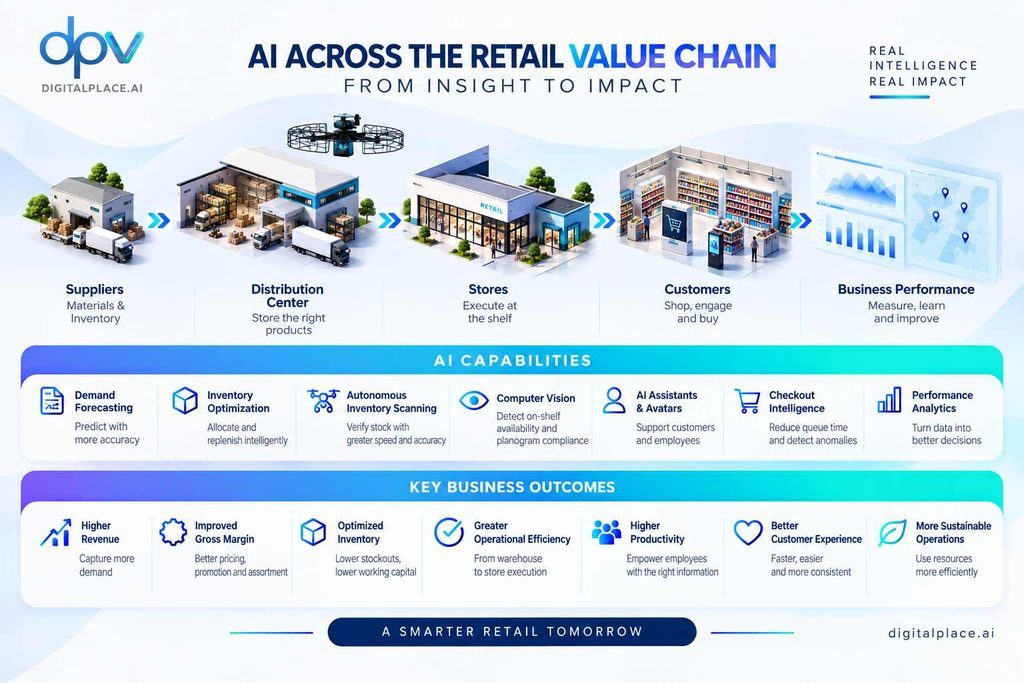
From Separate AI Tools to a Closed Operational Loop
The larger opportunity appears when AI systems begin feeding better information into the next operational decision.
Consider this sequence.
1. Predict
Demand forecasting estimates what customers are likely to need.
2. Replenish
Inventory requirements are calculated and stock moves across the network.
3. Verify
Warehouse systems confirm that physical inventory matches expectations.
4. Execute
Shelf checks identify whether products are actually available and correctly positioned.
5. Serve
Employees and AI customer interfaces help shoppers find and understand products.
6. Transact
Checkout systems process demand and create new sales data.
7. Learn
Those transactions become new signals for the next planning cycle.
The result is a feedback loop:
Demand → Decision → Execution → Customer → Transaction → New Demand Signal
That is considerably more interesting than simply adding individual AI tools to unrelated parts of a retailer.
Do Not Measure Every AI Project With the Same KPI
Different value levers require different measures.
Inventory AI may be evaluated using:
- stockout rate;
- Days Sales of Inventory;
- inventory turnover;
- forecast accuracy;
- lost sales;
- working capital.
Store-execution AI may focus on:
- on-shelf availability;
- planogram compliance;
- issue-resolution time.
Workforce AI may use:
- labour hours;
- tasks completed;
- overtime;
- schedule adherence;
- service levels.
Checkout AI might be judged through:
- transaction throughput;
- queue time;
- abandonment;
- transaction accuracy;
- shrink.
Customer-facing AI could consider:
- successful inquiry resolution;
- interaction completion;
- conversion;
- customer satisfaction.
This prevents a common mistake: proving that the AI works technically without proving that it improves retail economics.
Start With Friction, Not With Technology
A retailer deciding where to use AI does not need to begin with a list of AI products.
Begin with operational questions instead:
Where do we repeatedly lose sales?
Where is too much cash tied up?
Which tasks consume employee time without requiring much judgement?
Where do customers wait?
Where do system records and physical reality disagree?
Which operational problems are discovered too late?
Those questions naturally lead to different AI applications.
The resulting framework becomes:
Operational friction → AI capability → Decision → Action → KPI
If those five elements are clear, the project has a foundation for measurement.
If they are not, “using AI” can easily become the objective itself.
Operational Efficiency Is Becoming Decision Efficiency
The future retail store does not necessarily need to look dramatically futuristic.
There does not need to be a robot in every aisle.
The larger transformation may be much less visible.
A planner receives better replenishment recommendations.
A warehouse worker investigates exceptions instead of scanning every location.
A store employee is directed toward the shelf that actually needs attention.
A manager adjusts staffing before queues grow.
A new employee retrieves a procedure without searching through a manual.
A shopper obtains routine information without waiting for a staff member.
A checkout system moves customers through the store more smoothly.
Each improvement is small.
Across a large retail network, the accumulated effect can be substantial.
As an AI retail technology partner, Digital Place can participate in this broader transformation by concentrating on several high-frequency operational decision points—inventory planning, replenishment, shelf execution, warehouse verification, and customer information. The wider lesson, however, goes beyond any one vendor or product: retailers create more value from AI when they first identify where decisions are slow, repetitive, inconsistent, or disconnected and then determine whether AI can improve that specific operating loop. The objective is not to automate retail for the sake of automation, but to make inventory, employees, stores, warehouses, and customer interactions work together with less friction.
AI therefore changes the meaning of operational efficiency.
It is no longer only about completing existing processes faster.
Increasingly, it is about making a better decision before unnecessary work, lost sales, excess inventory, queues, or service gaps occur in the first place.




