AI-driven replenishment solutions help retailers determine which products to reorder, how much inventory each location needs, and when replenishment should happen. Unlike traditional systems that rely primarily on fixed stock thresholds or historical sales averages, AI-powered approaches can analyze demand patterns, promotional activity, inventory positions, and supply constraints to produce more responsive replenishment decisions.
For retailers, the importance goes beyond inventory management. Poor replenishment decisions can lead to lost sales, empty shelves, unnecessary markdowns, and working capital tied up in products that customers are not buying. AI-driven replenishment addresses these challenges by connecting inventory decisions more closely to actual customer demand. However, its value depends on how effectively forecasting insights are translated into operational decisions.
Why Retail Replenishment Is a Revenue Decision
Replenishment is often treated as a routine supply chain activity. Store managers monitor stock levels, purchasing teams place orders, and distribution centers deliver products according to established schedules. From an operational perspective, the objective appears straightforward: ensure that inventory is available when needed.
From a commercial perspective, however, every replenishment decision affects potential revenue.
Consider a supermarket selling several brands of cooking oil. If a popular SKU runs out before the next delivery, customers may switch to another brand, postpone the purchase, or leave without buying the product. Some shoppers may also abandon related purchases, reducing the value of their shopping baskets.
The opposite situation creates different problems. If the retailer orders excessive quantities of a slow-moving product, inventory occupies shelf space and storage capacity while tying up working capital. Eventually, the retailer may need to discount the product to encourage sales.
These outcomes demonstrate that replenishment is not simply about maintaining sufficient inventory. It is about balancing product availability, inventory investment, and profitability.
The commercial objective is to make the right products available in the right quantities without creating unnecessary excess stock.
Where Traditional Replenishment Methods Fall Short
Many retailers still use replenishment methods built around spreadsheets, minimum and maximum stock levels, reorder points, or historical sales averages. These approaches provide structure and can work effectively for products with stable demand and predictable supply conditions.
Their limitations become more apparent when retailers manage thousands of SKUs across multiple stores.
A fixed replenishment rule might instruct every outlet to reorder a product when inventory falls below 20 units. However, demand for that product may differ considerably between locations. A supermarket near an office district might experience strong weekday demand, while another serving residential customers sees higher sales during weekends.
Using the same reorder threshold for both stores could create excess inventory in one location and repeated stockouts in another.
Historical averages introduce another challenge. Suppose a product normally sells 50 units per week but experiences a temporary increase to 120 units during a promotion. A simple averaging method may interpret the increase as sustained demand, causing the retailer to order too much inventory after the promotion ends.
Traditional methods are not inherently ineffective. The problem arises when retailers expect relatively static rules to manage demand patterns that change across products, locations, and time.
As retail networks grow, maintaining appropriate replenishment parameters manually becomes increasingly difficult.
What Makes AI-Driven Replenishment Different?
The fundamental difference between conventional automation and AI-driven replenishment lies in how decisions are generated.
Rule-based automation follows predefined instructions. AI-driven replenishment can adjust its recommendations based on patterns identified in available data.
A conventional replenishment system might calculate an order using current inventory, minimum stock requirements, and a fixed reorder quantity. An AI-enabled system can also consider expected demand, seasonality, promotions, supplier lead times, and differences between store locations.
For example, a retailer operating 100 supermarkets may sell the same beverage across its entire network. Traditional replenishment rules might assign similar stock coverage to stores within the same sales category.
An AI-driven approach can produce different recommendations for individual stores based on their demand characteristics. A store near a transportation hub may need additional inventory before morning commuting hours, while another location may require higher stock coverage during weekends.
AI can also distinguish between recurring demand and temporary sales fluctuations.
This matters because not every increase in sales represents a lasting change in customer purchasing behavior. Bulk orders, promotional purchases, product substitution, and seasonal events can distort historical averages.
These patterns are explored further in Digitalplace.ai’s article on six retail demand signals that sales averages often miss.
The advantage of AI is not that conventional inventory rules suddenly become irrelevant. Rather, AI provides a way to adjust replenishment decisions more consistently as demand conditions change.
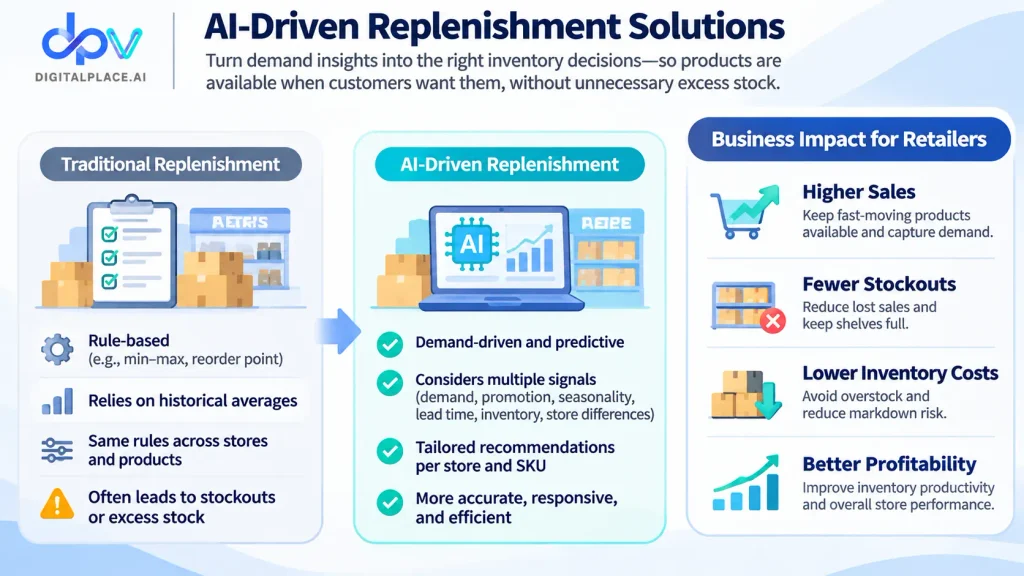
The infographic illustrates how AI-driven replenishment solutions help retailers move beyond traditional inventory rules toward more responsive, demand-based decisions. While conventional replenishment often relies on fixed reorder points, historical sales averages, and standardized stock parameters, AI-driven systems analyze multiple factors, including demand patterns, promotions, seasonality, supplier lead times, and store-level inventory conditions. This enables retailers to generate replenishment recommendations tailored to individual stores and SKUs rather than applying the same rules across their entire network. By improving replenishment decisions, retailers can reduce stockouts, capture potential sales that might otherwise be lost, minimize excess inventory, and improve profitability. The key advantage is not simply automating purchase orders, but ensuring that inventory decisions better reflect actual customer demand and business requirements.
From Demand Forecasting to Replenishment Decisions
Demand forecasting and replenishment are closely related, but they perform different functions.
Demand forecasting estimates how much customers are likely to purchase during a future period. Replenishment determines how much inventory should be ordered or transferred to support that demand.
A forecast predicting sales of 200 units does not automatically mean the retailer should order 200 units.
The appropriate replenishment quantity also depends on current inventory, incoming deliveries, supplier lead time, safety stock requirements, shelf capacity, and ordering constraints.
Consider two stores expected to sell 200 units of the same product next week. Store A currently holds 150 usable units, while Store B has only 40 units available. Even with identical demand forecasts, their replenishment requirements are different.
An effective AI-driven replenishment solution connects demand predictions with these operational variables to recommend appropriate ordering quantities.
This distinction is important because better forecasting does not automatically produce better inventory performance. The forecast must lead to executable decisions that reflect real supply chain conditions.
Research and industry analysis support this approach. McKinsey’s research on machine-learning-based fresh-food replenishment describes how retailers can combine demand predictions with supplier constraints, inventory requirements, and commercial objectives when generating replenishment recommendations.
How AI-Driven Replenishment Can Improve Sales and Revenue
The commercial value of AI-driven replenishment comes from improving inventory decisions that influence customer purchases.
1. Recovering Sales Lost to Stockouts
When a product is unavailable, retailers risk losing transactions that might otherwise have occurred.
AI-driven replenishment can help reduce this risk by identifying products likely to run out before the next replenishment cycle. Rather than waiting for inventory to reach a fixed threshold, the system can consider expected demand during the supplier lead time.
For example, a fast-moving snack may have sufficient stock for an ordinary weekday but not for an upcoming holiday weekend. Anticipating the demand increase allows the retailer to adjust orders before the shortage occurs.
The resulting commercial benefit depends on whether customers would otherwise have substituted another product, delayed their purchase, or abandoned the transaction.
2. Protecting Basket Size and Complementary Sales
Product availability also affects how many items customers purchase during a store visit.
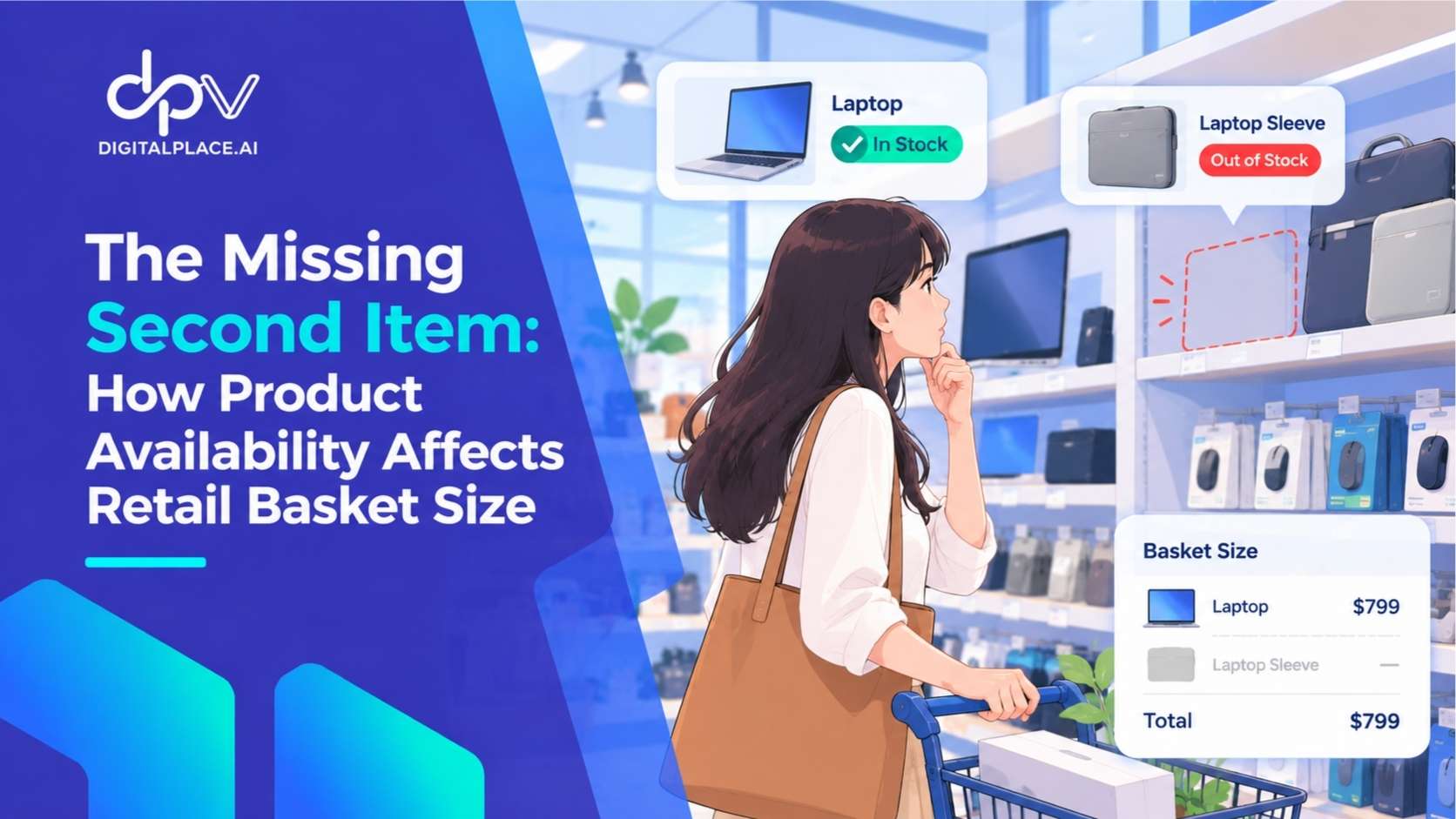
A retailer may have sufficient stock of a promoted coffee product but insufficient sugar or creamer. Customers can still purchase the main product, yet the retailer may miss opportunities to sell complementary items.
AI-driven replenishment can support more coordinated planning by identifying relationships between product demand patterns.
Improving the availability of complementary products creates opportunities to increase units per transaction and average transaction value, particularly when replenishment decisions account for promotional activity and related purchases.
However, the additional revenue is not guaranteed. Merchandising, pricing, customer preferences, and actual shelf availability remain important.
3. Reducing Markdown Pressure and Protecting Margins
Excess inventory can also reduce financial performance.
Products that remain unsold may require markdowns, additional storage, or eventual disposal. These costs are especially relevant for fresh food, seasonal merchandise, and products with short commercial lifecycles.
AI-driven replenishment helps retailers evaluate expected demand before committing to additional inventory.
For example, if a seasonal product is approaching the end of its selling period, the system can recommend more conservative replenishment rather than continuing to order based on earlier peak demand.
This can help protect gross margins by reducing unnecessary stock accumulation and discounting.
4. Improving Inventory Productivity
Revenue growth is not the only financial objective.
Retailers also need to consider how much working capital is required to generate sales.
If a business maintains excessive inventory across hundreds of stores, substantial capital remains tied up in products that may not sell quickly.
More responsive replenishment decisions can help retailers maintain product availability while reducing unnecessary inventory investment.
Google Cloud discusses this relationship in its analysis of retail forecasting, inventory placement, and profitability, highlighting the importance of matching anticipated demand with appropriate inventory locations.
Why AI Replenishment Still Requires Reliable Inventory Data
AI cannot compensate for every operational problem.
If inventory records are inaccurate, an AI system may generate replenishment recommendations based on stock quantities that do not physically exist.
A retailer might believe that 30 units remain in a store when the actual quantity is significantly lower. Even a sophisticated demand model could recommend insufficient replenishment if it relies on the incorrect inventory balance.
Inventory accuracy therefore remains essential.
Research by DeHoratius, Mersereau, and Schrage demonstrates how inventory record inaccuracies complicate automated inventory decisions and why replenishment policies must account for uncertainty in stock information.
There is also an important difference between inventory being available in a store and products being available on the shelf.
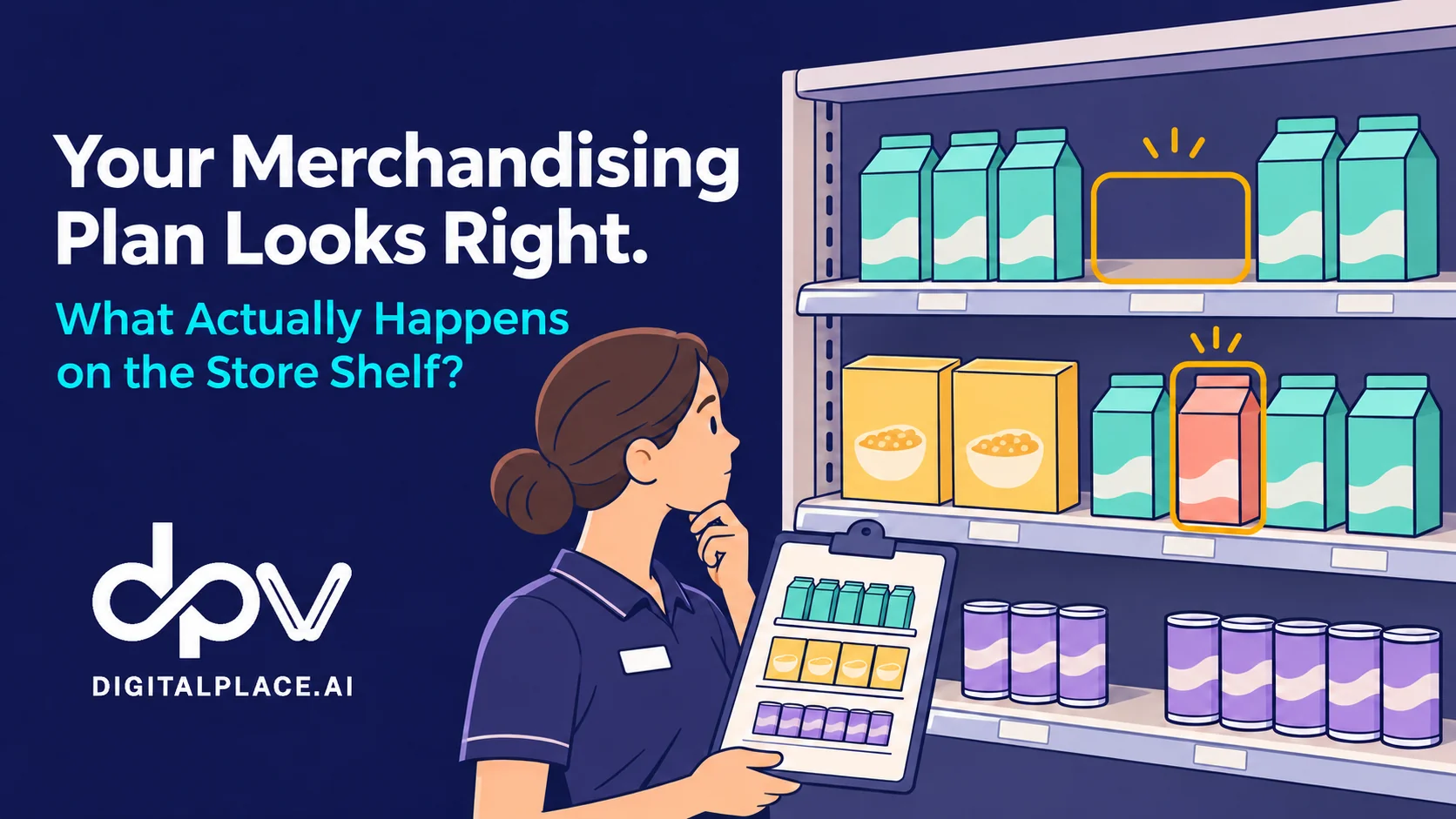
AI replenishment may successfully deliver sufficient inventory to a location, but customers can still encounter empty shelves if products remain in the backroom or are displayed incorrectly.
Retailers must therefore connect inventory planning with physical store execution rather than expecting forecasting technology alone to eliminate availability problems.
Implementing AI-Driven Replenishment in Retail
Retailers do not necessarily need to replace every existing inventory system to introduce AI-driven replenishment.
A practical approach is to begin with a limited group of stores or product categories, establish baseline performance, and evaluate whether AI-generated recommendations improve operational outcomes.
Relevant measures include out-of-stock rates, inventory turnover, days of inventory, replenishment accuracy, markdown costs, and sales performance.
It is also important to distinguish between improvements caused by the replenishment system and changes resulting from promotions, seasonality, or market conditions.
During implementation, retailers should validate data quality, define ordering constraints, and determine which decisions require human approval. Gradually increasing automation can help operational teams build confidence in the recommendations.
Digitalplace.ai approaches this challenge through AI-powered inventory optimization, connecting demand forecasting with replenishment and inventory allocation decisions across retail operations.
The objective is not simply to automate purchase orders, but to support better inventory decisions across stores and distribution centers.
Better Replenishment Decisions Create Better Retail Outcomes
AI-driven replenishment solutions represent a shift from maintaining static stock rules toward making inventory decisions that respond more closely to customer demand.
For retailers, the commercial opportunity is significant: better replenishment can help recover sales lost to stockouts, support complementary purchases, reduce excess inventory, and protect profitability.
However, AI should not be evaluated solely by forecasting accuracy or the number of purchase orders generated automatically.
Its effectiveness ultimately depends on whether better decisions lead to measurable improvements in product availability, inventory efficiency, and financial performance.
Retailers that connect demand intelligence, replenishment execution, and reliable inventory data are better positioned to turn inventory management from a routine operational task into a contributor to sustainable revenue growth.