Retail managers make decisions throughout the day: what to reorder, which store needs additional stock, which shelf issue deserves attention, and how to help customers choose. AI tools for improving retail decision-making can support these choices by analyzing information, identifying patterns, and recommending actions within defined business rules.
The value depends on the decision being improved. A forecast needs to inform an order. A shelf alert needs to identify a corrective task. A customer question needs a reliable answer. For grocery, convenience, and specialty retailers, the following applications show where AI can contribute—and what teams should check before acting.
1. Forecast demand by product and location
Decision improved: What will customers buy, where, and when?
AI forecasting tools can analyze sales history alongside promotions, seasonality, and store-level patterns to estimate demand for individual products. This gives planners a more specific basis for decisions than applying the same average across every outlet.
For example, a convenience store near offices may sell ready-to-drink coffee differently from one in a residential neighborhood. Forecasts should reflect those differences. Teams also need to identify periods when stockouts restricted sales, because recorded purchases may understate what customers wanted.
2. Calculate replenishment quantities
Decision improved: How much additional inventory should be ordered?
A demand forecast becomes more useful when combined with stock levels and operating rules. Replenishment tools can use these inputs to calculate quantities, while configured constraints account for factors such as case packs and delivery schedules.
Digitalplace.ai’s Inventory Optimization solution connects demand forecasting with replenishment and allocation decisions. Digitalplace.ai For retailers, an important evaluation question is whether incoming orders and revised arrival dates are represented accurately. Otherwise, a recommendation may duplicate stock already on its way or assume a delayed delivery is available too soon.
3. Allocate limited stock across stores
Decision improved: Which locations should receive available inventory first?
When a distribution center cannot fulfill every request, allocation requires trade-offs. AI-supported planning can help compare location-level requirements, available stock, and service priorities rather than distribute the same quantity everywhere.
Consider two stores requesting the same product. One may have sufficient coverage for several days, while the other faces a shortage before its next delivery. A useful recommendation should make that difference visible. Planners should also consider minimum display quantities and delivery feasibility before approving the allocation.
4. Review local assortment choices
Decision improved: Which products should each store carry?
Assortment analytics can help teams examine product performance across store groups and identify candidates for further review. Depending on the tool, analysis may include sales, margins, basket relationships, and local demand patterns.
A compact neighborhood store may need a different pack-size mix from a larger destination supermarket. However, low sales alone should not trigger delisting. The product may have suffered from poor availability or placement. Treat recommendations as hypotheses to test through controlled assortment changes, with category objectives clearly defined.
5. Evaluate promotions and markdowns
Decision improved: Which offer is likely to support the commercial objective?
AI models can help estimate how demand may respond to different promotional conditions. Retailers can use those estimates to compare scenarios, including the inventory required and the margin implications.
For example, a discount on one beverage could increase its sales while reducing purchases of another. Higher promotional volume therefore needs to be assessed alongside category margin, stock availability, and possible waste. Recommendations should operate within approved pricing rules, and teams should distinguish forecasted effects from results demonstrated through a test.
6. Prioritize shelf corrections
Decision improved: Which shelf problem should employees address next?
Computer vision tools can analyze shelf images to identify missing products, misplaced items, and deviations from approved layouts. Scheduled checks can give store teams a more consistent basis for follow-up. digitalplace.ai
The corrective action depends on the observation. A missing product may need replenishment, while a misplaced product may simply need relocation. On-shelf availability and planogram compliance tools are most useful when findings identify the affected SKU and position. Uncertain detections should be checked, and completed tasks should be verified.
7. Focus warehouse inventory investigations
Decision improved: Which stock records or locations need physical verification?
AI-assisted anomaly detection can help highlight unusual inventory movements or discrepancies for investigation. Where supported, image-based inspection tools can add physical observations to the transaction records used by warehouse teams.
A pallet recorded in one rack but observed elsewhere presents a specific location issue to investigate. The observation does not establish why the mismatch occurred. Employees still need to check movement history and confirm the correction. Automated findings should support an evidence-based review before inventory records are adjusted.
8. Plan staffing around expected workload
Decision improved: When and where will additional staff capacity be needed?
Predictive tools can help estimate workload using relevant inputs such as transaction patterns, expected deliveries, and planned promotions. Managers can use these estimates when preparing schedules and assigning tasks.
A busy evening may require checkout support, while an early delivery creates receiving and replenishment work. The usefulness of a staffing recommendation depends on how well it reflects those activities. Employee availability, skills, breaks, and applicable working rules remain constraints; a forecast of customer traffic alone is insufficient.
9. Improve customer guidance and service escalation
Decision improved: What information does this customer need next?
Conversational AI can help shoppers access product, promotion, and store information. An AI avatar can provide a consistent interface for these routine questions across supported touchpoints. digitalplace.ai
For store management, recurring questions can also suggest information gaps worth reviewing. Frequent confusion about a promotion may justify clearer signage or staff guidance. Responses should rely on approved, current information, and unresolved questions should reach a person. Product availability claims require a dependable connection to the relevant stock data.
10. Turn operational reports into investigation priorities
Decision improved: What should the manager investigate first?
AI-assisted analytics can help summarize performance changes, flag exceptions, and organize questions for further analysis. A manager reviewing declining sales could begin with a shortlist of affected stores, categories, and periods instead of examining every report manually.
However, a generated explanation is not proof of causation. A sales decline occurring alongside lower availability deserves investigation, but other factors may contribute. The tool should expose supporting data, calculation definitions, and uncertainty so managers can verify the finding before changing operations.
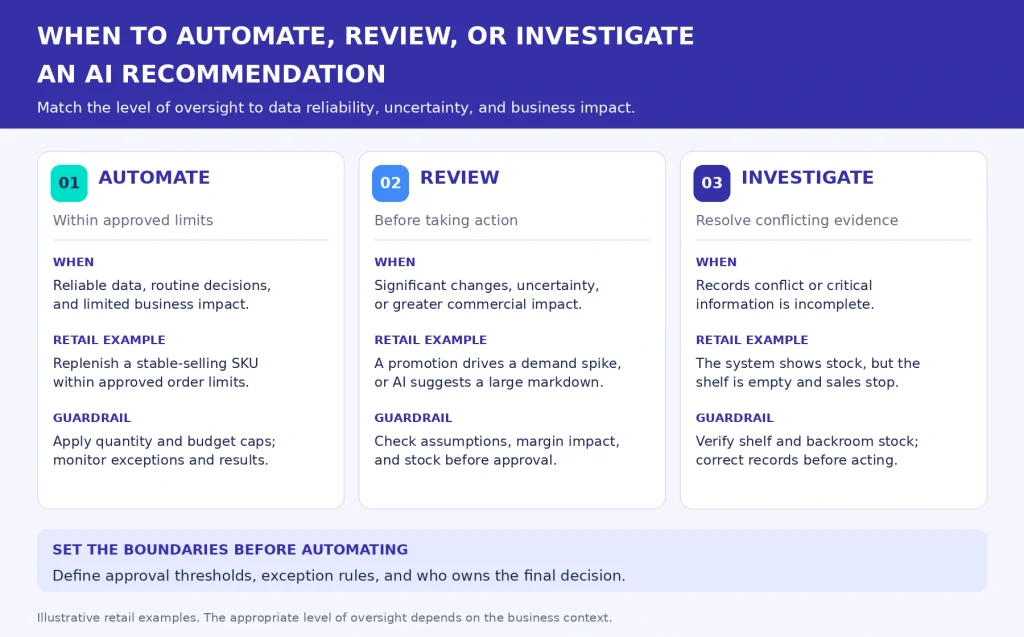
Not every AI recommendation should trigger an automatic action. Routine replenishment for a stable-selling product can be automated within approved order limits when inventory and delivery data are reliable. A sudden promotional spike or a substantial markdown deserves human review because the commercial consequences are greater and the underlying assumptions may have changed. When records conflict—for example, the system shows available stock while the shelf is empty—the priority is to investigate before acting. Defining these boundaries helps retailers automate routine work while keeping uncertain or consequential decisions under appropriate oversight.
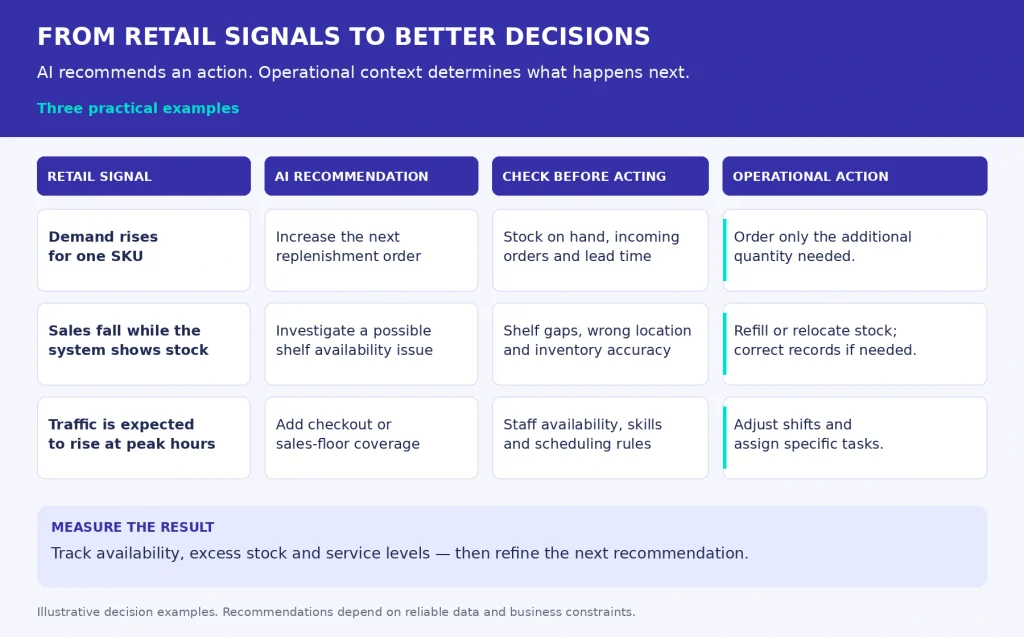
AI improves retail decision-making when recommendations are evaluated against operational realities. A rise in demand may justify a larger replenishment order, but existing stock, incoming deliveries, and lead times determine how much to buy. Falling sales despite recorded inventory may call for a shelf check before another order is placed, while an expected traffic peak may warrant additional staff coverage within scheduling constraints. These examples show why retailers need to connect each signal to a practical action, then measure the outcome through product availability, excess stock, and service levels.
Start with a decision you can measure
Choose one recurring decision with a clear owner and measurable outcome. Replenishment might be evaluated through availability and excess stock; shelf inspection through verified corrections; customer assistance through resolved inquiries and appropriate handovers.
Before expanding a pilot, check data quality, operational feasibility, and whether employees can understand and challenge recommendations. Digitalplace.ai focuses on connecting AI with practical retail workflows, where information leads to a specific action.
The strongest starting point is a decision your team already struggles to make consistently. Define the problem, establish a baseline, and test whether the AI-supported process improves the outcome under actual store conditions.