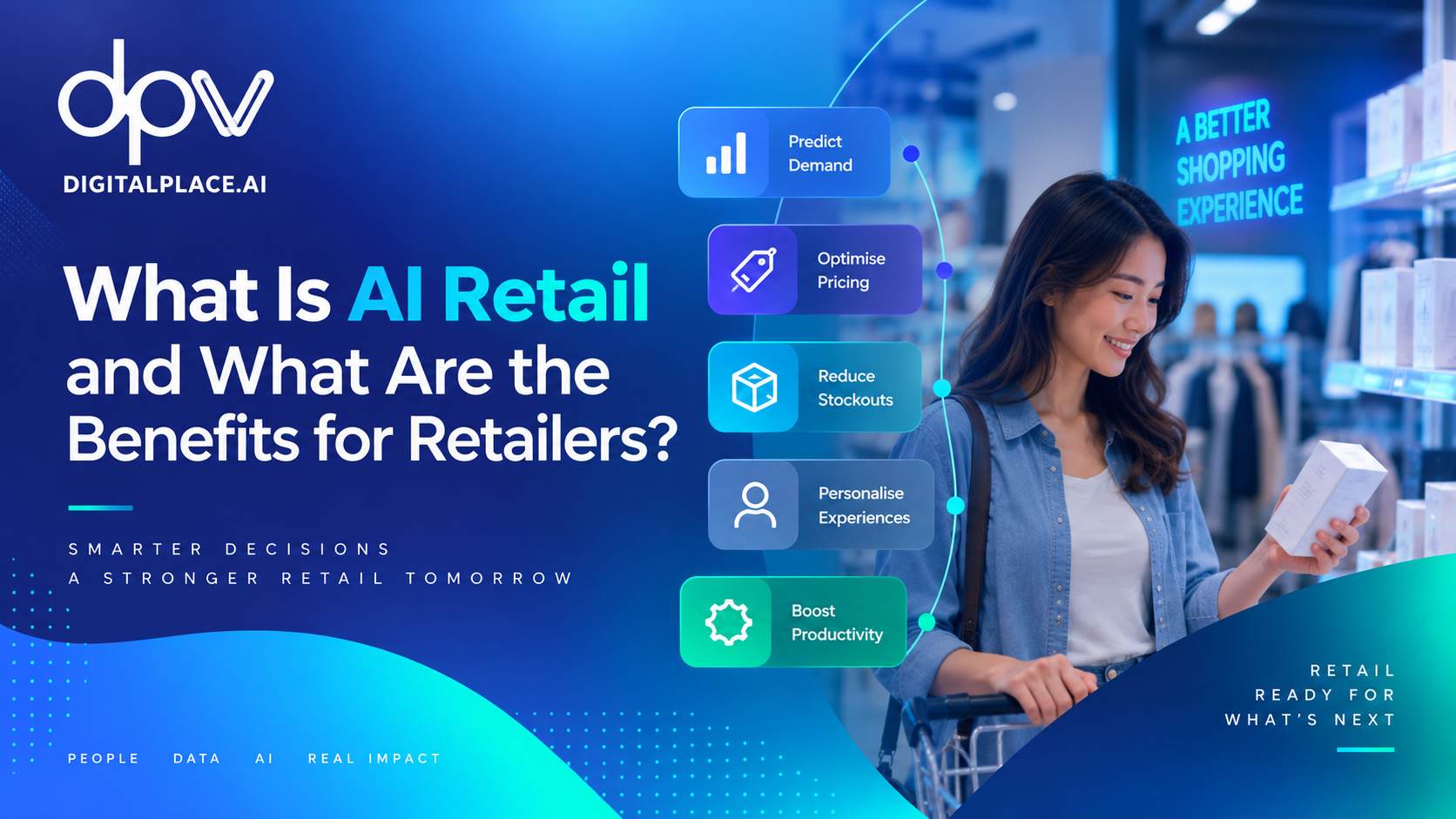
Retail does not suffer from a shortage of data. It suffers from a shortage of timely, confident decisions.
Every day, retailers make thousands of choices: how much inventory to order, which store should receive it, whether a promotion is profitable, which shelf problem deserves attention first, and which tasks employees should handle manually.
This is a practical way to understand what AI in retail means.
AI in retail refers to the use of artificial intelligence to improve, speed up, or automate decisions across retail operations, from planning and inventory management to store operations, customer interactions, and warehouse activities.
Its value comes from helping retailers make better decisions.
Installing a chatbot, testing image recognition, or using a forecasting model is only a starting point. Business impact comes when these tools help retailers achieve measurable results, such as fewer stockouts, higher margins, or lower operating costs.
AI in Retail Uses Multiple Technologies
AI in retail includes several technologies, each used to address different retail problems:
- machine learning for demand forecasting;
- optimization models for replenishment and allocation;
- computer vision for shelf execution;
- recommendation engines for personalization;
- natural-language AI for customer and employee assistance;
- robotics and autonomous systems for physical operations;
- AI agents that coordinate tasks or decisions.
Retailers rarely need “more AI” in the abstract. They need better outcomes in specific parts of the business.
A better question is:
Which retail decision becomes better because AI is involved?
From Prediction to Action
Demand forecasting is a good example.
Predicting that Product A will sell 18% more next week may be useful. But the forecast itself does not put products on shelves.
The real process is longer:
Demand signal → forecast → inventory requirement → reorder decision → allocation → delivery → shelf availability → customer purchase
This is why mature AI in Retail is not just predictive. It is increasingly prescriptive and operational.
Instead of stopping at “What is likely to happen?”, the system should move toward “What should we do because of it?”
That transition is where AI starts to affect revenue, working capital, margin, and execution rather than simply producing another dashboard.
How Many Benefits Does AI Offer Retailers?
There is no universal rule stating that AI in Retail has exactly six benefirs. Different retailers organize their businesses differently.
For practical decision-making, it is useful to focus on six key benefits of AI in retail:
- Revenue capture
- Gross margin
- Inventory and working capital
- Store and warehouse execution
- Customer experience and conversion
- Workforce productivity and decision quality
These benefits prevent a common mistake: measuring AI only through technical metrics such as model accuracy, response time, or number of automated tasks.
Technical performance matters, but the real question is whether AI improves the economics or execution of the retail business.
Benefit 1: Revenue Capture
The first lever is about reducing situations where customer demand already exists but the retailer fails to convert it into a sale.
This can happen because a product is out of stock, inventory is available in the wrong location, a customer cannot find the right item, a relevant recommendation is missed, or information is unavailable at the moment of purchase.
The key idea is subtle: AI does not always need to create new demand.
Sometimes its most valuable role is to capture demand that is already there.
At scale, even a small improvement in availability or conversion can become significant.
Benefit 2: Gross Margin
Higher sales do not always mean higher gross profit. Deep discounts can increase sales while leaving the retailer with less money after covering the cost of the products sold.
AI can help retailers decide which products to promote, how much discount to offer, and which products to stock in each store. These decisions can help increase sales while protecting margins.
For example, two campaigns might each generate $100,000 in sales. If the products sold cost $70,000 in one campaign and $80,000 in the other, their gross profit would be $30,000 and $20,000, respectively.
To measure AI’s impact, track gross profit and gross margin alongside sales growth.
Benefit 3: Inventory and Working Capital
Inventory is one of the clearest places where AI in Retail connects operations directly to finance.
Too little stock creates lost sales. Too much stock traps working capital, consumes space, increases carrying costs, and can eventually lead to markdowns, obsolescence, or waste.
The goal is not simply to reduce inventory. It is to place the right inventory, in the right quantity, at the right location, at the right time.
AI can support demand forecasting, safety-stock optimization, reorder calculations, allocation, and automated replenishment. A forecast therefore becomes valuable only when it changes what the retailer does next.
Digital Place can serve as an AI in retail technology partner by helping retailers connect demand forecasting with practical inventory and replenishment decisions. Rather than treating forecasting as an isolated analytics exercise, the focus can extend to stock levels, reorder timing, and allocation so that the output of AI becomes operationally useful.
The Missing Middle: When System Inventory and Physical Reality Disagree
The system says a store has stock.
The shopper sees an empty shelf.
Both statements can be true.
Inventory may be in the backroom, placed in the wrong shelf position, counted incorrectly, delayed in replenishment, or available at the wrong branch.
This gap between digital records and physical reality is an execution gap.
Forecasting asks what should happen.
Execution asks whether it actually happened.
Benefit 4: Store and Warehouse Execution
AI can make physical operations more measurable through use cases such as:
- on-shelf availability checks;
- planogram compliance;
- misplaced-product detection;
- shelf-gap identification;
- warehouse inventory verification;
- exception detection;
- task prioritization.
Computer vision can turn images or video into structured observations, while robotics can support repetitive warehouse verification. The goal should not be more alerts, but better operational priorities.
A useful system does not merely tell a store manager that 47 issues exist. It helps identify which five deserve attention first because they matter most to sales, availability, or compliance.
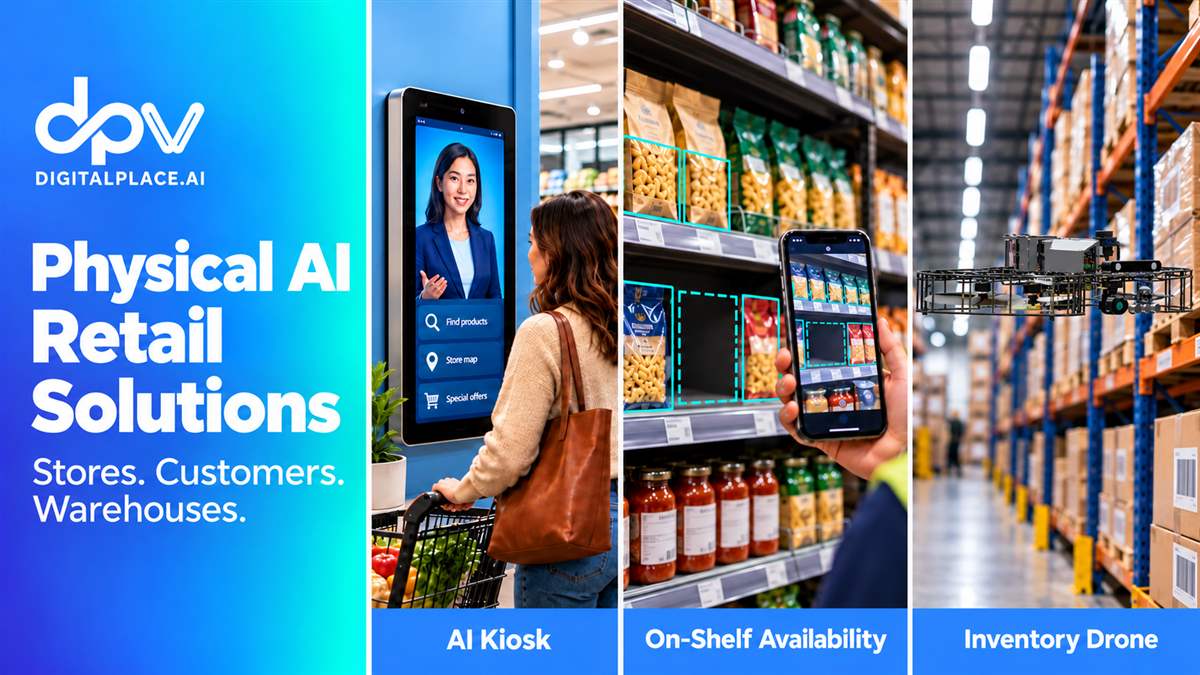
At the execution layer, Digital Place can work with retailers on AI-enabled visibility across shelves and warehouse inventory. On-Shelf Availability can help identify missing products, misplaced items, and planogram deviations through scheduled checks, while AI-supported warehouse inventory scanning can strengthen physical stock verification. This creates a bridge between what the system believes is happening and what is actually happening in the retail environment, giving teams clearer exceptions to act on instead of simply adding another dashboard.

Where Does AI Create Value in Retail?
Explore six key benefits of AI in retail and see how each one connects a retail problem to an AI-powered decision, a practical action, and a measurable business outcome.
Rather than asking “Where can we use AI?” retailers can start by identifying where value is currently leaking from the business and which decisions need to improve.
practical benefit for evaluating AI across the retail value chain
Revenue Capture
Reduce situations where customer demand already exists, but the retailer fails to convert it into a sale.
Gross Margin
Use AI to improve the quality of revenue, not simply increase transaction volume.
Inventory & Working Capital
Balance product availability with the financial cost of carrying more inventory than the business needs.
Store & Warehouse Execution
Close the gap between what digital systems say should be happening and what is physically happening in stores and warehouses.
Customer Experience & Conversion
Use AI to remove information friction during the shopping journey.
Workforce Productivity & Decision Quality
Help employees focus human attention where judgement and intervention create the greatest value.
Problem
Decision
Action
KPI
You can selects one of the six levers and sees:
- the retail problem;
- the AI decision;
- required data;
- operational action;
- KPI to measure;
- example workflow;
- implementation complexity.
This connects technology directly to measurable business outcomes.
Benefit 5: Customer Experience and Conversion
Customer-facing AI is often the most visible part of AI in Retail, but visibility does not necessarily equal value.
An AI avatar can look realistic and still be unhelpful if it cannot answer basic questions such as:
- Is this product available?
- What is the difference between these two options?
- Is there a promotion?
- Which product fits my needs?
- Where can I find it?
- Is it available at another branch?
Useful customer-facing AI should behave less like a novelty and more like a knowledgeable retail assistant. That requires product, inventory, promotion, and store information to work together.
Benefit 6: Workforce Productivity and Decision Quality
AI in retail is often framed as labor replacement. That framing is too narrow.
A more practical opportunity is to change how human attention is allocated.
Retail employees spend significant time deciding which SKU to investigate, which shelf to check, which order needs intervention, which customer inquiry can be answered immediately, and which inventory exception deserves escalation.
AI can process scale and repetition. People can focus on exceptions, judgment, and customer relationships.
In simple terms:
AI handles volume. Humans handle judgment.
Productivity may therefore come not from removing entire roles, but from reducing the amount of low-value decision work inside those roles.
AI also can help reduce operating costs by automating repetitive tasks, reducing manual errors, and helping teams plan workloads more efficiently. For example, automated inventory checks can reduce time spent counting stock, while better staff scheduling can help avoid unnecessary overtime.
Digital Place can also be positioned as an AI in retail technology partner across this broader decision flow. Inventory Optimization addresses planning and replenishment; On-Shelf Availability connects shelf conditions with store execution; AI-supported drone inventory helps with warehouse verification; and AI Avatar solutions can support customer-facing information access. The important point is not that every retailer needs every solution. A stronger approach is to start with the retailer’s most expensive bottleneck, solve that problem first, and then connect additional AI capabilities only where there is a clear operational or economic reason to do so.
One AI Use Case Can Affect Several Levers at Once
The six levers should not be treated as separate boxes.
Take demand forecasting. At first, it looks like an inventory use case.
But better forecasting may also:
- reduce stockouts, improving revenue capture;
- reduce excess stock, releasing working capital;
- reduce markdowns, protecting margin;
- improve availability, improving customer experience;
- reduce manual review, improving planner productivity.
This is why valuable AI use cases often create second-order effects across finance, merchandising, stores, and customer experience.
Start With Value Leakage, Not With AI
The wrong starting question is:
“Where can we use AI?”
Almost every retailer can generate dozens of answers.
A more useful question is:
“Where is value currently leaking from the business?”
Is the business losing sales because products are unavailable? Is too much cash tied up in slow-moving inventory? Are promotions generating volume without enough margin? Are planners spending too much time reviewing exceptions? Are store teams checking shelves without knowing where the biggest problems are?
Once the constraint is identified, AI becomes one possible mechanism for solving it.
A strong AI in Retail project should connect four elements:
Business problem → AI decision → operational action → measurable KPI
If one of those links is missing, the use case may still be technically interesting, but the business case is weaker.
What Is AI in Retail, Then?
AI in Retail is not about replacing retail experience with algorithms.
It is about using machine intelligence to improve the enormous number of decisions connecting demand, merchandise, inventory, operations, employees, and customers.
The six practical value levers are:
- revenue capture;
- gross margin;
- inventory and working capital;
- store and warehouse execution;
- customer experience and conversion;
- workforce productivity and decision quality.
The most successful retailer may not be the one with the largest number of AI tools.
It may be the retailer that knows exactly which decision needs to improve, what action should follow, and which business metric proves that the improvement matters.