
Since the 1960s, business students at MIT and elsewhere have played a deceptively simple board game. Each team runs a small supply chain for beer: a retailer, a wholesaler, a distributor and a brewery. Players can only see their own stock and the orders arriving from the link next to them. Customer demand barely changes during the game, usually just one small step up early on. Yet within a few rounds, orders swing wildly, the brewery overproduces, the wholesaler runs dry and most teams finish with a pile of excess stock alongside a list of missed orders. The lesson, known as the bullwhip effect, is that small changes at the shelf grow larger with every step upstream when each link plans on its own.
Read more
What Is AI-Powered Inventory Optimization? The Retail Decision Engine Between Forecast and Shelf
Why Grocery Retail Inventory Is So Difficult to Optimize
Most retail networks still play a version of that game every week.
“Multi-echelon inventory optimization treats the supplier, the distribution centre and the store as one connected system, so every order upstream is driven by the same view of demand as every shelf downstream.”
What multi-echelon means, and why one link isn’t enough
An echelon is simply a level in the supply chain. For a typical retailer there are at least three: suppliers, one or more distribution centres, and the stores. Multi-echelon inventory optimization plans stock across all of these levels together, instead of treating each one as a separate problem. The idea sounds obvious, yet in many organisations the levels are run by different teams with different tools. Store replenishment sits with operations, DC stock with logistics and supplier ordering with purchasing or category management, each working from its own spreadsheet and its own assumptions about demand.
When each link optimises for itself, gains made in one place tend to leak away in another:
- A store replenishment tool that cuts store stock can simply push the buffer back to the DC, where it sits as excess.
- A DC that minimises its own inventory may leave stores short during promotions, because it can’t see what they will need.
- Purchasing that orders by gut feel or last month’s average reintroduces the volatility the store forecast just removed.
- Every level adds its own safety stock “just in case”, so the network as a whole holds far more than it needs.
This is why single-point optimisation often disappoints. A retailer can roll out an excellent forecasting model for store orders and still see total inventory barely move, because the improvement is absorbed upstream. Multi-echelon planning closes that gap by deciding how much stock each level should hold, and where safety stock does the most good, based on demand at the very end of the chain.
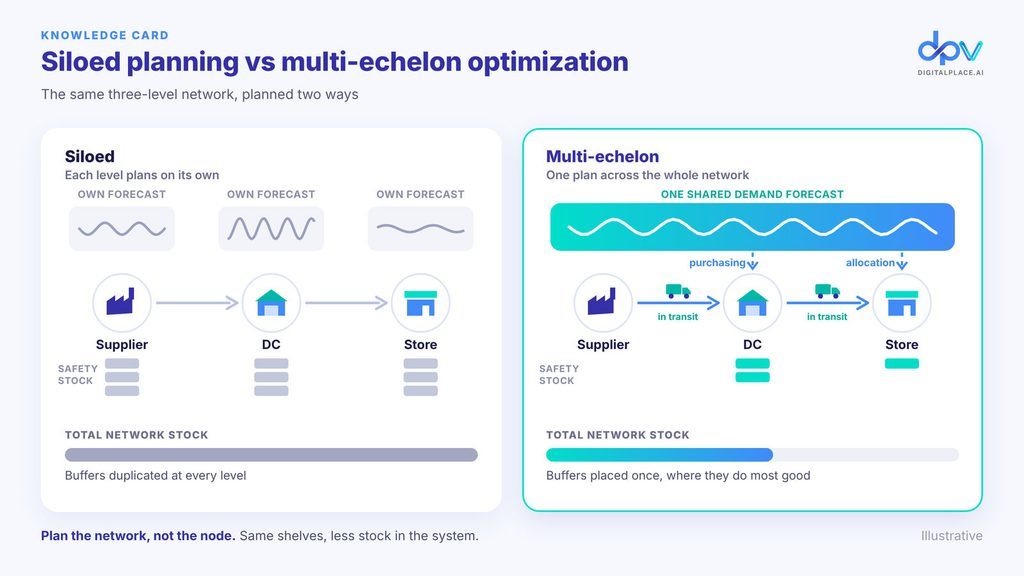
This image above compares two ways of planning the same three-level retail network of supplier, distribution centre and store. On the left, siloed planning gives each level its own forecast, and the DC’s demand signal swings far more than the store’s, an early sign of the bullwhip effect. Because no level can see what the others are doing, each one holds its own safety stock “just in case,” and total network stock ends up high. On the right, multi-echelon inventory optimization runs the whole network from one shared demand forecast. That forecast drives purchasing from the supplier to the DC and allocation from the DC to the store, and goods in transit are counted along the way. Buffers sit only where they protect availability, mostly at the DC with a small one at the store, so the same shelves are served with noticeably less stock in the system. The figures are illustrative and meant to show the principle rather than a specific result.
One forecast, two decisions
At the heart of a multi-echelon approach is a single demand signal. The same SKU-by-store forecast that drives replenishment from the DC to each outlet is rolled up to drive purchase orders from the supplier to the DC. When a promotion is planned for 400 stores next month, the DC already knows how much it will need to ship, and purchasing knows how much to buy and when, well before the first store runs low. Nobody upstream has to guess what the stores will do, because the stores’ expected demand is already the input.
The two decisions look different, but they answer the same question at different points in time:
- DC to store: how much each outlet needs over its next delivery cycle, given its own forecast, stock and display rules.
- Supplier to DC: how much the DC needs to cover all its stores over the supplier’s lead time, plus a buffer sized for how much that lead time varies.
Running both from one forecast also means both improve together. When digitalplace.ai, an AI-powered inventory optimization partner for retailers, connects the supplier-to-DC and DC-to-store legs to the same model, a better forecast at the shelf flows straight into better purchasing upstream instead of staying trapped at store level.
Goods in transit: the stock everyone forgets
Between the supplier and the DC, and between the DC and the stores, there is always stock on the move. Trucks are on the road, containers are waiting at the port, and pallets have been picked but not yet delivered. This inventory is easy to overlook because it isn’t on any shelf, yet it has already been paid for and will arrive whether anyone plans for it or not. When replenishment logic ignores goods in transit, it orders the same stock twice. When it counts transit stock as if it had already arrived, it can leave a store empty for the two days the truck is still on its way.
Getting transit right comes down to a few details:
- Record what was actually shipped, not just what was ordered, so partial deliveries don’t create phantom stock.
- Use realistic arrival dates based on observed lead times, not the supplier’s quoted ones.
- Count transit stock towards the location it is heading to, from the day it is expected to arrive.
- Flag overdue shipments so the next order can compensate before a gap appears on the shelf.
In a multi-echelon view, transit stock is simply another place where inventory lives, and it is planned like any other.
Balancing stock across stores and warehouses
Even with good forecasts, demand never lands exactly where it was expected. One store sells through a new product in a week while another, twenty minutes away, has barely touched it. A regional DC is short on a fast mover while a neighbouring DC holds more than a month of cover. Traditional planning tends to accept these imbalances and wait for the next cycle, ordering more stock for the short location while the surplus elsewhere slowly ages. Multi-echelon planning looks at the network first and asks whether the stock already exists somewhere before buying more.
In practice, several options are weighed side by side:
- Store-to-store transfers between nearby outlets with opposite imbalances.
- Re-routing a DC shipment to the location that needs it most.
- Pulling slow stock back to the DC before it ages on the shelf.
- Adjusting the next supplier order instead of buying stock the network already has.
Each option carries a cost, from transport and handling to the risk of emptying the sending location. An optimisation model can compare these trade-offs across thousands of SKUs and locations, something no planning team could manage by hand.
Weighing those moves network-wide is exactly what digitalplace.ai is built for. The result is less stock in the system overall, without more empty shelves.
Example: a supermarket and minimarket network
Consider a retailer that runs both large supermarkets and a dense network of small minimarkets, supplied through shared regional DCs. The two formats behave very differently. Supermarkets sell high volumes across a wide range, have space for buffer stock and receive large deliveries a few times a week. Minimarkets carry a narrower range, sell smaller quantities of many items and have almost no storeroom, so they are restocked frequently in small drops. A planning approach that treats both formats the same will either overload the minimarkets or under-serve the supermarkets.
In a multi-echelon setup, the same network can be planned very differently by format:
- Minimarkets hold little stock and rely on frequent DC deliveries, so the DC carries more of the buffer on their behalf.
- Supermarkets hold more safety stock on site, because their deliveries are larger and less frequent.
- The DC sizes its own stock against the combined forecast of both formats, including promotions planned in either.
- Supplier orders follow the DC’s needs, timed to supplier lead times and minimum order quantities.
Now add a festive promotion on cooking oil across the whole network. The forecast shows an earlier peak in supermarkets, where families stock up in bulk, and a later, sharper lift in minimarkets, where shoppers buy smaller packs closer to the holiday. With one connected plan, purchasing brings the supplier order forward, supermarkets receive their uplift first, and the DC holds back extra stock for the minimarket routes until the second wave arrives. When the promotion ends, the plan tapers off at every level at once, instead of leaving the DC holding the surplus.
The bottom line
Multi-echelon inventory optimization isn’t a separate technology so much as a different way of looking at the same problem. Instead of asking how much stock each store, DC or buyer should hold in isolation, it asks how much the network should hold and where each unit does the most good. Retailers that make this shift typically find they can carry less inventory overall while keeping shelves fuller, simply because buffers stop being duplicated at every level and decisions upstream finally reflect what is happening at the shelf.
Three quick signs your network would benefit:
- Total inventory stays flat even after store-level forecasting improves.
- DCs and stores both report high stock on the same items at the same time.
- Supplier orders swing more sharply than store sales do, the bullwhip at work.
A good first step is to map where your buffers sit today. From there, digitalplace.ai can help connect them into a single plan.