
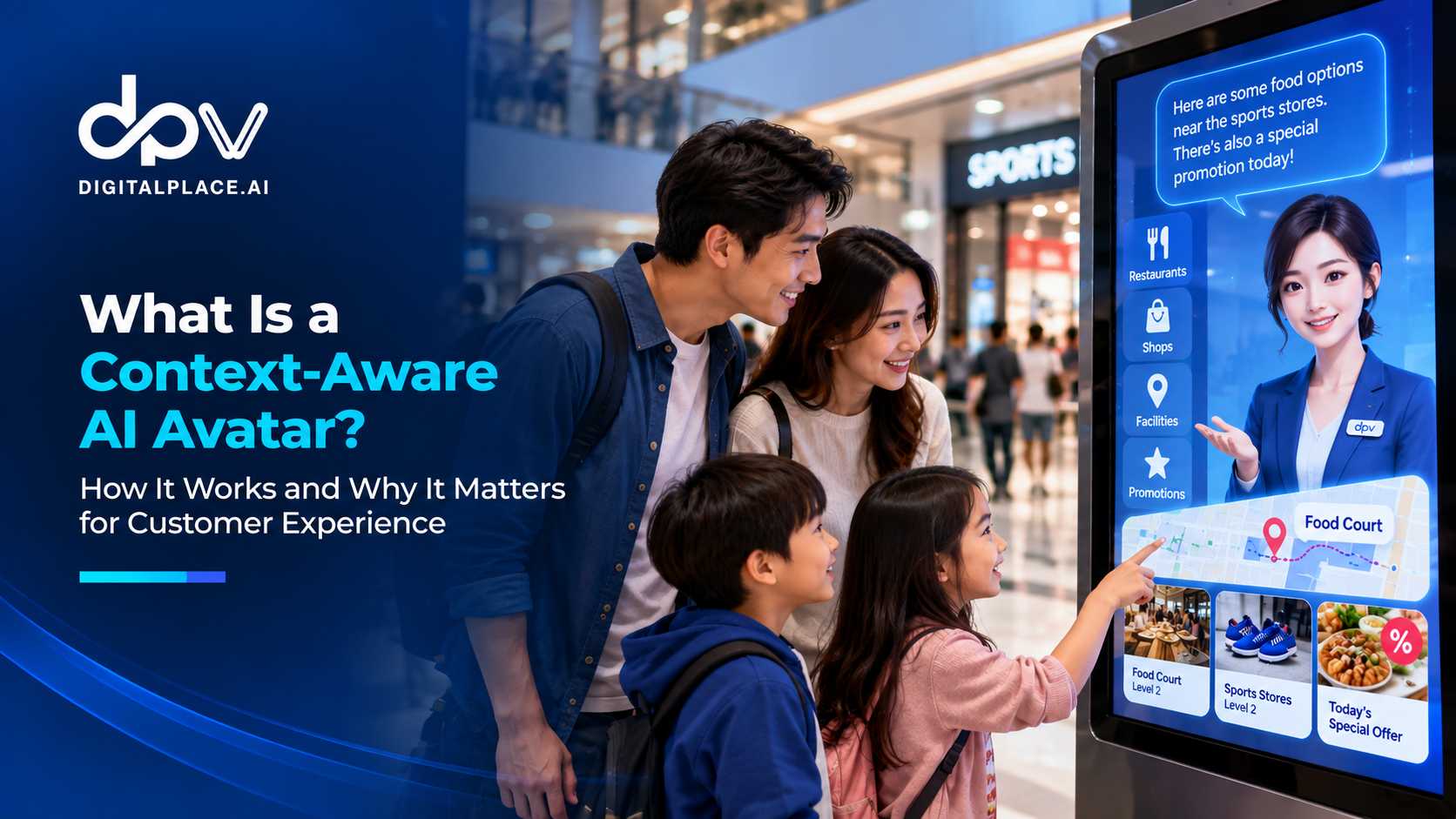
A family walks into a shopping mall on a Saturday afternoon. The kids want sneakers, the parents want lunch, and nobody knows where the nearest prayer room is. They stop at a digital kiosk and ask, “Where can we eat near the sports stores?” A basic screen would show a static map. A context-aware AI avatar does something more useful: it understands what they are looking for, remembers that they mentioned sneakers a moment ago, points them to the right floor, and mentions a food court promotion running only today.
That small difference is the reason context-aware AI avatars are getting attention from retailers, mall operators, hotels, hospitals, and office buildings. Customers expect help that feels personal and immediate, and businesses need a way to deliver it without adding staff at every touchpoint.
What Is a Context-Aware AI Avatar?
A context-aware AI avatar is a digital character, shown on a website, kiosk, or in-store screen, that holds natural conversations with people and adapts its answers to the situation around each question. Context can mean several things at once: what the person asked earlier in the conversation, where the avatar is deployed, what the business currently offers, the time of day, the language the visitor speaks, and the specific goal behind a question. Instead of matching keywords to a fixed list of replies, the avatar interprets intent and responds the way a well-briefed staff member would.
The “avatar” part matters too. A visible, expressive character with natural gestures makes the interaction feel closer to talking with a person than typing into a search box. For many visitors, especially in physical spaces, that lowers the barrier to asking for help in the first place.
How a Context-Aware AI Avatar Works
Behind the friendly face, three layers work together.
- Conversational AI engine. This layer understands natural language, follows the thread of a conversation, and works out what the person actually needs. It can handle follow-up questions like “What about the one on the third floor?” without asking the visitor to start over.
- Connected business information. The avatar draws on the organization’s own knowledge: product catalogs, promotions, store directories, doctor schedules, hotel services, or building procedures. Through API and system integration, that information stays current instead of going stale in a script.
- Expressive, guided delivery. Natural gestures, facial expressions, and a consistent personality turn an answer into an interaction. The avatar can also guide people toward a next step, such as a store location, a check-in process, or a sales consultation.
When these layers are combined, context flows through every exchange. The avatar knows where it is, what the business offers right now, and what this particular visitor has already said. At digitalplace.ai, the AI Avatar solution is built around exactly this structure, with custom knowledge, branded personality, and integration with existing business systems.

How It Differs from a Traditional Chatbot
Most people have met a frustrating chatbot. You ask a question in your own words, and it replies with a menu of options that do not match. You rephrase, and it sends you the same menu again. Traditional chatbots usually run on decision trees or keyword triggers, which work for narrow, predictable questions but break down as soon as a conversation drifts.
A context-aware AI avatar handles that drift. It keeps track of the conversation, connects a new question to earlier ones, and pulls answers from live business data rather than pre-written scripts. It also lives in more places. A chatbot is typically a text window on a website, while an AI avatar can greet visitors at a hotel lobby kiosk, stand beside a hospital registration desk, or guide prospects on a product page, keeping the same information and brand voice across every channel.
The visual presence is the other big difference. Seeing a responsive character who gestures and speaks makes help feel approachable, which is especially valuable for visitors who would never type a question into a small chat box.
Why It Matters for Customer Experience
Customer experience is shaped by small moments: how long someone waits, whether they get a clear answer, and whether they leave feeling helped or ignored. Context-aware AI avatars improve those moments in several practical ways.
- Faster answers, any time. The avatar is available 24/7, so a hotel guest asking about breakfast hours at 11 PM gets the same quality of help as one asking at noon.
- Consistent information. Every visitor hears the same accurate details about promotions, policies, and services, without depending on which staff member happens to be on shift.
- Less repetitive work for staff. Questions like “Where is the restroom?” or “Is this item on sale?” are handled automatically, freeing cashiers, receptionists, and front desk teams for higher-value service.
- Personalized guidance. Because the avatar understands each visitor’s needs, it can recommend relevant products, services, or next steps instead of generic suggestions.
- Multilingual support. Visitors can be helped in the language they are most comfortable with, which matters in tourist areas, international hotels, and diverse cities.
There is also a business case beyond satisfaction scores. When visitors find what they need quickly, they are more likely to buy, book, or come back. On websites, a context-aware sales avatar can qualify leads and move prospects toward a demo or consultation, turning passive browsing into a guided conversation.
Where Context-Aware AI Avatars Make a Difference
The same core technology adapts to very different environments, because the context changes from one setting to the next.
- Retail stores: product and promotion details, item locations, membership programs, payment options, and returns.
- Shopping malls: store and brand directories, tenant promotions, directions to parking, restrooms, prayer rooms, and ATMs.
- Office buildings: visitor check-in with ID capture and facial verification, host notification, and directions to meeting rooms and lifts.
- Hotels: round-the-clock guest assistance on check-in, Wi-Fi, housekeeping, amenities, and local recommendations.
- Hospitals: department and clinic information, doctor schedules, registration help, and directions to pharmacy, lab, or radiology.
- Websites: AI sales avatars that explain products, recommend solutions, qualify leads, and book next steps.
- Learning and training: AI tutors that answer questions on demand, adapt explanations to each learner, and track learning gaps.
Take the hospital example. A first-time visitor is often anxious, unsure where to register, and worried about missing an appointment. An avatar that knows today’s clinic schedule and the building layout can calm that moment with a clear, patient answer. Digitalplace.ai offers dedicated AI Avatar configurations for each of these settings, so the knowledge and flows match how people actually use the space.
What to Look for When Choosing a Context-Aware AI Avatar
Not every avatar product delivers real context awareness. Before committing, check for these capabilities:
- Custom knowledge: the avatar should learn from your own products, policies, and services, not generic internet content.
- System integration: APIs that connect to your inventory, booking, CRM, or visitor management systems keep answers accurate.
- Brand customization: appearance, voice, and personality should match your brand.
- Omnichannel deployment: the same avatar should work on kiosks, in-store screens, and websites.
- Language coverage: support for the languages your customers actually speak.
The Bottom Line
Context-aware AI avatars close the gap between self-service and personal service. They understand what people need, answer with up-to-date business information, and guide each visitor toward the right next step, in a format that feels human and approachable. For businesses that serve many customers across physical and digital spaces, that combination can improve satisfaction while easing pressure on frontline teams.
If you want to see how this works in practice, explore the AI Avatar solution at digitalplace.ai or try the avatars yourself.




