
A cycle count can look inexpensive when it is reduced to a simple calculation: number of employees multiplied by number of hours. In practice, that calculation leaves out much of the real cost.
Warehouse teams may need forklifts or other access equipment to reach high-bay locations. Aisles can become temporarily less efficient while counting takes place. Supervisors spend time resolving discrepancies. Pickers may lose time searching for stock that appears in the WMS but is not physically where it should be. In some cases, inventory inaccuracies are discovered only after they have already affected fulfillment.
For warehouse leaders, the business case for inventory verification therefore should not begin with the question, “How fast can we count?” It should begin with a broader one:
What does it actually cost the business to maintain confidence in physical inventory?
That is where drone-based cycle counting becomes more interesting—not simply as a replacement for manual scanning, but as a different operating model for inventory verification.
Digitalplace.ai approaches warehouse inventory counting from this broader perspective. Its AI-powered warehouse inventory drone is designed to perform repeatable scanning missions across configured warehouse areas, read QR-coded inventory, verify pallet locations, identify moved inventory, confirm empty positions and support high-bay counting. The objective is not only to reduce repetitive manual scanning, but also to make recurring verification easier to schedule without creating the same labor and equipment burden each time. For management, the value proposition is therefore tied to how often inventory can be checked, how quickly discrepancies can be discovered and how much operational effort is required to maintain accurate warehouse records.
The Real Cost of Manual Cycle Counting
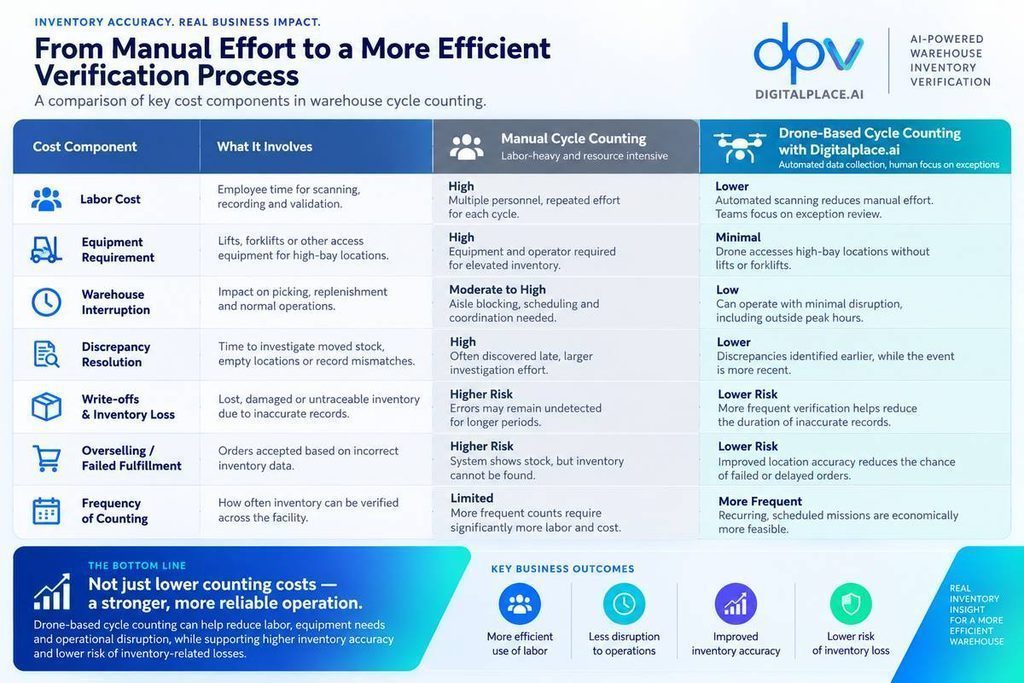
Manual cycle counting has a direct cost, but it also has several indirect costs that are easy to overlook.
A more complete framework includes:
- employee time used for counting and validation;
- forklifts, lifts or other equipment required to access elevated inventory;
- interruption or coordination costs inside active warehouse aisles;
- time spent investigating discrepancies;
- inventory write-offs or untraceable stock;
- failed or delayed fulfillment caused by inaccurate records;
- and the cost of limiting count frequency because each additional cycle requires more resources.
Viewed this way, cycle counting is not just an inventory-control activity. It is a recurring operating expense.
Labor Is Only the Starting Point
The most visible cost is labor. Employees need to move through the warehouse, identify assigned locations, scan or record inventory and compare the physical result with system records.
That work may appear straightforward, but its cost compounds because cycle counting is repetitive. A location counted this week may need to be counted again next month, next week or even sooner if it is operationally important.
Frequency Creates a Cost Trade-Off
This is where manual cycle counting creates an awkward economic relationship.
A warehouse that wants more confidence in its inventory usually needs to verify more frequently. But more frequent manual verification means more labor hours, more scheduling and potentially more equipment use.
If management reduces count frequency to control costs, the opposite problem appears: discrepancies can remain undetected for longer.
The issue is not simply whether the warehouse eventually finds the error. The question is how long the operation continues working with an inaccurate record before that error is found.
That period can be thought of as an inventory error exposure window.
The longer the window stays open, the more opportunities there are for the inaccurate record to affect picking, replenishment or fulfillment.
High-Bay Inventory Changes the Economics
Counting inventory at ground level is one thing. Counting inventory several meters above the warehouse floor is another.
A warehouse employee may need a forklift, order picker or other lifting equipment just to reach the label. That means the cost of one scan is no longer limited to a few seconds of employee time.
It can include equipment availability, operator time, safety procedures and coordination with other warehouse activity.
In a high-bay facility with thousands of pallet positions, that difference matters.
The value of a drone in this environment is not merely that it flies. The economic advantage comes from moving the sensing device to the inventory instead of repeatedly moving people and access equipment to the inventory.
Operational Disruption Is a Hidden Cost
Cycle counting happens inside an operating warehouse.
The same aisles may also be used for picking, replenishment, put-away and material movement. When counting activity requires people, lifts or other equipment to occupy those areas, normal warehouse activity may need to work around it.
This does not always create a formal shutdown. Often, the disruption appears in smaller ways: slower movement through an aisle, delayed use of equipment, additional scheduling or supervisors coordinating around the count.
Those costs are difficult to see in a conventional cycle-count budget because they are distributed across the operation.
For an Operations Director or CFO, however, they are still real.
Discrepancy Resolution Can Cost More Than Detection
Finding an error is only the first step.
Suppose the WMS says a pallet is stored at B3-02, but the location is empty. Someone now needs to determine what happened.
Was the pallet moved to B3-04? Was it picked but not correctly recorded? Was it placed on the wrong level? Is the label wrong? Does the pallet still exist somewhere else in the facility?
That investigation consumes time.
The older the discrepancy, the harder it may be to reconstruct the event that caused it. A recent movement is usually easier to understand than one discovered weeks later.
This is why earlier detection can have business value even when the final exception still needs human investigation.
At this point, Digitalplace.ai’s drone inventory model becomes relevant in a different way. Rather than positioning automation as “people versus drones,” Digitalplace uses the drone to handle repetitive physical observation while warehouse teams remain responsible for reviewing exceptions and taking corrective action. Configured missions can repeatedly verify QR-coded pallet positions and identify empty or moved locations, allowing teams to focus attention on the smaller number of cases that require judgment. This changes the labor equation: the warehouse spends less effort collecting routine verification data and more effort resolving the discrepancies that actually matter.
Inventory Loss Is Not Always Physical Loss
Warehouse leaders often associate inventory loss with shrinkage, damage or write-offs. But there is another form of loss that can be equally disruptive: inventory that exists physically but cannot be found operationally.
A pallet may still be inside the warehouse, yet if the WMS points employees to the wrong location, the inventory behaves as if it is unavailable.
That can trigger searching, recounting and additional handling. In some cases, the warehouse may take corrective action based on the assumption that stock is missing when it is actually misplaced.
This is why inventory accuracy should include both quantity accuracy and location accuracy.
A warehouse can have the correct total quantity and still experience fulfillment problems because the stock is in the wrong place.
Overselling and Failed Fulfillment Turn Internal Errors Into Customer Problems
Inventory inaccuracies become more expensive when they leave the warehouse.
If the system shows inventory as available, an order may be accepted. The problem appears later when the warehouse cannot find the stock or discovers that the expected location is empty.
At that stage, the cost is no longer limited to inventory operations.
The business may face delayed shipment, partial fulfillment, customer-service work, order cancellation or expedited replacement activity.
A discrepancy that could have been handled as a routine warehouse exception has now become a service problem.
That is why the timing of detection matters so much.
Accuracy Should Be Viewed as a System Outcome
It is tempting to evaluate warehouse drones with a single accuracy percentage. That is too simplistic.
Reliable inventory verification depends on the whole environment: label quality, QR-code size, scanning distance, lighting, flight stability, rack geometry, camera conditions and software processing.
A drone may perform very well in a warehouse with standardized QR labels and predictable rack layouts, but the same result should not automatically be assumed in a facility with inconsistent labels or difficult operating conditions.
From a business-case perspective, this means the relevant question is not:
“Is the drone accurate?”
It is:
“Can this warehouse create the conditions for repeatable, reliable inventory verification?”
That is why a controlled pilot matters.
A Better ROI Framework
A strong ROI model should look beyond counting speed.
Direct Efficiency
How many hours of repetitive counting can be reduced?
How much high-bay equipment is used primarily to access labels?
Operational Continuity
Can inventory verification happen with less interference to picking and replenishment?
Can scanning be scheduled outside the busiest operating periods?
Inventory Risk
Can moved pallets and empty locations be detected sooner?
Can the warehouse reduce the amount of time inaccurate records remain active?
Exception Management
Can employees spend less time collecting routine data and more time investigating the situations that actually need human attention?
These questions connect the technology to business outcomes rather than to a technical demonstration.
The Strategic Value Is More Frequent Verification
The strongest business case for drone-based cycle counting may not be that one count becomes faster.
The more important change is that inventory verification can become easier to repeat.
A labor-heavy process naturally limits frequency because every additional count consumes people, equipment and coordination. A repeatable automated process makes it more realistic to verify selected warehouse areas more often.
That can shorten the inventory error exposure window.
A discrepancy discovered today is usually easier to resolve than the same discrepancy discovered three weeks later after it has already affected multiple processes.
Digitalplace.ai positions its warehouse inventory drone around this transition from periodic counting to recurring physical verification. The solution can support scheduled missions for selected aisles or wider facility checks, QR-based inventory identification, high-bay scanning, moved-location detection and empty-location verification. The resulting data can then be reviewed within the warehouse workflow rather than treated as a standalone drone exercise. For decision-makers, the relevant investment calculation should therefore include labor, access equipment, disruption, discrepancy-resolution effort, count frequency and the business cost of inventory errors that remain hidden for too long.
From Counting Cost to Verification Capability
The financial discussion around cycle counting should ultimately move beyond “How much does a manual count cost?”
A more useful question is:
How much does it cost to maintain reliable knowledge of what is physically in the warehouse, where it is located and when that information was last verified?
That is a different business problem.
Drone-based cycle counting can reduce manual effort and equipment requirements, but its larger potential value lies in creating a more frequent and repeatable verification process.
For Warehouse Managers, that can mean fewer disruptive counting activities. For Supply Chain and Operations Directors, it can mean earlier visibility into inventory exceptions. For CFOs, it creates a framework for evaluating not only labor savings, but also the less visible costs of inaccurate inventory.
The business case is therefore not simply about replacing people with drones.
It is about whether the warehouse can verify physical reality more often, with less disruption, and identify costly inventory errors before they become larger operational problems.




