
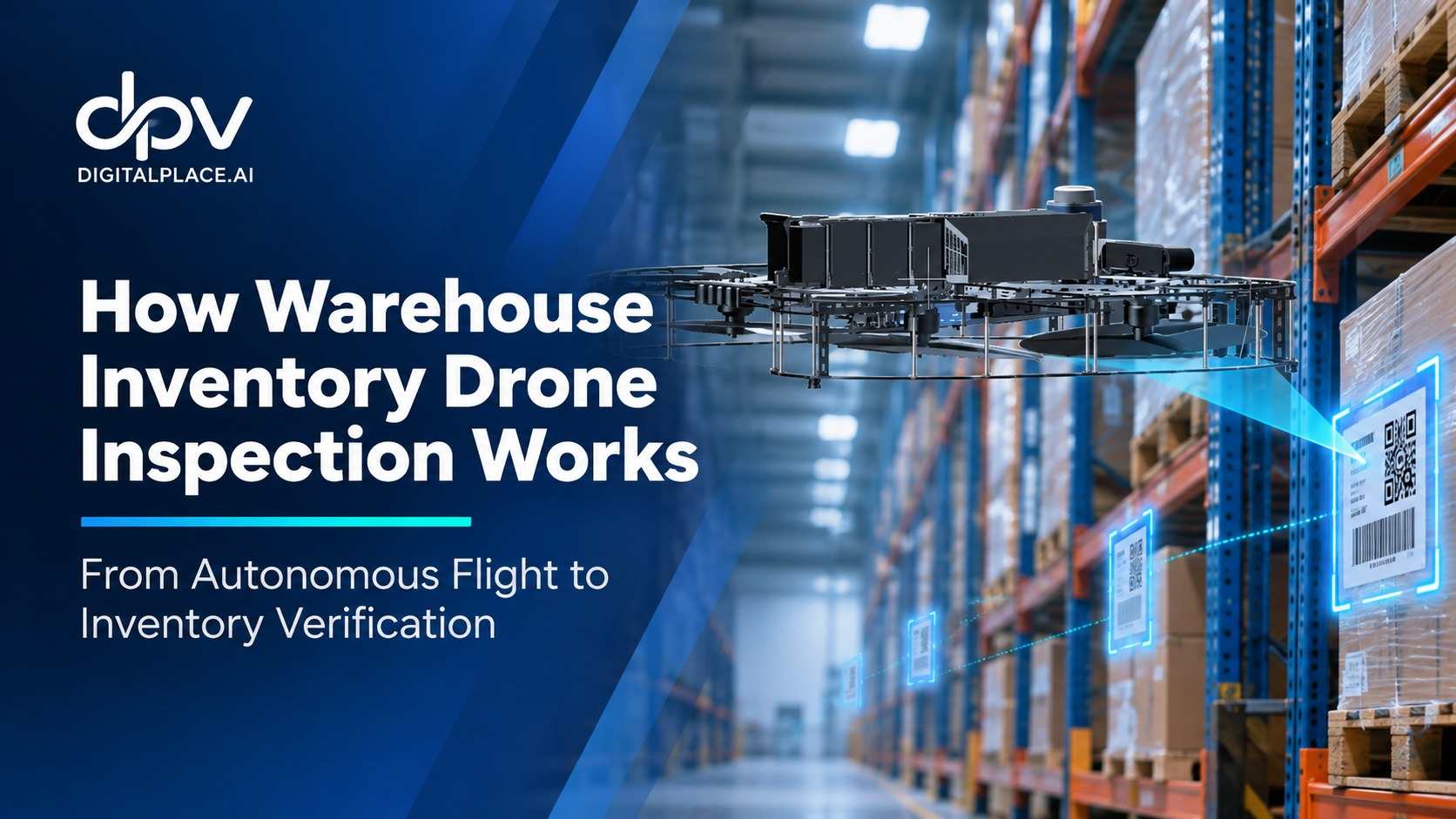
A warehouse inventory drone does not create value simply because it can fly between racks. The real value comes from what happens during and after the flight: identifying storage locations, reading inventory labels, comparing physical observations with expected records, and surfacing discrepancies that warehouse teams can investigate before they become fulfillment problems.
That distinction matters. A drone moving through an aisle is only the visible part of the process. Behind it sits a workflow that connects mission planning, autonomous navigation, rack scanning, QR or barcode capture, location mapping, inventory verification, and eventually warehouse management system (WMS) data.
Digitalplace.ai works with warehouse operators as an AI-powered warehouse inventory drone partner.
Understanding that workflow makes it easier to see where warehouse inventory drone inspection fits alongside cycle counting, physical inventory, and normal warehouse operations.
How Warehouse Drones Prepare for Inventory Inspection
Before a drone can inspect inventory reliably, the warehouse environment has to be understood.
Rack dimensions, aisle widths, storage heights, label locations, flight clearance, and potential obstacles all affect how a mission is configured. In a typical deployment, warehouse teams first define which aisles or rack zones need to be scanned and how the drone should move through those areas.
This is different from outdoor drone operations. A warehouse is a structured but constrained environment. The drone may need to move between tall racks, remain aligned with storage locations, maintain a safe distance from pallets, and avoid sprinklers, pipes, loose wrapping, fans, or other obstacles. The purpose is not simply to fly safely, but to create a repeatable path that allows the same storage positions to be observed consistently over time.
That repeatability is important because warehouse inventory inspection is not a one-off exercise. If a warehouse wants to verify inventory every day, every week, or at another recurring interval, the inspection path has to be predictable enough to support repeated inventory missions.
Drone Automation Starts With Mission Setup
A warehouse inventory drone inspection does not necessarily mean scanning the entire facility every time.
Different missions can be created for different operational purposes:
- full warehouse inventory scans,
- selected aisles or storage zones,
- high-bay rack locations,
- areas with frequent pallet movement,
- locations that often generate discrepancies,
- or targeted cycle-counting areas.
This makes the mission layer a central part of drone automation.
A warehouse may want to inspect fast-moving zones every day while checking slower areas less frequently. Another facility may prioritize high racks because they are expensive, time-consuming, or inconvenient to inspect manually. Instead of treating every storage position the same way, warehouse teams can align inspection frequency with operational risk and inventory movement.
In practical terms, the mission defines where the drone travels, which rack faces it observes, which labels it attempts to capture, and which locations will later be compared with inventory records.
Once these parameters are configured, repeated missions can become significantly easier to operate. Instead of recreating the inspection process from scratch, teams can run predefined missions across selected warehouse areas.
Autonomous Flight Makes Inventory Verification Repeatable
Once a mission has been configured, the drone follows the predefined path through the warehouse.
Indoor warehouse drones cannot generally depend on conventional GPS in the same way outdoor drones can. Warehouse buildings limit satellite visibility, so indoor navigation may rely on onboard sensors, mapped routes, visual positioning, environmental references, or combinations of these technologies.
The objective is not autonomous flight for its own sake.
The objective is repeatable observation.
If the drone is expected to verify the same racks every day, it needs to approach those rack locations consistently enough to capture the required inventory information. That reliability is what turns autonomous flight into part of an inventory-control workflow rather than simply a robotics demonstration.
A repeatable flight path also helps warehouse teams build inspection schedules around normal operations. Selected areas can be scanned without converting each inventory check into a large manual counting project.
How Drone Inventory Counting Works at Rack Level
During the mission, the drone moves along rack faces and captures information from storage locations.
This is where drone inventory counting becomes more than simply reading labels.
A useful inventory observation needs both identification and location. Reading a pallet code tells the system which pallet has been found. But without knowing where that pallet was observed, the information has limited value for inventory accuracy.
The system therefore needs to create an observation that conceptually looks like:
Rack A-03-07 → Pallet 52841 detected
or:
Rack B-05-02 → No pallet detected
These observations create a physical snapshot of selected warehouse locations.
This matters because many warehouse inventory problems are not purely quantity problems. A warehouse may still have the correct total stock while one or more pallets are stored in the wrong position. From an operational perspective, inventory that exists somewhere in the building but cannot be found where the WMS expects it can still create picking delays, unnecessary searches, and fulfillment problems.
QR and Barcode Capture Identify What the Drone Sees
The next layer is inventory identification.
Warehouse inventory drones commonly use onboard cameras or scanning systems to capture QR codes or barcodes attached to pallets, cartons, bins, or rack positions. Those codes create the connection between the physical item and the corresponding inventory record.
But automated scanning depends heavily on label quality.
A code that is too small, damaged, partially covered, positioned inconsistently, or difficult to read from the drone’s operating distance can reduce scan reliability. Lighting conditions, glare, packaging, and label orientation can also affect capture quality.
This means warehouse inventory drone deployment is not only a robotics question. It is also a data-readiness and labeling question.
Warehouses considering automated inspection should therefore review factors such as:
- QR or barcode size,
- label placement consistency,
- rack-level identification,
- visibility from the aisle,
- physical damage to labels,
- and whether one-dimensional or two-dimensional codes are better suited to the environment.
Reliable physical data capture is the foundation of reliable inventory verification.
Turning an Inventory Count Into Location Verification
An inventory count tells the warehouse what was observed.
Location verification tells the warehouse whether what was observed matches what should have been there.
Suppose the WMS says:
Pallet 78431 should be stored at Rack C-05-02.
During an inspection mission, the drone finds the same pallet at:
Rack C-06-02.
The warehouse still has the pallet. From a total inventory perspective, nothing may appear missing.
But from a location-accuracy perspective, there is a discrepancy.
The same logic applies to empty locations. If the system expects inventory at a particular slot but the drone observes an empty position, that location can be flagged for investigation. Conversely, if inventory appears in a location that the system believes should be empty, the stock may have been moved without the corresponding transaction being recorded.
This is one reason warehouse inventory drone inspection should not be viewed only as an automated counting tool.
The more valuable question is often:
Does the physical warehouse match the digital inventory record?
Warehouse Drones Can Surface Inventory Discrepancies Earlier
Once physical observations are compared with expected inventory records, the system can identify exceptions.
Typical discrepancies may include:
- a pallet found in the wrong location,
- an expected pallet not detected,
- unexpected inventory in an empty location,
- an empty position where inventory is expected,
- duplicate or unreadable labels,
- inventory moved without an updated system record.
The drone does not necessarily resolve these problems.
Its role is to make them visible.
Warehouse teams can then investigate the cause. Was a pallet moved without a WMS transaction? Was the location label incorrect? Was the stock picked but not confirmed? Did a receiving or putaway process create the mismatch?
This changes the role of warehouse staff.
Instead of spending a large share of their time checking locations that are already correct, teams can increasingly focus on the locations where the physical warehouse and digital record disagree.
From Drone Inventory Counting to WMS Data
A drone inspection becomes far more useful when its output can be incorporated into the systems warehouse teams already use.
After a mission, inventory observations may be reviewed through a platform, exported into a structured report, uploaded for reconciliation, or integrated with the WMS through an API or other data interface.
The exact model depends on the warehouse.
Some operations may initially use drone results as an additional verification report. Others may move toward deeper integration, where physical observations automatically support exception management or reconciliation workflows.
This is an important distinction because warehouse operators do not need another isolated data source.
They need information that helps improve the quality of the inventory records already used for picking, replenishment, allocation, and fulfillment.
As an AI-powered warehouse inventory drone technology partner, Digitalplace.ai can help connect recurring physical inventory verification with existing warehouse workflows instead of treating the drone as a standalone device.
Drone Automation Changes the Role of the Inventory Count
Traditional inventory counting is largely a data-collection exercise.
People go to locations, identify inventory, count or scan it, record the result, and then reconcile differences.
Drone automation changes the balance.
The collection layer can become more repeatable, allowing warehouse teams to spend more time on the exceptions that require human judgment.
For example:
Expected inventory matches physical inventory?
No investigation may be necessary.
Pallet found at a different rack location?
Investigate the movement.
Expected location appears empty?
Investigate the inventory record.
Unexpected inventory appears in an empty slot?
Investigate the putaway or movement history.
The objective is not to remove inventory control from the warehouse.
It is to make inventory control more exception-driven.
Warehouse Inventory Drone Inspection Is a Verification Layer
Warehouse inventory drones should not be viewed simply as flying barcode scanners.
Their more important role is to create a recurring verification layer between the physical warehouse and the digital inventory record.
The workflow can be summarized as:
Mission setup → autonomous flight → rack scanning → QR/barcode capture → location mapping → discrepancy detection → WMS output
Every stage contributes something different.
Mission setup determines where the inspection takes place. Autonomous navigation creates repeatability. Rack scanning captures physical observations. QR and barcode recognition identify inventory. Location mapping establishes where each item was observed. Discrepancy detection compares physical reality with expected records. WMS integration turns those observations into something warehouse teams can use operationally.
The value grows when this process is repeated frequently.
A misplaced pallet does not need to remain invisible until the next manual cycle count. An unexpected empty slot does not have to become a surprise when a picker reaches the location. Physical inventory conditions can be checked closer to the moment when discrepancies occur.
That changes the key question from:
“When did we last count this location?”
to:
“Does the physical warehouse still match what our inventory system believes?”
That is the real purpose of warehouse inventory drone inspection.




