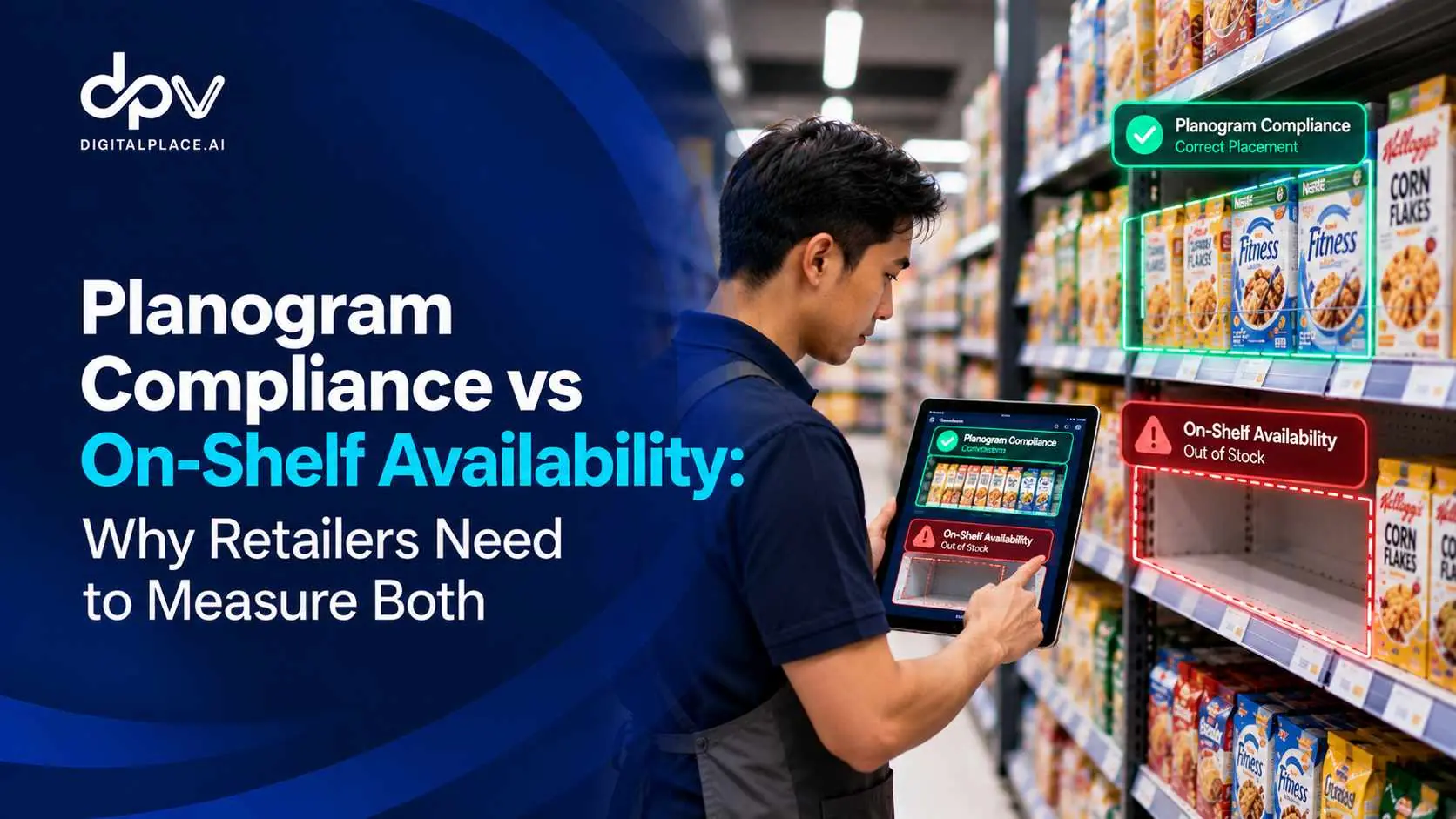
A supermarket in Metro Manila may have shelves filled with products, yet several items are displayed in the wrong positions. In another branch, perhaps in Cebu or Davao, products may be arranged exactly according to the approved merchandising plan, but fast-moving items are missing because the shelves have not been replenished. Both stores face shelf execution problems, although the underlying causes and appropriate corrective actions are different.
For Philippine retailers managing multiple supermarket, grocery, and convenience store locations, these situations highlight the importance of two operational metrics: planogram compliance and on-shelf availability (OSA). Planogram compliance measures whether products are displayed according to the approved merchandising layout, while OSA measures whether expected products are physically available for customers to purchase.
Although closely related, the two metrics should not be treated as interchangeable. A store can maintain an organized display while experiencing frequent shelf gaps, or keep products available while failing to follow merchandising standards. Measuring both helps retailers identify execution problems more accurately, improve replenishment priorities, and maintain a more consistent shopping experience across locations.
Key Takeaways
- Planogram compliance measures whether products are positioned and displayed according to an approved merchandising plan.
- On-shelf availability measures whether customers can find expected products at their designated shelf locations.
- Philippine supermarkets and convenience stores face different shelf execution challenges because of variations in store formats, product assortments, customer demand, and available display space.
- High inventory availability does not necessarily mean high on-shelf availability, particularly when products remain in the stockroom instead of reaching store shelves.
- AI-powered shelf monitoring can help retailers identify missing products, misplaced SKUs, and merchandising deviations through structured shelf inspections.
Why Shelf Execution Matters in the Philippine Retail Market
The Philippines has a diverse grocery retail landscape that includes supermarkets, hypermarkets, convenience stores, warehouse clubs, independent groceries, and traditional sari-sari stores. These formats serve different customer needs, ranging from large household shopping trips to quick purchases of beverages, snacks, personal care products, and everyday essentials.
According to Agriculture and Agri-Food Canada’s report on grocery retail trends in the Philippines, small local grocers accounted for approximately 63.5% of grocery retail value sales in 2024, while supermarkets and hypermarkets together represented approximately 26.5%. Convenience and forecourt retailers accounted for a smaller share, although the format continues to play an important role in urban and residential shopping environments.
These figures illustrate why Philippine retail operations cannot be managed through a single store execution model. Large supermarkets typically carry broader assortments across numerous product categories, while convenience stores operate with fewer SKUs and more limited display space. Traditional neighborhood stores follow different operating practices, making standardized planogram management more directly applicable to modern retail chains than to many independent sari-sari stores.
For modern retailers expanding across Metro Manila, Luzon, Visayas, and Mindanao, maintaining consistent shelf execution becomes increasingly important. A merchandising plan developed at headquarters may be implemented differently across branches because of store layouts, staffing levels, replenishment practices, and local shopping patterns.
The operational challenge is therefore not simply ensuring that products reach stores. Retailers must also make sure that the appropriate products are available, correctly positioned, and accessible when customers want to purchase them.
What Is Planogram Compliance in Retail?
A planogram is a visual merchandising guide that specifies how products should be arranged on retail shelves. It determines the designated location of individual SKUs, the number of product facings, the allocation of display space, and the relative positioning of products within a category.
Planogram compliance measures how closely the actual shelf arrangement follows this approved merchandising plan.
For example, a Philippine supermarket may allocate a specific section to powdered beverages, with designated shelf positions for different brands, package sizes, and product variants. The planogram may require a particular SKU to occupy three facings, while another product receives two facings based on merchandising priorities.
If store employees move products to different positions or allocate additional shelf space to one SKU at the expense of another, the display may no longer comply with the approved planogram. The shelf could still appear fully stocked and visually organized, but the actual arrangement would not reflect the intended merchandising strategy.
Depending on the retailer’s measurement methodology, planogram compliance may evaluate:
- Correct product placement and shelf positioning.
- Required SKU presence within the approved assortment.
- Product facing counts and display quantities.
- Shelf-space allocation across brands and product variants.
- Misplaced products, unauthorized substitutions, and over-displayed SKUs.
For retail chains operating across multiple Philippine cities, consistent planogram execution helps maintain merchandising standards while making store-level deviations easier to identify. However, approved layouts should also account for differences in fixture sizes, store formats, and local assortments rather than assuming every branch has identical physical conditions.
What Is On-Shelf Availability?
On-shelf availability refers to whether an expected product is physically available at its designated shelf location when a customer wants to purchase it. Unlike inventory availability, which generally reflects stock recorded in inventory systems, OSA focuses on the actual availability of products on the sales floor.
Consider a convenience store in Quezon City that has several cases of bottled beverages recorded in its inventory system. The products have already been delivered, but most of them remain in the stockroom because employees have not completed shelf replenishment. During a busy afternoon, customers find an empty space where their preferred beverage should be displayed.
From an inventory management perspective, the store still has stock. However, from the customer’s perspective, the product is unavailable.
This distinction matters because a product recorded as available in inventory does not automatically translate into a product available for purchase on the shelf.
In Philippine supermarkets and convenience stores, several operational conditions can affect OSA:
- Delayed shelf replenishment despite available stockroom inventory.
- Strong demand for beverages, snacks, and everyday essentials during peak shopping periods.
- Insufficient shelf capacity for frequently purchased SKUs.
- Incorrect inventory records or products stored in unexpected locations.
- Products placed in the wrong shelf positions.
- Supply interruptions or delayed deliveries affecting selected locations.
These problems can have different consequences depending on store format. A missing product in a large supermarket may encourage customers to select an alternative brand, while a missing frequently purchased item in a convenience store may affect customers seeking a quick, specific purchase.
In both cases, inventory that is not accessible to shoppers cannot fully serve its intended purpose.
Planogram Compliance vs On-Shelf Availability: Key Differences
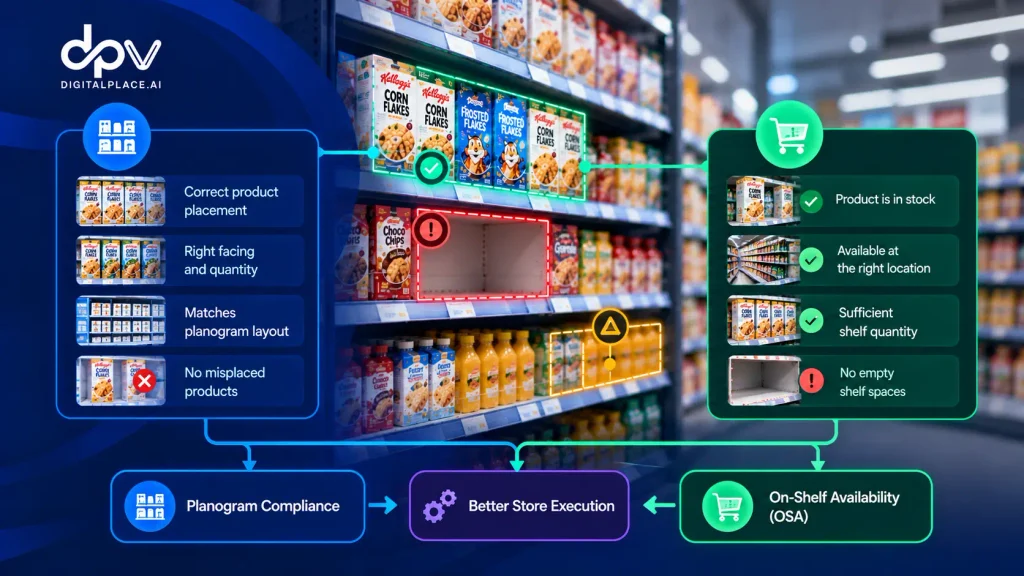
Although the two metrics are connected, they address different aspects of shelf execution. Planogram compliance focuses on the arrangement of products, while on-shelf availability focuses on whether products can be found and purchased.
| Comparison | Planogram Compliance | On-Shelf Availability |
|---|---|---|
| Main question | Are products displayed according to the approved merchandising plan? | Are expected products available for customers to purchase? |
| Primary focus | Product positioning and display execution | Product presence and shelf availability |
| Typical problems | Incorrect placement, wrong facings, misplaced SKUs, unauthorized displays | Empty shelf spaces, missing products, delayed replenishment |
| Related functions | Merchandising, category management, store operations | Store operations, inventory management, replenishment |
| Common corrective action | Rearrange products or correct display quantities | Replenish shelves or investigate missing inventory |
| Business objective | Maintain consistent merchandising execution | Reduce shelf-level out-of-stocks and missed sales opportunities |
Understanding these differences becomes especially useful when retailers evaluate stores with varying physical layouts and customer demand patterns.
Scenario 1: High Planogram Compliance but Low On-Shelf Availability
A supermarket branch in Makati begins the day with products arranged according to the approved planogram. The positions and display allocations are correct, but several fast-moving products sell out during the afternoon.
The remaining products are still correctly positioned, yet customers encounter empty shelf spaces. In this situation, the immediate priority is replenishment rather than rearranging the display. The overall planogram compliance score may also decline if the retailer’s scoring system includes required product presence rather than evaluating placement alone.
Scenario 2: High On-Shelf Availability but Low Planogram Compliance
A grocery branch in Cebu has sufficient products available across its household essentials category. However, employees have allocated more shelf space than planned to several slow-moving products, while popular items occupy fewer facings than specified.
Customers can still find the products, so OSA may remain high. Nevertheless, the shelf arrangement does not follow merchandising guidelines and may create unnecessary replenishment pressure on products with insufficient display capacity.
The appropriate response is to correct the display configuration, not automatically order additional inventory.
Scenario 3: Both Metrics Are Underperforming
A convenience store branch in Davao experiences repeated shelf gaps in its snack and beverage sections. Employees respond by moving nearby products into empty spaces, making the display appear fuller even though several expected SKUs remain unavailable.
This creates problems for both availability and compliance. Corrective action requires verifying which products are missing, checking stock availability, replenishing the appropriate items, and restoring the intended display arrangement.
These examples demonstrate why a single shelf-performance score may not adequately describe store execution. Retailers need to distinguish between product availability problems and merchandising deviations before determining the appropriate operational response.
Why Philippine Retailers Should Measure Both Metrics
Measuring planogram compliance and OSA together provides a more complete understanding of shelf execution, particularly for businesses managing different store formats and operating environments.
1. Managing Limited Shelf Space in Convenience Stores
Convenience stores typically operate with limited floor space and smaller product assortments compared with supermarkets. Every shelf position must accommodate competing merchandising requirements, particularly in categories where customers expect products to be easy to locate and purchase quickly.
An incorrect facing allocation may reduce the available space for popular SKUs, while delayed replenishment can create empty displays even when inventory remains in the stockroom. Monitoring both metrics helps retailers distinguish between insufficient display capacity and replenishment execution problems, allowing managers to make more appropriate adjustments.
2. Maintaining Consistent Execution Across Regional Branches
Retail chains operating across Metro Manila and provincial cities may use standardized merchandising guidelines, but local store conditions can differ considerably. Branches may have different fixture dimensions, customer traffic patterns, delivery schedules, and assortment requirements.
A common measurement framework can help headquarters identify stores with recurring planogram deviations or availability problems. However, the evaluation should reflect each branch’s approved assortment and store configuration so that performance comparisons remain meaningful.
3. Supporting Promotional and Seasonal Execution
Promotions can create additional shelf execution challenges, particularly when product displays change temporarily or demand increases over a short period.
For example, beverage demand may increase during hot weather, while selected food and household categories may experience different purchasing patterns during holiday periods. Back-to-school promotions can also change demand for particular products and require temporary adjustments to merchandise presentation.
When promotional inventory is available but displayed incorrectly, the campaign may not receive the intended shelf visibility. Conversely, a promotional display may follow the approved layout while quickly becoming empty because replenishment has not kept pace with sales.
Measuring both compliance and availability helps retailers evaluate whether promotional products are correctly displayed and accessible to customers throughout the campaign.
4. Improving Coordination Between Merchandising and Store Operations
Merchandising teams determine where products should be placed, while inventory and replenishment teams work to maintain sufficient stock. Store employees are responsible for executing these plans under actual operating conditions.
Problems arise when these responsibilities are evaluated separately. A merchandising team may see incorrect shelf allocation, while store operations focuses on missing products without identifying how the two issues interact.
Using both metrics creates a shared view of shelf conditions, helping teams distinguish merchandising problems from inventory or replenishment issues and coordinate corrective actions more effectively.
How to Measure Planogram Compliance and On-Shelf Availability
Traditional shelf inspections involve employees comparing actual displays against reference plans and checking whether expected products are present. While this process remains common, manually evaluating large assortments across multiple branches can consume considerable staff time.
Retailers can improve consistency by defining clear measurement criteria and using a structured inspection process.
Measuring Planogram Compliance
A simplified position-based calculation is:
Planogram Compliance (%) = (Compliant Planned Positions ÷ Total Evaluated Planned Positions) × 100
Suppose a supermarket evaluates 100 planned shelf positions and finds that 88 meet its defined compliance criteria. Its measured compliance score would be 88%.
However, retailers may use different scoring methods. Some focus on correct SKU positioning, while others also evaluate product presence, facing quantities, or shelf-space allocation. Measurement criteria should therefore be standardized before comparing performance across stores.
Measuring On-Shelf Availability
A simplified SKU-level calculation is:
On-Shelf Availability (%) = (Available Expected SKUs ÷ Total Expected SKUs Checked) × 100
If 94 of 100 expected SKUs are physically available at their designated shelf locations during an inspection, measured OSA is 94%.
This figure reflects availability at the inspection time rather than throughout the entire operating day. A product may be available during the morning check but become unavailable during afternoon shopping hours, making inspection timing an important consideration.
For Philippine retailers with stores experiencing different traffic patterns, scheduled checks should be designed around actual operational conditions rather than relying on a single inspection time for every location.
How AI and Computer Vision Support Retail Shelf Monitoring
AI-powered computer vision provides a more structured approach to evaluating physical shelf conditions. By analyzing images captured inside stores, these systems can identify visible products, examine their positions, and compare actual displays with approved merchandising references.
A typical AI-supported shelf monitoring process includes four stages:
- Shelf image capture: Store employees use mobile devices to capture images during scheduled shelf inspections.
- Product recognition: Computer vision identifies visible products and examines their positions or display characteristics.
- Planogram comparison: Observed arrangements are compared against approved reference layouts.
- Issue identification: The system highlights problems such as missing products, misplaced SKUs, incorrect facings, or unfamiliar packaging.
For retailers managing many locations, structured inspections can help standardize how shelf conditions are evaluated and reduce dependence on subjective visual assessments.
However, AI detection accuracy depends on image quality, product visibility, and reference data. Similar packaging, obstructed labels, poor lighting, and changes in product design may affect recognition results. Retailers should therefore maintain updated product references and establish verification procedures for uncertain detections.
Digitalplace.ai provides an AI-powered On-Shelf Availability and Planogram Compliance solution designed to help retailers identify shelf gaps, misplaced products, and merchandising deviations through scheduled mobile shelf checks. The approach supports more structured shelf inspection workflows without requiring fixed cameras throughout every store aisle.
Turning Shelf Issues Into Corrective Actions
Detecting shelf problems is useful only when retailers can translate the findings into appropriate operational responses. An empty shelf space may require replenishment, while a misplaced product may simply need to be returned to its assigned location.
In Philippine retail operations, where store formats and staffing resources may differ across locations, clearly defined corrective actions can help teams resolve recurring problems more consistently.
| Detected Shelf Issue | Recommended Store Action |
|---|---|
| Empty shelf position | Check stockroom inventory and replenish if available |
| Product in the wrong position | Return the SKU to its designated shelf location |
| Incorrect product facings | Adjust quantities according to the approved planogram |
| Unknown SKU or new packaging | Verify the product and update reference information |
| Repeated shelf gaps | Review replenishment frequency and inventory accuracy |
| Excessive display allocation | Restore the planned shelf-space distribution |
Not every issue requires the same level of urgency. A missing fast-moving beverage SKU during peak shopping hours may deserve immediate attention, while a minor display deviation involving a slower-moving product may be addressed during the next scheduled merchandising check.
By prioritizing corrective actions according to operational impact, retailers can make better use of store employees’ time and focus on problems that are most likely to affect customer experience.
Building a Practical Shelf Monitoring Schedule for Philippine Stores
Shelf conditions change throughout the day as customers purchase products, staff replenish inventory, and promotional activity affects demand. A store that begins the morning with strong availability and compliance may experience different conditions during afternoon or evening shopping periods.
A practical inspection schedule can follow several operational checkpoints:
- Before opening or early morning: Confirm initial shelf readiness and identify unresolved issues from the previous day.
- Midday: Check high-demand categories and products affected by early customer purchases.
- Afternoon or early evening: Inspect selected fast-moving SKUs during busier shopping periods.
- Before closing: Identify outstanding replenishment and display issues that should be addressed before the next operating day.
The appropriate schedule depends on the store’s operating hours, customer traffic, assortment complexity, and replenishment capacity. Convenience stores operating extended hours may require a different inspection rhythm from supermarkets located inside shopping malls.
Scheduled mobile shelf checks provide visibility into conditions at selected points during the day. However, they should not be confused with continuous real-time monitoring, since each inspection represents the condition of the shelves when the scan takes place.
Connecting Shelf Execution With Inventory and Merchandising Decisions
Planogram compliance and OSA should not be viewed as isolated store-level measurements. Both provide information that can influence merchandising plans, inventory allocation, and replenishment decisions.
A practical framework connects these activities through a recurring operational process:
Plan → Stock → Display → Check → Correct → Measure
The approved planogram establishes how products should appear on shelves. Inventory planning and replenishment determine whether sufficient stock reaches each branch, while store operations ensures products are displayed in their designated locations. Scheduled inspections identify deviations, and corrective actions help restore expected shelf conditions.
Repeated issues can also reveal broader operational weaknesses. For example, a popular SKU that frequently runs out of shelf space may require a different display allocation or replenishment schedule. Similarly, recurring placement deviations across several branches may indicate that an existing planogram is difficult to execute under actual store conditions.
For Philippine retail chains operating across different regions, this feedback can be particularly valuable because store demand, assortment, and physical constraints may vary considerably.
Rather than treating each shelf discrepancy as an isolated incident, retailers can use recurring observations to improve the decisions that influence store execution.
Conclusion: Better Shelf Execution for Philippine Retailers
Planogram compliance and on-shelf availability measure different but closely connected aspects of retail operations. Planogram compliance determines whether products follow approved merchandising arrangements, while OSA evaluates whether expected products are physically available when customers want to purchase them.
For supermarkets, grocery chains, and convenience stores in the Philippines, measuring both can provide a more accurate understanding of shelf conditions and help distinguish between merchandising, inventory, and replenishment problems. This is especially important for retailers managing multiple store formats and locations with different customer demand patterns.
AI-powered shelf monitoring can support these efforts by making inspections more structured and helping employees identify problems that require operational attention.
Through its On-Shelf Availability and Planogram Compliance solution, Digitalplace.ai helps retailers conduct scheduled AI-supported shelf checks to identify missing products, misplaced SKUs, and display deviations.
Ultimately, effective shelf execution means more than keeping shelves visually organized. It requires ensuring that products are correctly positioned, consistently available, and accessible when customers are ready to buy.