For years, conversations about technology in retail have mostly revolved around e-commerce. Yet a large share of consumer transactions still happens in physical stores — on minimarket shelves, in supermarket aisles, and inside neighborhood pharmacies.
This is where retail operations are often most complex: inaccurate stock levels, empty shelves when customers arrive, and staff overwhelmed by repetitive questions. Artificial intelligence is now starting to solve these problems directly on the store floor, not only behind an e-commerce website.
This is the space Digitalplace.ai focuses on — building AI solutions designed specifically for retailers, with a clear emphasis on critical pain points: inventory management, customer engagement, and store-level operations. This article explores how AI is transforming offline retail and the practical solutions that retailers can already apply today.
Why Offline Retail Needs AI More Than Ever
Physical stores face limitations that digital channels do not. Inventory cannot be updated with one click. Shelves still need to be replenished manually. Every confused customer who does not get help quickly may leave the store without buying anything.
Some recurring problems appear across many retail businesses:
- Inaccurate demand forecasting — promotions, seasonal patterns, or bulk purchases can be difficult to predict, causing stock levels to become misaligned.
- Stockouts on fast-moving products — leading to lost sales and disappointed customers.
- Overstock on slow-moving products — tying up working capital and increasing storage costs.
- Empty shelves even when products are available in the backroom — an execution issue that directly reduces sales opportunities.
- Staff spending too much time on repetitive tasks — from manual shelf checks to answering the same customer questions repeatedly.
These problems cannot be solved simply by adding more people. More labor means higher fixed costs, while the root issue — limited visibility and slow response time — remains unresolved.
What retailers need is a system that can predict, detect, and respond faster than manual processes, while freeing store teams to focus on activities that truly create value: serving customers and driving sales.
Four AI Solutions for Physical Retail Stores
1. AI-Driven Inventory Optimization
The foundation of healthy retail is having the right product, in the right place, at the right time. Machine learning-based inventory optimization helps predict consumer demand more accurately and automates replenishment quantities across the supply chain — from suppliers, to distribution centers, to store outlets.
What makes this approach powerful is its ability to identify factors that are often missed in manual planning: promotion effects, including halo effect, stockpiling, and product cannibalization, as well as seasonal patterns and the impact of bulk purchases.
As a result, retailers can reduce lost sales caused by stockouts while also lowering excess inventory that ties up working capital.
For the Indonesian retail context, one important advantage is that the system is designed to be compatible with low-spec devices and can operate in offline mode. Store devices do not need to stay connected to the internet all the time, making the solution suitable for retail networks spread across locations where connectivity may not always be stable.
2. Warehouse Inventory Tracking Drone
Behind every store is a backroom, warehouse, or distribution center — and this is where stock accuracy begins. Large-scale manual stock-taking is time-consuming, tiring, and often disrupts daily operations.
An autonomous drone solution addresses this by scanning warehouse areas on a scheduled basis. It can be configured to operate during low-traffic hours or break times so it does not interfere with the team’s activities.
The drone can detect misplaced goods, confirm empty locations, and perform cycle counting in selected zones or across the entire facility. It is available in two levels: semi-automated operation guided by an operator, and fully automated operation where the drone navigates warehouse aisles independently.
For warehouses with high racks and thousands of SKUs, this means more consistent inventory visibility without increasing manual workload. This is where Digitalplace.ai takes a practical approach: each solution is designed to integrate with existing workflows, rather than forcing stores to completely change the way they operate.
3. Interactive AI Avatar Kiosk
On the store floor, staff are not always available to answer routine questions. They may be handling the cashier, replenishing shelves, or assisting other customers. Yet questions about promotions, prices, product availability, or loyalty programs come repeatedly throughout the day.
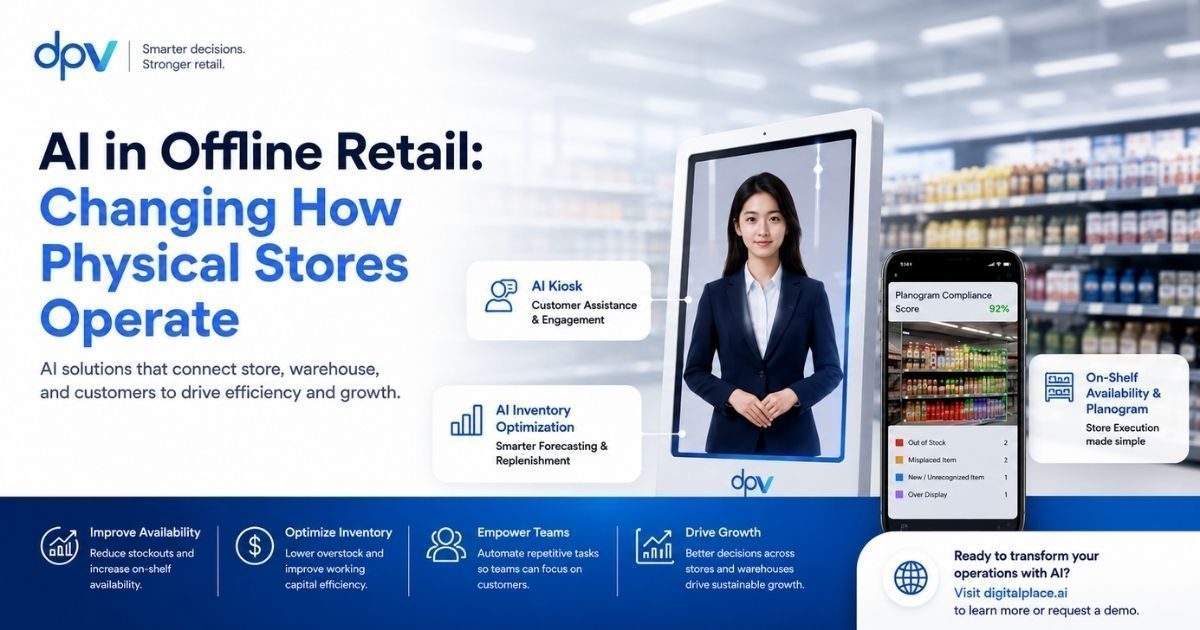
An AI avatar kiosk helps take over these repetitive interactions. The responsive digital avatar can answer customer questions in real time, guide product discovery, share QR links to loyalty programs, and connect with internal systems through API integration.
One realistic avatar can be created from just a single photo and can be deployed both physically and digitally. Its use case is not limited to retail. Shopping malls, clinics, campuses, and public service offices often face the same need for consistent, scalable customer interaction.
4. On-Shelf Availability and Planogram Application
Shelf availability is the moment of truth in retail. A product may exist in the store’s backroom, but if it does not reach the shelf when the customer wants to buy it, the sale is still lost.
This computer vision-based application allows store staff to record a video of designated shelves. AI then analyzes the footage against the approved planogram from head office and generates a compliance score.
The system can detect empty shelf spaces, misplaced items, unregistered new products, and displays that exceed the planogram rules. Checks can be performed regularly and on schedule — in the morning, afternoon, or evening, depending on store policy — so problems are detected earlier before they reduce sales.
Because the process is based on video scanning, stores do not need to install permanent camera infrastructure.
Building a Smarter Retail Ecosystem
The real value emerges when these four solutions work together.
The drone improves stock visibility in the warehouse. The inventory optimization system turns that data into better forecasts and automated replenishment. The planogram application ensures products actually reach the shelf. The AI kiosk helps customers get the answers they need during the shopping journey.
Together, this closes the gaps that often cause sales leakage — from supplier, to warehouse, to store shelf, to customer.
The impact can be measured across three layers:
Operational Impact
Retailers can reduce repetitive manual work, detect problems faster, and improve coordination between store teams, warehouses, and head office.
Customer Experience Impact
Customers are more likely to find the products they need, receive consistent service, and get answers without waiting for available staff.
Financial Impact
Retailers can reduce repetitive manual work, detect problems faster, and improve coordination between store teams, warehouses, and head office.
Because Digitalplace.ai offers modular and customizable solutions, retailers do not need to adopt everything at once. They can begin with the most urgent operational pain point and expand into other areas as their organization becomes more ready.
Key Considerations Before Adopting AI
AI is not a magic button. Successful implementation depends on data readiness, the quality of existing processes, and the involvement of store teams on the ground.
The good news is that retail-focused AI solutions can significantly lower the barrier to adoption when they are designed for real store conditions — compatible with low-spec devices, able to operate offline, and built to fit daily workflows.
Every improvement number will depend on the condition of each business. That is why the best starting point is not always the most advanced technology, but the area where the business impact is clearest and most measurable.
Conclusion
The transformation of offline retail is no longer about whether AI will enter physical stores. It is about how quickly retailers can use AI to close the gaps that have long been accepted as “normal operational costs” — empty shelves, inaccurate stock levels, and customers leaving without being served.
The technology to solve these problems is already available. It is no longer just a future concept.
For retailers that want to take the first step, the key is to start from the most visible business problem, not from the most sophisticated technology. From there, retail-specific solutions like those offered by Digitalplace.ai can grow with the business — transforming physical stores from cost centers filled with uncertainty into predictive, efficient operations that truly support the customer experience.
To see how these solutions could work in your business context, the next step is simple: visit Digitalplace.ai or contact the team for a personalized demo.