“Most store problems do not appear suddenly. They grow quietly between checks.”
A queue starts with one unattended customer.
A stock issue starts with one empty-facing product.
A sales gap starts with one slow hour that no one notices.
A team energy problem starts with one quiet afternoon where everyone begins to lose focus.
This is why strong retail management is not about running everywhere at once. It is about creating a rhythm.
In a large store, that rhythm may involve multiple departments, dozens of staff, fitting rooms, service counters, and high-traffic promotional zones. In a small convenience-format store, the rhythm may be simpler: a few staff members, fast-moving shelves, a cashier area, chiller products, promo displays, and constant replenishment pressure.
The size of the store may be different. But the management principle is the same: the store manager needs a repeatable pattern of checks so that nothing important goes wrong without being noticed early.
That is the real purpose of hourly store control.
Why Hourly Management Matters
Retail performance can change quickly during the day. A store may start strong in the morning, slow down after lunch, recover in the evening, and then miss its target because no one responded fast enough during the weak hours.
Hourly management gives store managers a practical way to stay in control.
It is not a complicated system. It is a short, disciplined routine. Every hour, the manager steps back from daily noise and checks the few things that matter most: performance, display, people, flow, energy, and pricing.
In a larger retail store, this may take around five minutes because there are multiple zones to review. In a smaller convenience-format store, the same idea can be done even faster, often in two or three minutes. The format changes, but the discipline remains.
The goal is not to micromanage the team. The goal is to detect small issues before they become expensive problems.
Two Retail Contexts: Large Stores and Small Convenience-Format Stores
Hourly management is often taught using the example of a large store, such as a 14,000-square-foot retail space with around 40 staff. In that environment, the manager cannot personally be everywhere at once. They need a predictable operating rhythm, clear staff zones, and regular floor checks.
But the same concept also applies to smaller stores, including small convenience-format retailers.
The difference is not whether hourly control is needed. The difference is how it should be applied.
In Large Retail Stores
Large stores usually have more departments, more staff, more customer movement, and more potential failure points.
The manager needs to check whether the right people are in the right zones, whether displays are still presentable, whether high-demand products are still visible, whether fitting rooms or checkout areas are building queues, and whether each team member is actively engaging customers.
In this context, hourly management is about coordination.
A large store manager is not only managing products. They are managing a moving system of people, traffic, merchandising, service, and sales targets. Without a rhythm, the store becomes reactive.
In Small Convenience-Format Stores
Small stores operate differently.
There may not be departments, fitting rooms, or large visual merchandising zones. Staffing may be limited to a small team per shift. The manager or shift leader may also be handling cashier work, stock receiving, shelf replenishment, customer questions, and cleaning.
In this context, hourly management is about focus.
The checklist should be simpler: Are fast-moving items still available? Are promo prices correct? Is the cashier queue under control? Are chiller and key shelves still presentable? Is the store clean? Is the team ready for the next customer wave?
Small stores do not need a complex floor-walk system. But they do need a simple rhythm that prevents out-of-stock items, wrong prices, messy displays, and service delays.
The Six Checks Every Store Manager Should Adapt
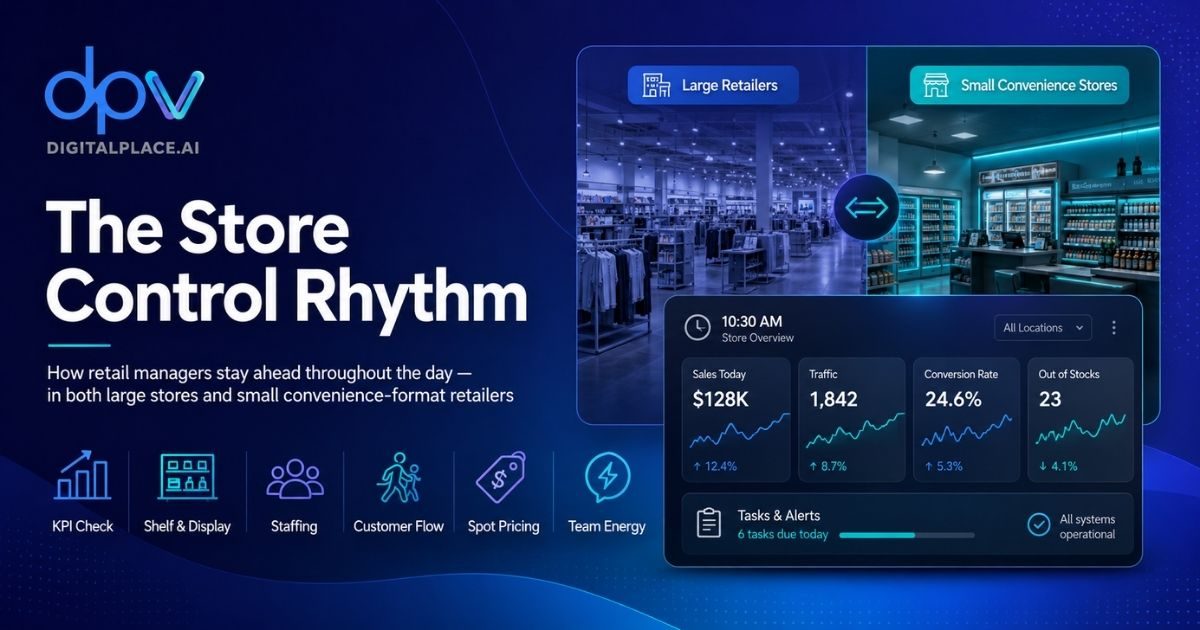
The original hourly management rhythm can be summarized into six checks. These checks are useful for both large and small retailers, but each format should apply them differently.
1. KPI Check: Are We on Track?
The first check is performance.
In a large retail store, this may mean comparing transactions, sales, conversion rate, average basket size, or category performance against the hourly target. If conversion is below expectation, the manager needs to intervene quickly. Waiting until the end of the day is too late.
In a small convenience-format store, the KPI check may be simpler. The shift leader may look at transaction count, sales compared with the same hour yesterday or last week, basket size, or promo-item movement.
The important question is the same: are we where we should be by this hour?
If the answer is no, the manager should not panic. They should act. That may mean moving one staff member closer to the entrance, refilling a key product, checking whether a promo item is visible, or encouraging add-on selling at the cashier.
KPI checks only matter if they lead to action.
2. Display and Planogram Check: Is the Store Still Selling Visually?
The second check is store presentation.
In a large store, this may involve visual merchandising compliance. Has anything fallen, shifted, or become depleted? Are hero products still in the right hotspot? Are promotional displays still attractive?
In a small convenience-format store, this becomes more about planogram discipline, shelf availability, and promo visibility. Are fast-moving products still on the shelf? Are the end-gondola displays still filled? Are chiller products visible? Are promotional shelf talkers still in place?
This matters because retail selling is visual. Customers respond to what they can see, understand, and reach.
A product that is technically available in the backroom but missing from the shelf is still a missed opportunity. A promotion that is active in the system but unclear on the shelf may not drive the expected result.
For retailers using digitalplace as part of their store execution workflow, shelf visibility and daily operational checks can become easier to monitor, especially when teams need to identify issues before they affect sales.
3. Staffing Position: Are the Right People in the Right Places?
The third check is staffing position.
In a large store, this is critical because footfall shifts throughout the day. A team member who was useful near the entrance in the morning may be needed near fitting rooms, checkout, or a high-traffic promotional area later.
The question is not simply, “Do we have enough staff?”
The better question is, “Are our people placed where customer demand is happening now?”
In a small convenience-format store, staffing flexibility is more limited. There may only be two or three people on duty. But the principle still applies.
During quiet periods, one person may handle shelf replenishment while another stays near the cashier. During busy periods, replenishment may need to pause so the team can focus on checkout speed, customer assistance, and queue control.
Small stores cannot always add more people. But they can still reposition attention.
4. Customer Flow: Where Is the Friction?
The fourth check is customer flow.
In a large store, friction may appear in fitting rooms, payment counters, service desks, product trial areas, or crowded promotional zones. A queue in one area can affect the entire customer experience.
In a small convenience-format store, friction usually appears at the cashier, near the entrance, in narrow aisles, around the chiller, or near high-demand promo shelves.
The manager should look for simple signs:
Are customers waiting too long?
Is anyone standing unattended?
Is the cashier queue blocking the aisle?
Are staff too focused on tasks and missing customers?
Are key products hard to reach?
Customer flow problems are often easy to see, but only if someone is looking for them.
A store can lose sales not because customers dislike the product, but because the buying process feels slow, crowded, or unclear.
5. Team Energy: Is the Team Still Engaged?
The fifth check is team energy.
This is one of the most underestimated parts of retail management.
A store can have the right stock, the right displays, and the right pricing, but if the team looks passive, tired, or disconnected, performance will drop.
In a large store, low energy may appear as staff standing in groups, leaning on fixtures, avoiding customer contact, or waiting for instructions. In a small convenience-format store, it may appear as slow cashier response, delayed shelf replenishment, weak greetings, or lack of urgency during busy moments.
The manager’s job is not only to correct poor behavior. It is also to raise energy.
Sometimes this requires a quick reminder. Sometimes it requires rotating responsibilities. Sometimes it requires giving one staff member a short break before their performance drops further.
Retail is physical work. Energy must be managed, not assumed.
6. Spot Pricing: Do Shelf Prices Match the System?
The sixth check is pricing accuracy.
In the original hourly routine, the manager picks three random products and checks whether the shelf label matches the POS price. This is a simple habit with big value.
In large stores, pricing mistakes can happen across categories, promotional displays, and multiple fixtures. In small stores, pricing mistakes are especially risky because customers often make quick buying decisions and expect clarity.
Wrong prices create friction at checkout. They slow down the cashier, frustrate customers, and reduce trust.
For small convenience-format retailers, this check is especially important during promotions, price changes, supplier-funded campaigns, and high-turnover categories.
A two-minute price check can prevent many avoidable service problems.
The Floor Walk Should Recognize Good Work, Not Only Mistakes
Many managers treat floor walks as inspections. They walk the store looking for errors: messy shelves, passive staff, missing products, wrong displays.
Those things matter. But floor walks should not only be about catching people doing something wrong.
The best managers also use floor walks to catch people doing something right.
A strong greeting.
A helpful product suggestion.
A well-recovered display.
A fast queue response.
A clean shelf reset.
A good add-on conversation.
When managers recognize good behavior immediately and clearly, the team understands what excellence looks like. Recognition does not need to be expensive. A few words, said at the right moment, can shape behavior for the rest of the day.
In a large store, public recognition can create momentum across departments. In a small store, it can strengthen ownership within a small shift team.
People repeat behavior that gets noticed.
The Afternoon Dip: A Hidden Risk in Daily Store Performance
Many stores experience a natural energy dip in the afternoon, often after the lunch peak and before the evening traffic builds. In the original material, this window is described around 2:30 PM to 4:00 PM, when footfall may slow and team energy can drop.
This period is dangerous because performance can decline even when nothing obvious changes externally.
Customers may still enter the store, but the team may greet less actively. Shelves may look slightly weaker. Replenishment may slow. Conversion can fall because the store loses energy.
For large retailers, the solution may include staggered breaks, a five-minute stand-up briefing, target reset, and moving strong salespeople into high-footfall zones.
For small convenience-format stores, the response should be simpler but still intentional:
Refill fast-moving shelves.
Check promo displays.
Refresh the cashier area.
Clean visible customer zones.
Confirm chiller availability.
Give the team a short reset before evening traffic.
The afternoon dip should not be treated as dead time. It is a preparation window for the next sales wave.
What Large and Small Retailers Have in Common
Large stores and small stores operate differently, but they share several core realities.
Both need visibility.
Managers need to know what is happening before problems become serious.
Both need rhythm.
Without a routine, managers become reactive and spend the day chasing issues.
Both need clear priorities.
Not every task matters equally every hour. The manager must know what deserves attention now.
Both need team energy.
A tired or passive team can reduce sales even when stock and pricing are correct.
Both need pricing accuracy.
Wrong prices create friction in any format.
Both need customer flow control.
Whether it is a fitting room queue or a cashier queue, waiting affects performance.
Both need fast intervention.
The value of hourly management is not the check itself. The value is the action that follows.
What Should Be Different
The difference is complexity.
Large retailers need broader zone management. They may require department ownership, multiple staff rotations, category-level checks, visual merchandising audits, and more structured KPI reviews.
Small convenience-format retailers need a lighter routine. Their hourly check should not become administrative work. It should be practical, fast, and focused on the few levers that matter most: shelf availability, cashier flow, promo visibility, price accuracy, cleanliness, and team readiness.
A large store may use a six-point checklist every hour.
A small store may use a three-minute version:
Are key shelves full?
Is the cashier area clear?
Are promo prices and displays correct?
Is the team ready for the next customer wave?
That may be enough.
The mistake is not simplifying the system. The mistake is having no system at all.
How Technology Supports the Rhythm
Hourly management depends on discipline, but technology can make the discipline easier to maintain.
Retail teams often struggle because they rely only on manual observation, memory, or end-of-day reports. By the time a problem appears in the daily numbers, the opportunity to fix it may already be gone.
Digital tools can help store teams see issues earlier, prioritize action, and connect store execution with sales performance. For example, digitalplace can support retailers by improving visibility across inventory, shelf execution, and daily operational decisions, allowing managers to act faster during the trading day.
But technology should not replace the manager’s judgment. It should strengthen it.
The best store managers combine data, observation, and team leadership. They know when to look at the dashboard, when to walk the floor, and when to encourage the team.
Conclusion: Control Comes from Rhythm
Retail management is not about being everywhere at once.
It is about having a rhythm that keeps the store visible, responsive, and ready.
For large retailers, hourly management creates structure across people, zones, displays, and customer flow. For small convenience-format retailers, it creates focus across shelves, pricing, cashier flow, promo readiness, and team energy.
The format may change. The principle does not.
Every hour, the manager should know whether the store is on track, whether customers are being served well, whether shelves are ready to sell, whether prices are correct, and whether the team has the energy to keep performing.
That is how managers stay in control.
Not by reacting at the end of the day, but by noticing early, acting quickly, and building a rhythm the whole team can follow.
The Store
Control Rhythm
A practical hourly management framework for keeping stores visible, responsive, and ready — whether the format is a large retail store or a small convenience-format retailer.
Walk the floor, check key shelves, review pricing, observe customer flow, and reset priorities before small issues become bigger problems.
The 6 Checks That Keep a Store Under Control
These checks can be used by both large and small retailers. The difference is not the principle, but the depth and speed of execution.
Compare current performance with the hourly target.
Check availability, promo displays, planogram, and visibility.
Place the right people in the right zones for current footfall.
Watch queues, unattended customers, and crowded areas.
Pick random products and confirm shelf price matches POS price.
Observe fatigue, engagement, and service urgency during the day.
One Rhythm, Two Retail Contexts
Hourly management is not only for large stores. It can also work for small convenience-format stores, as long as the checklist is simplified and focused on the most important daily execution points.
Multiple departments, wider selling areas, more staff, and more customer movement points.
Keeping every zone coordinated without the manager needing to be everywhere at once.
Focus: Coordination Across Zones
In large stores, hourly management helps the manager coordinate departments, displays, staff zones, service areas, checkout flow, and category performance.
- Review KPI performance by hour, category, or department.
- Check visual merchandising, hero products, and promotional hotspots.
- Move team members based on current customer traffic.
- Watch queues in checkout, fitting rooms, or service areas.
- Recognize strong selling behavior publicly and immediately.
Smaller selling area, leaner shift team, faster customer visits, and high dependence on shelf availability.
Keeping the store ready with fast, simple checks while the team also handles cashier, shelves, and customers.
Focus: Fast, Simple, Practical Checks
In small convenience-format stores, the same rhythm should be lighter. The goal is to protect shelf availability, cashier flow, promo clarity, and team readiness without creating extra admin work.
- Check fast-moving shelves and chiller availability.
- Confirm promo displays and price labels are correct.
- Keep the cashier area clear and responsive.
- Use quiet periods to refill, clean, and prepare for the next customer wave.
- Reset team focus before afternoon or evening traffic increases.
What Is the Same, What Should Be Different?
What Both Store Types Share
Both need visibility, rhythm, pricing accuracy, customer flow control, shelf readiness, and team engagement. The manager must know what is happening early enough to act before the issue affects sales.
What Should Be Different
Large retailers need broader zone management and staff coordination. Small stores need a faster, simpler routine focused on key shelves, cashier flow, promo readiness, price accuracy, and basic store execution.
| Control Area | Large Retailers | Small Convenience Stores |
|---|---|---|
| KPI Check | Sales, conversion, category performance, department targets. | Transaction count, sales pace, basket size, promo-item movement. |
| Shelf & Display | Visual merchandising, hero products, promotional zones, category displays. | Fast-moving shelves, chiller, promo shelves, cashier-area displays. |
| Staffing | Move staff across zones based on traffic and service points. | Balance cashier coverage, shelf replenishment, and customer assistance. |
| Customer Flow | Monitor checkout, fitting rooms, service counters, and high-traffic zones. | Monitor cashier queue, narrow aisles, entrance area, and promo shelves. |
| Team Energy | Observe engagement across departments and reset the team before energy dips. | Observe service urgency, cashier responsiveness, and readiness for the next rush. |