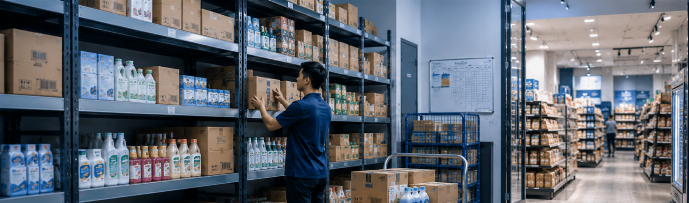
Stockouts and overstock often come from delayed or inaccurate planning. Digitalplace.ai helps retailers identify demand changes earlier and generate smarter stock recommendations across outlets and warehouses.
How AI Improves Inventory Planning
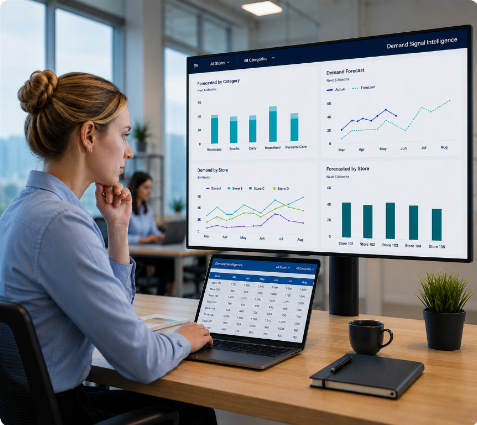
Demand Signal Intelligence
Combines sales history, promotions, seasonality, store-level patterns, and external signals to forecast SKU demand by location.
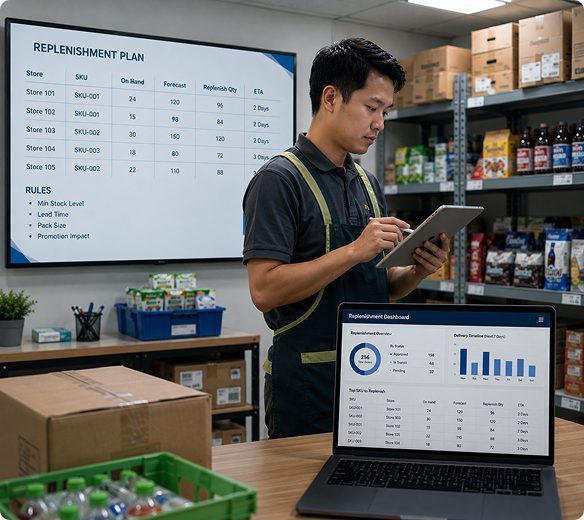
Replenishment Optimization
Calculates replenishment quantities using demand forecasts, stock levels, and operational rules to keep inventory closer to actual needs.
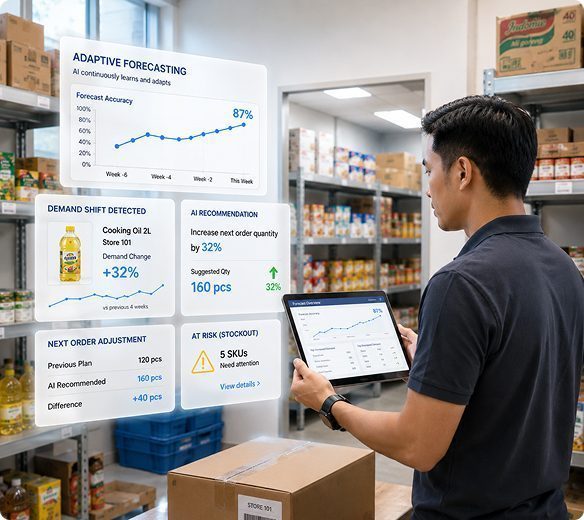
Adaptive Learning
Continuously recalibrates demand forecasts as new sales patterns, promotions, and demand shifts emerge.
AI-Powered Inventory Optimization Retail KPIs
We help retailers improve the key levers behind inventory performance: demand forecasting, stock allocation, replenishment automation, and inventory productivity. The figures below reflect average client results and may vary depending on data quality, SKU complexity, store network, and implementation scope.
>25%
Improve Days Sales Of Inventory
>30%
Improve Out of Stock Perfomance
>10%
Impact to Cost Ratio
100%
Replenishment Automation
Less Day Sales Inventory means you can invest more in other key areas of your business.
Customers get what they want when they want it. No more disappointed customers.
The profit gained from prevented lost sales compared to our subscription cost.
Automate your inventory with us and focus more on other things that matter.
AI INVENTORY OPTIMIZATION
Smarter Demand Forecasting and Replenishment
Turn demand signals into better inventory decisions at SKU and location level. Forecast what is likely to sell, determine how much inventory is needed, and generate replenishment and allocation decisions that keep stock closer to actual demand.
Demand Forecasting
Analyze historical sales, promotions, seasonality, store-level patterns, and other demand signals to predict future demand more accurately by SKU and location.
Automatic Replenishment
Automatically generate and place replenishment orders based on forecast demand, stock levels, and operational rules, reducing manual ordering and keeping stores supplied from distribution centers more consistently.
Balanced Stock Allocation
Determine how available inventory should be distributed across stores and warehouses based on location-level demand, helping avoid situations where one location carries excess stock while another faces shortages
Lower Stockouts & Overstock
Keep inventory levels more closely aligned with demand to improve product availability while reducing excess stock, carrying costs, and unnecessary working capital tied up in inventory.
AI PLANNING ACROSS THE SUPPLY CHAIN
Connect Inventory Decisions Across Network
Extend inventory planning beyond individual SKUs and locations by connecting decisions across suppliers, distribution centers, and retail outlets. Improve visibility across the network, coordinate inventory between locations, and respond more effectively when supply and demand become unbalanced.
End-to-End Inventory Visibility
Create a more connected view of inventory across suppliers, distribution centers, warehouses, and retail outlets so planning teams can understand where stock is available and where additional inventory may be required.
Multi-Location Planning Coordination
Support more consistent inventory planning across multiple stores and distribution centers by applying common forecasting, replenishment, and planning rules across the network
Supplier-to-Store Coordination
Align upstream supply, distribution-center inventory, and downstream store requirements so replenishment decisions across the network are based on a more consistent view of demand and inventory needs.
Scalable Inventory Planning
Apply forecasting, replenishment, and inventory planning rules across large SKU and store networks, reducing repetitive manual work as operations grow.
FAQ
Frequently Asked Questions
What is AI-powered inventory optimization?
AI-powered inventory optimization uses sales patterns, promotions, seasonality, inventory levels, and other demand signals to improve forecasting and stock-planning decisions. It enables retailers to determine what inventory is needed, where it should be positioned, and when replenishment should occur across stores and distribution centers.
How is AI-powered inventory optimization different from traditional inventory planning?
Traditional planning often relies on historical averages, fixed rules, spreadsheets, and manual adjustments. AI-powered inventory optimization continuously evaluates changing demand patterns at SKU and location level, allowing forecasts, replenishment quantities, and stock allocation decisions to respond more effectively to actual market conditions.
How does the system determine the right replenishment quantity for each SKU and location?
Replenishment recommendations are calculated by combining demand forecasts with current stock levels and relevant operational rules. Rather than applying the same replenishment logic across every location, the system can account for differences in demand patterns between stores and warehouses, helping inventory move closer to where it is actually needed.
This is particularly important for retail networks where the same SKU may sell very differently across locations.
How does inventory optimization respond when demand patterns change unexpectedly?
Forecasting models can be recalibrated as new sales patterns, promotional effects, seasonality, or other demand shifts emerge. As more recent information becomes available, the system can adjust its view of expected demand instead of continuing to rely heavily on older patterns.
This allows planning teams to identify meaningful changes earlier and adjust replenishment or allocation decisions before the gap between planned inventory and actual demand becomes too large.
How can inventory optimization reduce both stockouts and excess inventory at the same time?
Stockouts and overstock are often two outcomes of the same underlying problem: inventory is not sufficiently aligned with demand by SKU and location.
More accurate forecasting identifies where demand is likely to occur, while replenishment and allocation logic determines how much inventory should be positioned at each location. This allows retailers to increase stock where demand requires it while reducing unnecessary inventory in slower-moving locations.
The objective is therefore not simply to hold more or less inventory, but to place the appropriate amount of stock in the appropriate location.
How does the system support inventory planning across multiple stores and distribution centers?
Multi-location planning considers inventory requirements across the wider retail network rather than treating each location as an isolated operation. Demand requirements at individual outlets can be evaluated alongside inventory available within warehouses or distribution centers.
This creates a more connected planning process across the network and supports more consistent decisions when retailers manage large SKU portfolios, multiple warehouses, and many store locations.
How can inventory optimization improve working-capital efficiency?
Inventory represents capital that remains tied up until products are sold. When forecasts or replenishment decisions consistently result in excess stock, more working capital remains locked in inventory than necessary.
By aligning stock levels more closely with expected demand, retailers can reduce unnecessary inventory exposure while maintaining product availability. This can improve inventory productivity, lower carrying costs, and make capital available for other operational or growth priorities.
What factors influence the results of an AI-powered inventory optimization implementation?
Performance depends heavily on the quality and structure of the underlying planning environment. Important factors can include the quality of historical sales and inventory data, SKU complexity, promotional activity, demand volatility, the number of stores and warehouses involved, and the operational rules used for replenishment.
For this reason, inventory optimization should not be viewed simply as a forecasting model. Effective implementation requires the forecasting, replenishment, allocation, and network-planning processes to work together so that improved demand intelligence can translate into better inventory decisions.